

Macro focus – Diverging fortunes in the euro area core: Germany's economy continues to outperform France, with Q2 GDP revised up to 0.3% Q/Q and recent survey data pointing to further near-term momentum. The combination of improving export performance, stronger business sentiment and some optimism surrounding the government's fiscal and reform agenda has improved the outlook. However, we remain cautious about declaring a decisive turning point. Structural challenges facing German industry persist, while rising political uncertainty and near-term headwinds such as low Rhine water levels and rising gas pressures could yet weigh on activity in the near-term. In France, the picture remains much weaker. Growth has stalled, business surveys remain firmly subdued and there are still few obvious growth drivers. Political uncertainty continues to hang over the economy ahead of what is likely to be another difficult budget process before the presidential election next year. While Germany faces its own risks, our base case is that the recent divergence between German and French growth trajectories will persist over the coming year.
What we’re watching next week: The ECB is set to raise the deposit rate by 25bp at next week's meeting, taking rates to 2.50% and the upper end of the estimated neutral range. The updated ECB projections should show modestly stronger growth and little change to the broader inflation outlook, although the underlying assumptions may already look somewhat dated given recent market moves. While President Lagarde is likely to maintain a vigilant tone against a backdrop of higher energy prices and elevated headline inflation, we see a higher bar for additional tightening beyond September given the absence of any broadening in inflationary pressures. Our call remains that the ECB will be able to remain on hold after this meeting. Elsewhere, the data calendar is relatively light, with German industrial production and UK GDP figures for July the highlights.
Euro area growth – divergence in the core
Germany’s cyclical recovery is gaining traction while the outlook for France remains mired in political uncertainty
Looking across what has been a relatively quiet data flow over recent summer weeks, one theme which stands out to us is the divergence in activity between the euro area’s largest members, Germany and France.
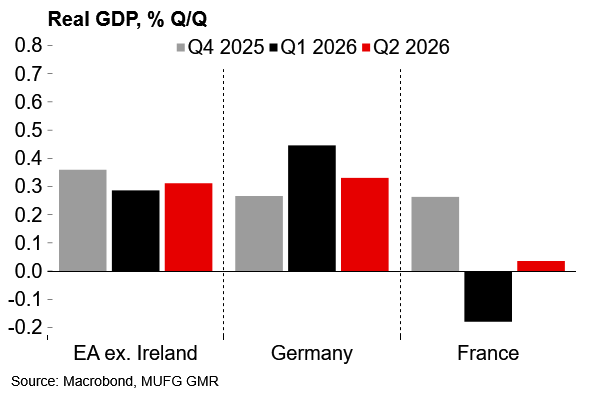
Last week saw the German Q2 GDP estimate upwardly revised to a respectable 0.3% Q/Q. The French number, by contrast, was revised down from an initial estimate of 0.2% to 0.0% Q/Q, and that comes after a contraction in the first quarter.
Survey indicators suggest the trend will continue. The reliable German ifo survey jumped in August with the business climate index reaching its highest mark in a year. The final composite PMI also came in above the flash estimate this week, reaching a five-month high. The French PMI, meanwhile, slipped back in August and continues to languish below the breakeven mark.
The French economy has lagged the euro area in H1
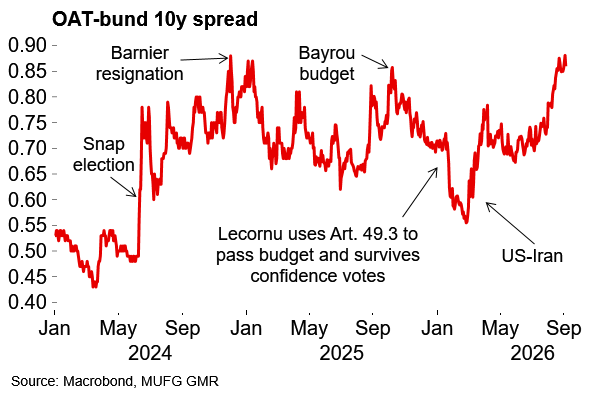
OAT-Bund spreads have widened over the summer
Focusing on Germany, the news flow has certainly been encouraging. The economy has weathered the US-Iran shock in much better shape than initially expected. Annual GDP growth of ~1% in 2026 suddenly looks plausible – not exactly a lofty figure but promising in the context of recent outcomes (0.0% in 2024 and 0.2% in 2025).
But after that extended period of stagnation our core message remains that it is too early to definitively say that Germany has turned a corner. The story is mostly one of better cyclical export performance and the confidence boost from the government’s fiscal shift and subsequent structural reform efforts. Government spending on infrastructure and defence will increasingly show up in the GDP figures, but a sustained, broad-based uptick in growth is certainly not guaranteed. This morning’s factory orders release sums it up well: new orders are up a healthy 2.9% on a 3m/3m basis – but down 2.2% once large-scale orders (e.g. ships and aircraft) are excluded.
We’ve written a lot about the structural headwinds facing German industry (most recently here) which will not go away. There are also near-term headwinds – the low levels of the river Rhine, one of Europe’s key industrial arteries, will likely weigh on manufacturing output and overall GDP in Q3.
Rising political uncertainty poses an additional risk. This Sunday will see the first of a trio of state elections in a fortnight (Saxony-Anhalt, before Mecklenburg-Vorpommern and Berlin on 20 September). The direct impact of these will likely be limited, but consequences for federal politics could be meaningful. Chancellor Merz has historically weak approval ratings and his CDU party continues to lose ground in national polling. The hard-right AfD party looks well set to win the most seats in the Saxony-Anhalt contest, and could even secure an outright parliamentary majority if some parties fail to clear the 5% threshold. This would pile more pressure on the Chancellor. From a macro perspective, we worry that tensions in the governing coalition might rise, hindering the reform agenda. Uncertainty about the viability of the coalition, or Merz’s leadership of CDU, could also start to weigh on business confidence and investment.
This links us back to the outlook for France where political uncertainty has been a headwind since Macron’s ill-fated decision to call a snap parliamentary election in June 2024. Of course, the fiscal backdrop is very different with French consolidation efforts contrasting with the blockbuster shift in Germany. But persistent political uncertainty has undoubtedly weighed on household spending and business capex.
Last summer we wrote that there were no obvious growth drivers for France (see here) and that view essentially still holds today. Net exports did provide support in H2 2025 but that was largely on the back of big-ticket deliveries (i.e. aerospace) and some front-loading of pharmaceutical exports amid US tariff threats – so neither a structural nor durable trend. Rising demand for defence equipment could offer a more enduring boost, as is the case with Germany, but it feels like a narrow base.
And France is now moving into a critical period: 2027 budget talks, presidential elections, then likely parliamentary elections. The draft budget bill is set to be presented at the end of the month. It’s likely to be a difficult process once again. Parliamentary arithmetic has not changed and parties’ appetite for endorsing spending cuts or tax rises with the election looming is likely to be small. It seems fairly likely that a special law will be required once more to roll forward the current budget at the start of 2027.
We have written our initial views on next year’s presidential election here: France’s 2027 presidential race starts to take shape. Polling suggests that Le Pen is clearly on course to reach the second round and ultimately has a plausible path to the Élysée. While arguably less troubling for investors than would have been the case in years gone by, there is much uncertainty around RN’s policy platform.
The parliamentary election, which a new president would likely call immediately, is arguably as important as the presidential one given the legislative logjam since 2024. Polling is limited but it’s far from clear that any group will be able to secure a workable majority at the next election. That would mean a lack of meaningful reform, fiscal or otherwise, and frozen agendas more broadly. The OAT-Bund 10Y spread has widened to the levels seen when Barnier resigned as PM in 2024.
All told, we see material downside risks to French growth at a time when the economy is scarcely avoiding recession. It’s possible that Germany will face an increase in domestic political uncertainty, and the country’s industrial base would be relatively more exposed to persistently elevated gas pricing. But our base case is that the recent trend of divergence in Germany and French growth profiles will continue over the coming year.
What we’re watching next week
The ECB is set to raise rates to the upper end of the neutral range
The ECB is set to raise the deposit rate by 25bp at next week’s meeting in Berlin with several Governing Council members having endorsed a hike. A September move has long felt likely to us (see our take on the last meeting here). If there was any doubt, it was extinguished by data showing headline euro area inflation reached 3.3% in August, the highest in almost three years, with the release also coming against a backdrop of rising energy prices.
We do not expect major changes to the updated projections relative to the June edition. There will probably be better 2026 and 2027 GDP growth numbers after recent data has shown clear resilience in Q2 and little sign of fading activity in forward-looking survey indicators. Headline inflation could be revised down after lower-than-expected Q2 numbers. The cut-off date for the technical projections is likely to have preceded the recent uptick in natural gas prices, however, as well as the global bond sell-off, which means that these numbers will feel a bit stale. We assume that the ECB will again publish alternative scenarios with different energy assumptions.
In terms of the core guidance, it’s likely to remain unchanged (‘meeting-by-meeting’ and data dependent) and we do not anticipate any major additions to the statement. The message from Lagarde will undoubtedly be one of vigilance given the energy market backdrop – the ECB is set to leave the door open to further tightening if required. But a hike next week would take the deposit rate to 2.50%, which is the ECB’s estimate of the upper end of neutral, and would complete the repositioning phase. We see a higher bar for further policy action thereafter. So far there has been scant evidence of any broadening of inflation pressures with core inflation edging lower this week and wage indicators remaining broadly target-consistent. Accordingly, our base case remains that this will be the last hike in the cycle, but we acknowledge risks are tilted towards another move before year-end.
In terms of data releases, it will be a quiet week. German industrial production and UK GDP for July will be the highlights.
Key data releases and events (week commencing 7 September)
Day | Time | Region | Event | Period | Consensus | MUFG | Previous |
Mon 7 Sep | 07:00 | GE | Industrial Production SA MoM | Jul | 0.4 | 0.1 | 0.2 |
Mon 7 Sep | 09:30 | EC | Sentix Investor Confidence | Sep | 1.6 | 1.4 | 0.9 |
Thu 10 Sep | 09:00 | EC | ECB Deposit Facility Rate | 10-Sep | 2.50 | 2.50 | 2.25 |
Fri 11 Sep | 13:15 | UK | Monthly GDP (MoM) | Jul | 0.0 | 0.1 | 0.3 |
Note: All times are GMT+1 (London). Source: Bloomberg, MUFG GMR