

ECB Review: Holding course in choppy waters
Macro view: The ECB left the deposit rate unchanged at 2.25%, as expected, and retained its standard flexible guidance. Policymakers acknowledged that recent re-escalation in the Middle East has effectively returned the outlook to the June baseline, while stressing that the full inflationary impact of higher energy prices has yet to be felt. Although Lagarde remained broadly non-committal and flagged the lack of second-round effects so far, she noted that some governors had considered whether a rate hike was warranted and stated that inflation risks remain tilted to the upside. Recent developments in oil and gas markets have certainly reinforced our expectations for a rate hike at the next meeting. Our base case remains for one additional 25bp hike in September, taking the deposit rate to 2.50%, although risks to that call are skewed towards a more hawkish outcome.
Markets view: Market expectations for three ECB hikes this year set a high hurdle for hawkish policy surprise today. Upside risks to inflation from the Middle East conflict would have to intensify to push euro-zone yields much higher in the near-term. The lack of a deal to end the conflict and reopen the Strait alongside the recent hawkish repricing of Fed rate hike expectations leaves risks titled to the downside for EUR/USD. The pair is currently drifting back towards the bottom of the 1.1400-1.1800 trading range that has been in place since the onset of the Middle East conflict.
Macro view: Back to square one
The door is open for another hike in September as energy pricing returns to the June baseline
The ECB maintained the deposit rate at 2.25%, as expected. The core guidance was also left unchanged (“a data-dependent and meeting-by-meeting approach”, without pre-commitment) in what was a relatively short statement (see here).
Policymakers acknowledged that Middle East re-escalation has essentially rewound the tape back to June with the statement noting that currently energy pricing is back around the baseline assumption and Lagarde stating that the ‘Mild’ scenario currently looks “quite unlikely”. It was also noted that the full inflationary impact of the US-Iran conflict is “yet to play out”.
While Lagarde said that the decision was ultimately unanimous, she acknowledged that some governors “asked themselves if a hike was needed”. The ECB president also noted that risks to inflation remain “to the upside”.
Those are hawkish signals. But given the geopolitical backdrop, we thought there was scope for Lagarde to give slightly more explicit signals in the Q&A (see our preview here). Instead she played it with a straight bat, remaining as non-committal as the statement. She stressed that the central bank is not giving forward guidance and emphasised that there has been scant evidence of any second-round effects in the data.
If not quite 100% nailed on, we still see a September hike as extremely likely. We doubt it would take much in the upcoming data to justify another hike from a central bank which we see as inclined to tighten further in order to lean against inflation risks. Lagarde also said that the ECB’s reaction function is “well understood” by market participants, which also seems to be something of an endorsement of current pricing.
A September hike was our base case even before Middle East re-escalation. Brent has since pushed above 100 USD/bbl with the Houthis opening the Red Sea as an additional front. Oil markets were quick to sell on ceasefire news earlier in the conflict, but it’s not clear to our minds that this dynamic will be repeated. There are concerns that the market enters this period of re-escalation with much less of a buffer in terms of inventories and so prices may prove to be stickier on the upside from here. The added complication is the increase in European natural gas prices to YTD highs amid concerns around storage buffers, which was acknowledged by Lagarde.
Against this background, our call remains that the ECB will deliver one further 25bp hike in September, taking the deposit rate to 2.50%, which would be the upper end of the ECB’s own estimate of neutral rate (see here). Risks to our call are clearly tilted to the upside given the energy price backdrop discussed above. The initial hike in June was framed as a “good monetary policy decision” rather than an insurance move. But another sustained energy price rise would raise fears that inflation expectations could become unanchored and strengthen the argument for pro-active policy tightening.
Lastly, Lagarde was also asked about her professional future amid speculation that she might leave early to participate in French politics. We wrote on the topic of succession back in February (see here). Today Lagarde said “you are not going to see the back of me before 2027”, adding that “when there are clouds on the horizon, the captain stays on the ship”. The waters certainly look choppy against the current geopolitical backdrop.
Markets view: Worsening energy shock encouraging weaker EUR
Higher yields not sufficient to prevent a weaker EUR
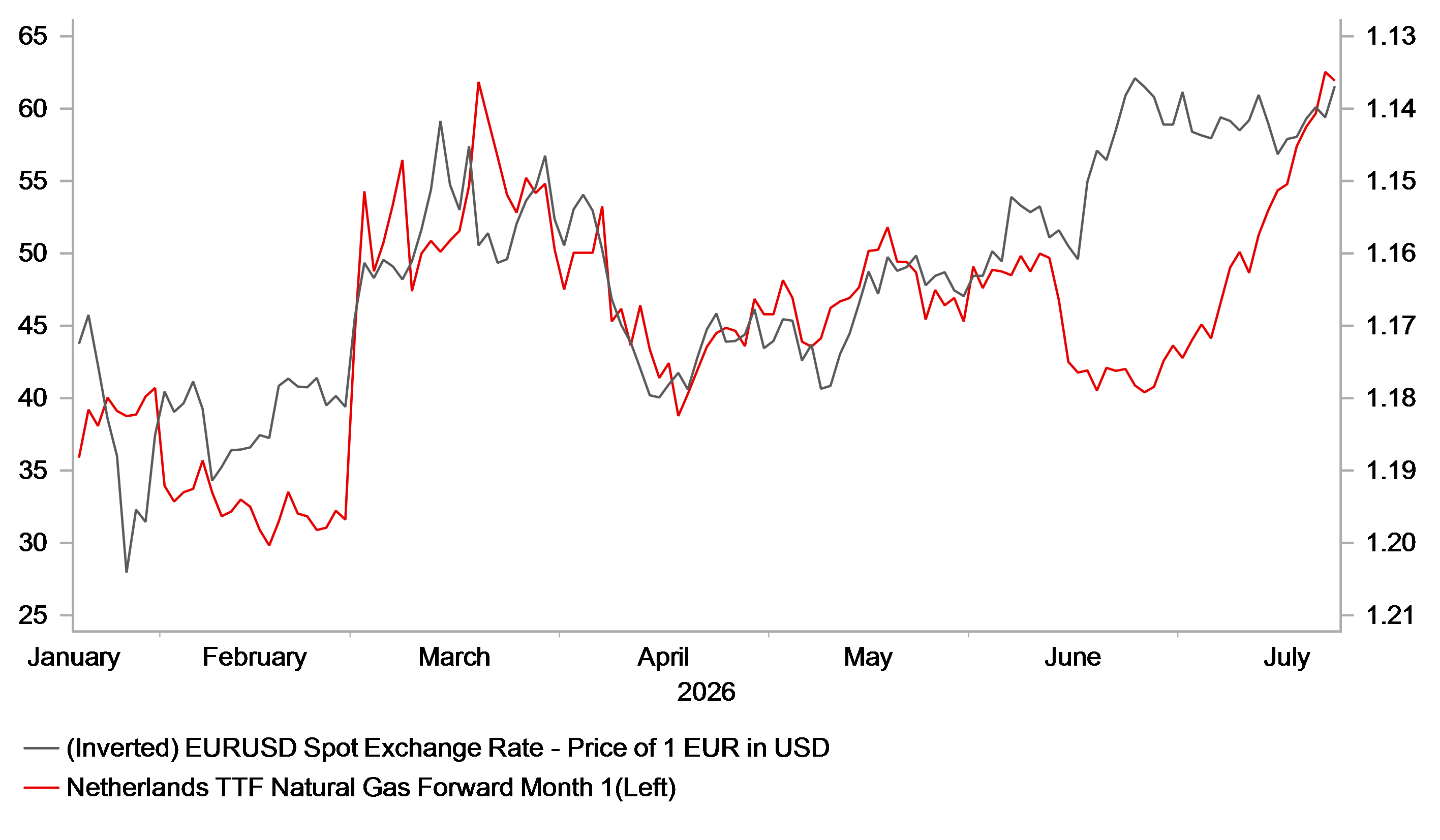
EUR/USD is once again attempting to break below the lower end of the 1.1400 to 1.1800 trading range that has been in place for more than a year. The latest catalyst has been the sharp rebound in energy prices, with Brent crude rising back above USD 100 per barrel. At the same time, European natural gas prices have climbed to fresh year-to-date highs, reinforcing stagflation risks in the region. The euro area economy has proven more resilient than expected during the first half of this year, but the renewed threat of a more persistent energy price shock could present a more significant challenge. There is currently no clear indication of when the tit-for-tat strikes between the US and Iran will end, while the Houthis are increasingly disrupting Saudi Arabia's efforts to reroute energy supplies through the Red Sea.
These unfavourable developments for the euro area economy have contributed to a divergence between EUR/USD and yield spreads. Euro area yields have risen by more than their US counterparts this month as market participants have priced back in the prospect of multiple ECB hikes. There are currently almost two additional hikes price in by year-end, with the next increase expected in September. Comments from President Lagarde after today's policy meeting did little to push back against this hawkish repricing. She indicated that the euro area economy is evolving broadly in line with the ECB's baseline scenario, which assumes oil prices averaging around USD 97 per barrel in 2026. The ECB has previously stated that the baseline scenario would likely require "measured policy tightening", which we interpret as leaving the door open to one or two additional hikes this year.
We continue to forecast a final rate hike in September but acknowledge the risk of an additional move later this year if the ECB becomes more concerned about second-round inflation effects. President Lagarde noted today that the ECB is not yet observing clear evidence of such effects, although the Governing Council is increasingly concerned by recent developments in the Middle East. While this leaves room for euro area yields to continue moving higher in the near term, higher rates alone are unlikely to prevent further EUR weakness if the energy price shock intensifies.
NEGATIVE ENERGY PRICE SHOCK WEIGHING ON EUR
Source: Bloomberg, Macrobond & MUFG GMR