

Macro focus – Still looking for a recovery in German industry: Recent German industrial data continue to paint a picture of a fragile stabilisation rather than a meaningful rebound. Manufacturing surveys have improved, with both the PMI and Ifo indicators signalling firmer activity ahead, while fiscal support should start to provide more of a tailwind over coming quarters. But a range of risks continue to weigh on sentiment and activity. Low EU gas inventories are increasingly a concern with a durable US-Iran deal still proving elusive. Meanwhile, record-low Rhine water levels are disrupting industrial operations domestically. Disruption to inland waterway freight alone could shave around 0.2pp off Q3 GDP growth. Looking further ahead, Germany's fiscal shift and structural reform efforts will be supportive, but the loss of cheap energy, weaker external demand dynamics and persistent supply-side constraints mean that any recovery is likely to be steady rather than spectacular. We see overall GDP growth at 0.8% this year.
What we’re watching next week: It is another light week of European data releases with UK Q2 GDP being the highlight. We have pencilled in a slightly above-consensus figure of 0.5% Q/Q. This would certainly be a good outcome in the context of the US-Iran shock and domestic political uncertainty, but we expect a familiar story of UK growth momentum tailing off in H2 amid fiscal uncertainty and rising inflation.
Macro Focus: Still looking for a recovery in German industry
Another weak IP number amid US-Iran uncertainty, low gas storage and impediments for inland waterway freight
In a quiet week of data releases our focus has been on the German industrial sector. There wasn’t much to get excited about in the June IP release today – headline industrial production came in at 0.2% M/M (-0.1% Y/Y). The narrower manufacturing index was flat on the month and down 0.3% Y/Y. There were some bright spots with automotive production expanding by 3.6% M/M and other transport equipment (aircraft, ships, trains & military vehicles) by 8.4%, however output in these sectors is often volatile.
Earlier in the week, data showed factory orders increased by 3.1% M/M in June. That looked encouraging at first glance, but these numbers are volatile, prone to distortion and often revised the following month. On a smoothed basis (% 3M/3M) and with large-scale orders excluded, new orders were unchanged. Combined with the IP numbers this fits with our broader view that the industrial sector is undergoing fragile stabilisation.
More encouragingly, forward-looking sentiment indicators have strengthened. The headline manufacturing PMI in July rose to 52.2, matching its highest level since May 2022. The Ifo manufacturing business climate gauge, meanwhile, is at the highest level since May 2024 and the expectations component rose sharply in July.
But both surveys were largely collected prior to the US-Iran re-escalation later in July. It’s clear that the energy backdrop will remain key to the German industrial sector’s near-term outlook with a US-Iran deal remaining elusive. A credibly durable settlement would obviously provide a significant lift to sentiment and activity, not least with tight gas markets emerging as a new concern. TTF front-month gas is trading around 55 EUR/MWh, up ~15% on the month and 70% on the year. EU gas storage stands at just 58% of capacity at the start of August, well below the seasonal average of 73% recorded since 2011 after the Iran conflict affected summer stockpiling. This increases vulnerability to both a cold winter and further disruption in the Strait of Hormuz.
For now, we see the industrial data as fitting into a broader narrative of resilience, both in German manufacturing and across the wider euro area economy (see here). This is certainly helpful in what seems to be a world of more frequent geopolitical shocks.
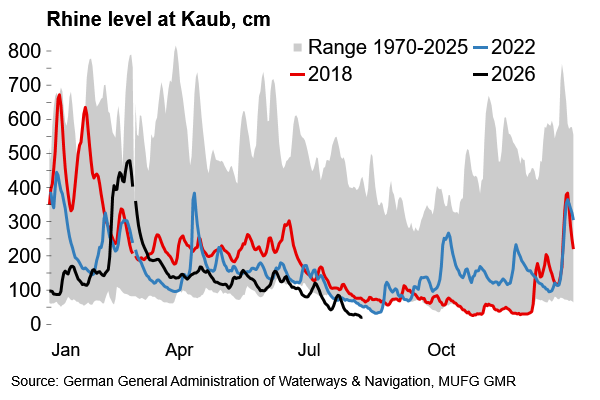
However, the challenges are not solely external. The industrial sector is also being tested by physical climate risks. In a significant development, water levels on the Rhine have fallen to record lows (see chart below). This severely restricts freight capacity on one of Europe’s key industrial arteries for the transport of chemicals, coal, fuel and metals. The use of river water for industrial cooling purposes is also constrained (this issue has also limited nuclear power generation elsewhere in Europe). Since the low-water episode in 2018, firms have invested in shallower-draft barge fleets and other supply-chain contingency measures, but we still estimate that low water levels alone could shave around 0.2pp off German Q3 GDP growth, with downside risks if navigation remains difficult in September.
Any recovery is likely to be moderate amid a structurally weaken environment
Looking ahead, our broad view is that German industry is on the cusp of a moderate cyclical improvement but this comes within a structurally weaker environment. It has long been clear that the conditions that supported output during the previous decade, such as reliable access to global markets, relatively cheap energy, and strong Chinese demand, no longer exist. Those challenges are compounded by a shrinking working-age population, skilled labour shortages, infrastructure issues and regulatory burdens.
The government has worked to address the latter two issues. Germany’s blockbuster fiscal shift remains a significant macroeconomic development and has supported the economy’s return to growth on the consumption side. But the impact of infrastructure investment is proving slow to pass through to the real economy due to planning and capacity constraints. Defence spending is likely to feed through more quickly but is less likely to generate a broad-based industrial upswing.
Fiscal policy is now being accompanied by meaningful structural reform efforts with the government recently announcing 34 measures to support growth and streamline regulation. The benefits will take time to appear (it took years for the famous Hartz labour market reforms to show up in the data), but efforts to add flexibility to labour markets and reduce red tape are positive and demonstrate recognition that a fiscal demand boost alone is not sufficient for sustainable growth.
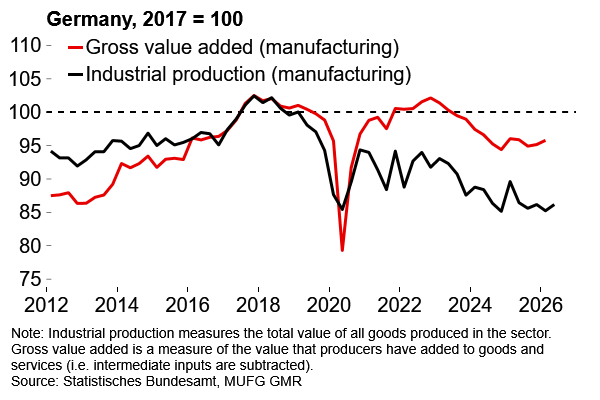
For German industry, even getting back to the 2017-18 levels of output still looks like quite the challenge. The export-driven model has broken down and finding sources of growth is going to be difficult. Yes, manufacturing surveys have generally looked firmer in recent months, and fiscal policy has turned supportive. But to claim German industry is on the cusp of a revival after years of stagnation remains a tough sell with a range of near-term headwinds and adverse structural shifts. Our base case is that the current period of stabilisation will be followed by a steady but ultimately relatively modest expansion. We see overall annual average German GDP growth at 0.8% this year, rising modestly in 2027.
Industrial activity remains well short of its peak
Low river levels now pose another threat to supply chains
What we’re watching next week
Another good UK GDP print – but momentum is likely to fade
It is set to be another light week for European data releases. The highlight will be the first estimate of UK Q2 GDP growth. We have pencilled in a slightly above-consensus figure of 0.5% Q/Q, with activity likely to have been supported by sunny weather and England’s run to the World Cup semi-finals. This would certainly be a good outcome in the context of the US-Iran shock and domestic political uncertainty. However, it is likely to be a familiar story of momentum tailing off in H2 – we expect higher inflation and fiscal uncertainty to weigh on activity in the coming months, with quarterly growth falling to ~ 0.2% Q/Q in the second half of the year.
Key data releases and events (week commencing Monday 10 August)
Day | Time | Region | Event | Period | Consensus | MUFG | Previous |
Mon 10 Aug | 09:30 | EC | Sentix Investor Confidence | Aug | -0.5 | -1.4 | -3.1 |
Thu 13 Aug | 07:30 | UK | GDP QoQ | 2Q P | 0.4 | 0.5 | 0.6 |
Thu 13 Aug | 10:00 | EC | Industrial Production SA MoM | Jun | 0.0 | 0.2 | -0.2 |
Note: All times are GMT+1 (London). Source: Bloomberg, MUFG GMR