

Euro area GDP expanded by 0.4% in Q2 (MUFG: 0.3%, cons: 0.2%) with all the major national economies posting positive figures. It is another sign of resilience to the US-Iran energy shock and, zooming out, the euro area continues to chug along at a steady if somewhat modest rate. But the economy is not out of the woods. Indeed, looking ahead, re-escalation in the Middle East, tighter gas markets ahead of the winter, weather-related headwinds and trade tensions could all weigh on activity in H2. On that basis, we pencil in a slight growth slowdown to 0.2% Q/Q in H2, but still lift our annual average forecast to 0.8% after today’s beat.
Healthy growth in Q2 provides another sign of resilience
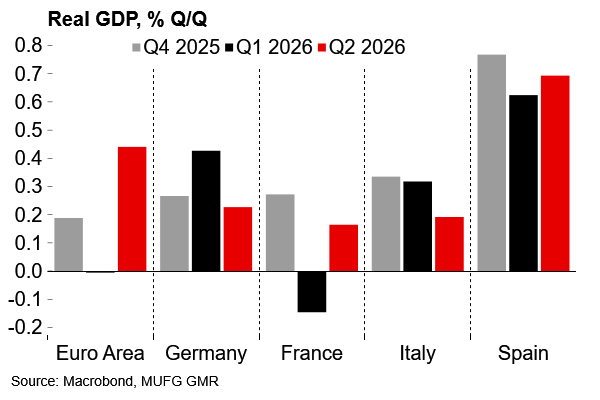
The euro area economy expanded by 0.4% Q/Q in Q2, exceeding our above-consensus call of 0.3% (cons: 0.2). That is the fastest rate since Q1 2025 and certainly a good outcome in the context of elevated energy prices and geopolitical uncertainty.
On a national basis, the largest economies all expanded, suggesting broad-based resilience to the US-Iran shock. Growth was estimated at 0.2% in Germany, France and Italy, while Spain remains the euro area’s star performer with growth of 0.7%.
Excluding the positive distortion from the volatile Irish numbers (first estimate: +3.9% Q/Q), the euro area economy grew a solid 0.3%. Looking further back, euro area growth excluding Ireland has generally held in a narrow range of around 0.2%-0.3% Q/Q since 2024. The big picture here is that the economy has been chugging along at a steady rate despite the range of headwinds over that period, supported by the Spanish expansion.
The economy is not out of the woods
We don’t think steady growth should be taken for granted. In terms of the immediate outlook, the euro area PMI reached a five-month high of 51.9 in July and there have been encouraging signals in national surveys, including the reliable German Ifo numbers. But these survey numbers already look stale after re-escalation in the Middle East. The PMIs were collected 9-22 July when Brent averaged $84/bbl. Brent has since moved above $100/bbl before retracing, but remains above the $90/bbl threshold at the time of writing.
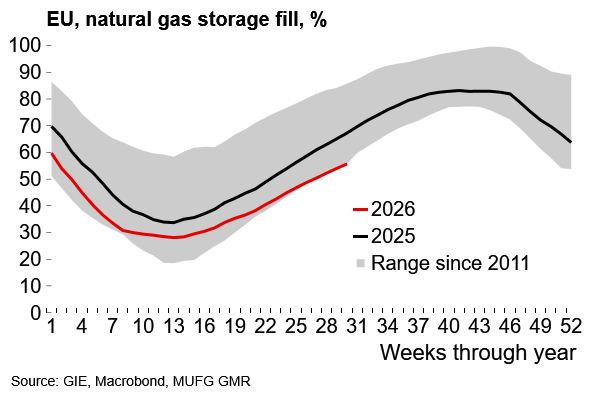
Attention is also increasingly turning to the gas storage deficit heading into the winter. European natural gas storage fill is at just 56%, ~10pp below this time last year and front-month TTF is up ~35% on the month. Meanwhile, lower water levels in the River Rhine are set to hamper barge transport and industrial production in Germany over the summer. Wildfires in Spain, Italy and Greece could affect tourism and agriculture, although offsetting fiscal support measures are possible.
Externally, there are also increasing concerns around EU-China trade relationship. Last week the EU widened sanctions on Russia to entities located in third countries, including in China, which are seen as supporting the Russian military industrial complex. China responded by placing 14 European companies on its export control list. There is risk for tit-for-tat escalation. The fragile trade equilibrium with the US may also become a renewed focus after Trump’s administration launched a probe into EU digital services practices under Section 301.
On monetary policy, we expect an ECB rate hike in September (see here) with policymakers set to lean further against inflation risks. Today’s healthy GDP release supports the case for tightening. The inflation numbers out so far today – a beat in Spain and higher German regional inflation rates – are also supportive. More broadly, the ECB noted that the full effect of the energy shock “is yet to play out” on the prices front. We agree – the headline inflation rate is likely to move above the 3.2% peak recorded in May as the uptick in energy prices reinforces lagged effects from the initial energy shock.
The euro area economy expanded by a healthy 0.4% Q/Q in Q2...
...but a tighter gas market adds to the list of downside risks in H2
We pencil in a slight slowdown in H2, but today’s beat lifts our annual average forecast
Looking ahead, we balance the continued resilience shown today with the range of immediate risks (both external and domestic) facing the euro area economy. The European economy may have weathered the initial shock but the outlook remains highly dependent on energy pricing in particular. Whether a credible and durable ceasefire can be achieved is far from clear. Sporadic episodes of US-Iran escalation with volatile energy pricing around current levels ($80-$95/bbl) would mean persistent headwinds for investment and squeezed consumer dynamics. Despite the resilience shown in Q2 the economy is not out of the woods.
In terms of the outlook, we pencil in quarterly growth of 0.2% in Q3 and Q4, i.e. a moderate slowdown in H2. But today’s upside surprise lifts our projection for euro area annual average GDP growth to 0.8% this year.