

Macro focus – The UK’s narrow policy path: This week’s UK PMI data underlined the difficult backdrop facing the BoE with inflationary pressures edging higher while demand and labour market conditions remain soft. The energy market situation means the argument to leave policy unchanged is becoming harder to maintain. MPC speakers this week have reinforced our sense that a hike in November is likely – we continue to expect 25bp rate hikes in November and February, taking Bank Rate to 4.25%. Our central scenario is that this would be the terminal rate. The UK economy still shows signs of slack and wage growth looks broadly compatible with the inflation target. Hence some unwinding of tightening from H2 next year is plausible if there is credibly durable de-escalation in the Middle East.
Meanwhile, attention is increasingly turning towards fiscal policy with the UK Autumn Budget on 28 October. The PMI release noted that speculation is already proving a headwind to activity, which is now a wearily familiar autumnal theme. We pencil in a roughly £15bn deterioration in fiscal headroom, pointing to more hard choices ahead. There has been some suggestion in the media that the government may not restore the headroom back to its March level. That certainly seems risky in this market, although not necessarily fatal provided that the overall package is credible, transparent and leaves the deficit on track to improve. But it certainly seems a narrow path to us and will be a huge test of communication for the new Chancellor, who is yet to win the trust of investors.
What we’re watching next week: Our focus next week will be on euro area flash inflation figures for September. The headline number is set to rise to the highest level in three years following the uptick in energy. Any broadening of domestic price pressures would support our out-of-consensus call for a back-to-back ECB hike in October.
UK: Slowing economy, rising prices, shrinking headroom
BoE policymakers lay more groundwork for a November hike
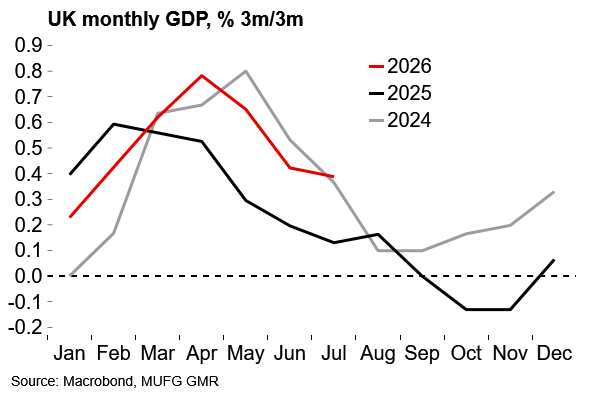
This week’s flash PMI data provided a snapshot of the current UK macro backdrop: rising inflationary pressures and weakening demand. The price components, both input and output, increased but remain short of the peaks seen earlier in the year. On activity, the headline composite number of 51.7 remains in expansion territory, in a sign of some continued resilience, but shows clear softening from earlier in the year. There are also hints of stabilisation in the employment components, albeit at weak levels.
Following the onset of the US-Iran shock, the BoE has been able to point to the degree of slack in the economy and the lack of any broadening in inflationary pressures as a reason to hold fire on any rate rises. The length of the conflict and the rise in energy prices mean that this is becoming less tenable. Headline inflation is on course to exceed 4% in the new year following what is set to be a sizeable uplift in the Ofgem price cap, absent any policy intervention.
In terms of the monetary policy outlook, it seemed clear from last week’s policy meeting that the door is open to a hike at the next meeting in November (see our take here). Since then, a range of policymakers have reinforced the message. Today Bailey said that “it’s going to get harder to maintain” the stance of leaving policy unchanged. Lombardelli, who we thought might have dissented in favour of a hike this month, sounded hawkish in a speech yesterday, noting “policy is increasingly likely to need to tighten if elevated energy prices persist”. The sentiment was echoed by Breeden at a Macro Policy Forum event in London, although less forcefully. Even Dhingra, one of the pair of hard doves on the MPC, sounded open to the idea of tightening, but with less urgency.
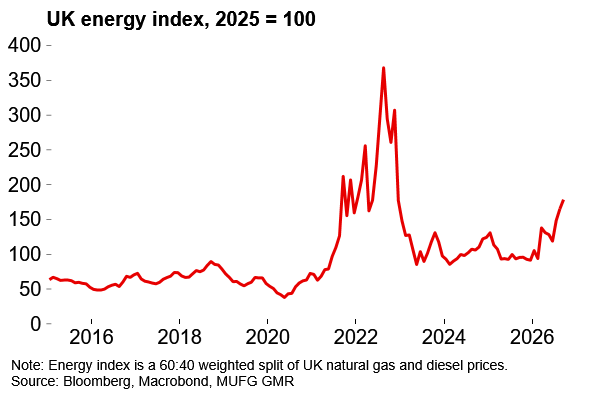
To reiterate our call, we see two 25bp hikes (in November and February) which would take Bank Rate to a moderately restrictive 4.25%. We put the neutral rate at ~3.5%. Looking back at the response to the 2021-22 energy shock, Bank Rate was lifted to 5.25% (~175bp above neutral). With the benefit of hindsight, it looks a well-calibrated response. UK inflation would likely be around target currently if not for the US-Iran shock – and would likely have got there quicker if not for the government policy-induced hump in inflation seen last year. On the simple basis that the uptick in energy is somewhat less than half the magnitude of the 2021-22 shock (see chart below), and without the post-pandemic rebound effects on demand, then 4.25% (~75bp above neutral) seems to be a suitable terminal rate. Current market pricing is for around 100bp of hikes to ~4.75%, but the BoE has suggested there might be significant term premia embedded within that as investors require compensation for the heightened uncertainty.
Looking further ahead, we do stress that there is some slack in the UK economy. The labour market may be stabilising but it’s far from a robust picture. Forward-looking survey indicators suggest that annual pay settlements for 2027 are likely to be only slightly above the 3% mark, which would be target-consistent. On that basis, we think some easing as early as H2 2027 is plausible provided there is credibly durable de-escalation in the Middle East and domestic data allows the all-clear to be declared on second-round risks.
Putting the energy shock in context
The UK economy is once again losing steam in H2
Will the government leave itself less fiscal headroom?
The other UK data of note this week came in the form of the latest public finance data for August, which showed that borrowing is running £8bn above the OBR’s March forecast. These numbers are volatile and prone to revision but they sum up the government’s challenges well with the overshoot driven by spending on net social benefits and debt interest payments.
Turning back to the PMIs, the release noted that pre-Budget uncertainty is beginning to weigh on UK activity. Speculation weighing on activity is now a familiar theme after the last few years. There are still five weeks to go until the statement (28 October) and it’s likely to get worse.
Our working assumption remains that the Chancellor’s fiscal headroom has deteriorated by around £15bn since March, leaving it modestly below £10bn even before any policy decisions on things like energy price support. We will write more in the coming weeks but as we’ve stated before (e.g. here) we assume some tax increases will be introduced. There’s not much juice left to squeeze given Labour’s manifesto pledges and following efforts already taken at previous Budgets, but some measures could be implemented on e.g. property, capital gains, gambling and the banking sector.
There were also some stories in the media this week suggesting that the Chancellor is open to operating with a smaller headroom buffer. We have some sympathy with the argument that there is too much fixation on the headroom. What matters more is the trajectory of the deficit, where there has been some progress. Assuming that is expected to continue, some reduction in headroom buffer is not necessarily fatal, but there is very little room for error. Market tolerance for any signs of slippage or gaming of the framework will be limited, particularly against the current backdrop of higher yields globally and with an untested Chancellor and PM. It’s a narrow path.
What we’re watching next week
Euro area inflation to rise further
It’s euro area inflation week and the numbers are set to come in higher, reflecting the uptick in energy pricing seen over the summer. We expect the headline euro area rate will come in at 3.7% – the highest since September 2023. As my colleague notes here, there has been limited evidence of any broadening into domestic price pressures as yet. But we expect the core rate set to tick up to 0.2pp to 2.6% in this release. This would support our out-of-consensus call that the ECB will go back-to-back with another hike at the next meeting in October (see here). From a BoE perspective, the DMP survey on Friday will be the focus. Signs of any rising second-round effects in the data would help to prompt wavering MPC members to back a hike at the next meeting.
Key data releases and events (week commencing 28 September)
Day | Time | Region | Event | Period | Consensus | MUFG | Previous |
Tue 29 Sep | 10:00 | EC | Economic Confidence | Sep | 98.8 | 98.0 | 98.4 |
Wed 30 Sep | 07:45 | FR | CPI EU Harmonized YoY | Sep P | 3.1 | 3.2 | 2.6 |
Wed 30 Sep | 08:55 | GE | Unemployment Change (000's) | Sep | 2.0k | 8k | 4.0k |
Wed 30 Sep | 10:00 | IT | CPI EU Harmonized YoY | Sep P | 3.7 | 3.9 | 3.2 |
Wed 30 Sep | 13:00 | GE | CPI EU Harmonized YoY | Sep P | 3.2 | 3.2 | 2.9 |
Thu 1 Oct | 10:00 | EC | Unemployment Rate | Aug | 6.4 | 6.4 | 6.4 |
Fri 2 Oct | 09:30 | UK | DMP 1 Year CPI Expectations | Sep | 3.2 | 3.3 | 3.1 |
Fri 2 Oct | 10:00 | EC | CPI YoY | Sep P | 3.6 | 3.7 | 3.2 |
Fri 2 Oct | 10:00 | EC | CPI Core YoY | Sep P | 2.5 | 2.6 | 2.4 |
Note: All times are GMT+1 (London). Source: Bloomberg, MUFG GMR