

BoE Review: The door is open for a November hike
Macro view: The BoE left rates unchanged at 3.75%, as expected, and the 6-3 vote split was unchanged. However, the announcement carried distinctly hawkish signals. The MPC acknowledged near-term inflation is now tracking its adverse scenario with CPI set to exceed 4% in Q1 2027. Four of the six members who voted for a hold signalled that the case for a hike is building, including Governor Bailey. While there wasn’t an urgent tone, it seems the threshold for a hike is close to being met. We expect a 25bp hike in November, followed by a further move in February to bring Bank Rate to 4.25%, conditional on energy prices remaining elevated. The QT announcement was the bigger surprise: the BoE has now committed to unwinding its gilt portfolio by 2034 as it tries to draw a line under the QE era.
Markets view: The BoE's policy update proved less hawkish than some investors had feared, triggering a pullback in both GBP and gilt yields as the MPC stopped short of signalling a November rate hike and continued to stress that tighter financial conditions are already helping to contain inflation. At the same time, long-end gilts were supported by the BoE's revised QT framework. The BoE’s updated plan includes pausing Gilt sales until April which will help to modestly ease supply pressures at the long-end of the curve.
Macro view: The BoE moves closer to a hike
We expect a move at the next meeting if energy prices remain elevated
The Bank of England held Bank Rate at 3.75% at its September meeting, in line with expectations. The vote split, 6-3, was unchanged from the previous meeting, as was the core guidance stating that the MPC “stands ready to act as necessary” to keep inflation target-consistent over the medium term.
But there was a discernible shift in tone. It is clear that the MPC as a whole is finding it harder to look through the energy shock, despite the limited evidence of any broadening in inflation pressures thus far. The collective guidance notes that risks to the inflation outlook have tilted further to the upside since the last meeting. It was acknowledged that near-term energy pricing is close to the BoE’s adverse scenario from July and that headline inflation is on course to exceed 4% in Q1 2027, which is in line with our tracking (see here).
Among the six MPC members who voted to leave rates unchanged, the individual comments indicate that four of those (Bailey, Lombardelli, Ramsden and Breeden) feel that the case for tightening on a risk management basis is building. Dhingra and Taylor remain the key dovish figures and maintain that more evidence of second-round effects would be required to justify tightening.
Looking across the statements, this is the key line from Bailey: “if the conflict in the Middle East persists for an extended period, as appears to be the case, and the risk of second-round effects emerging increases, it is likely that policy may have to tighten.” That’s about as strong a signal for a November hike as could have been expected from the Governor at this stage.
There were some other hawkish hints. It was acknowledged that the labour market remains weak but on the basis of recent survey data “it was now judged likely that there had been some stabilisation in slack”. Meanwhile, Q3 growth expectations were revised up from 0.1% Q/Q to 0.4%. Upside risks to food inflation stemming from energy developments and weather conditions were also flagged.
Still, the MPC has been careful to preserve flexibility. There is no pre-commitment here – a move in November hinges on whether energy prices remain elevated. If there is retracement following de-escalation in the Middle East then the case for a proactive approach would go and the focus would be squarely on whether there is evidence of emerging second-round risks. So far this has been limited.
As we wrote in the preview, we think protracted disruption to energy supply into next year with episodes of re-escalation seems a reasonable base case. On that basis, we expect the BoE will hike in November. Our assumption is that this would be followed up with another hike in February, bringing Bank Rate to 4.25%. We certainly wouldn’t discount the possibility of a back-to-back move in December (in line with our current ECB call), however, but we don’t detect quite that urgency at this stage.
The MPC seems to be moving toward a hike following the energy-driven rise in inflation risks
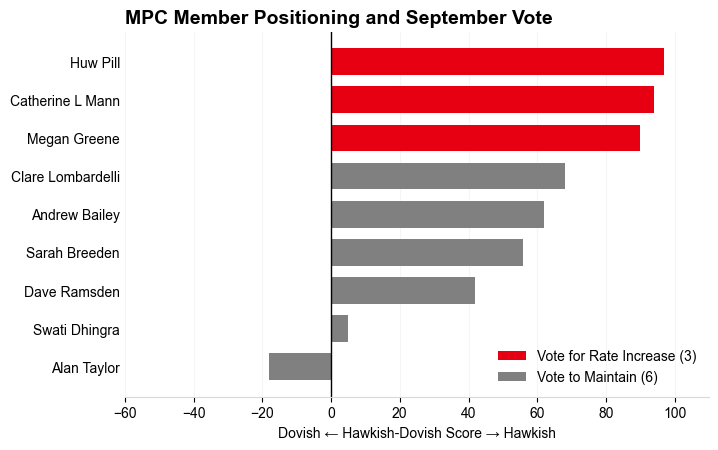
This chart uses a textual-analysis framework to evaluate the policy stance of individual MPC members using the member views section of the monetary policy statement. Communications are scored on a -100 to +100 hawkish-dovish scale, with the analysis focused primarily on each member's policy reaction function, including their willingness to tighten or ease policy in response to evolving inflation risks.
The BoE has set out a multi-year plan to unwind its gilt holdings at a steady pace
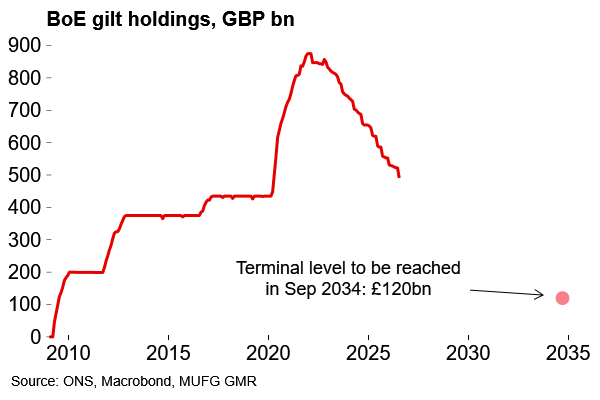
The BoE looks to draw a line under the QE era
Separately, the BoE also announced significant changes to its QT programme. These are certainly consistent with the principle that the process should be gradual and predictable. Rather than setting the envelope on an annual basis, it has committed to a new multi-year plan to reduce the stock of assets held for monetary policy purposes to zero by September 2034. It was stated that there is a “high bar” for any reconsideration.
In terms of the details, the average annual pace of reduction is to be £46bn (down from £70bn over the past 12 months), comprising an average £20bn of active sales alongside passive runoff from maturing gilts. £120bn of the longest-dated gilts will be set aside to back banknote issuance and will not be sold. There is also an interesting plan for gilts to be sold back to the government via the DMO rather than auctioned to the market. It seems that details are still to be thrashed out. The plan is subject to final agreement with the Treasury, with auctions paused in the meantime until April 2027.
Markets view: BoE update drives down GBP & UK yields
BoE rate hike expectations called back & QT sales paused until April
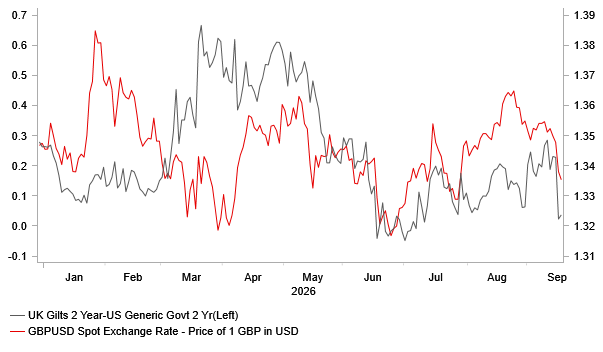
The GBP and UK yields have initially fallen after today’s MPC meeting. Cable has extended its sell-off since last night’s FOMC meeting falling from just above 1.3400 prior to today’s MPC meeting to a low of 1.3350. Similarly, EUR/GBP has jumped from around 0.8560 to a high of 0.8593. At the same time, yields on 2-year and 10-year Gilts have both dropped by around 7-8 bps. The price action indicates that there was some initial relief that the BoE did not deliver an even more hawkish policy update. After today’s pullback, yields in the UK are still at significantly higher levels than at the end of last month.
The UK rate market has got ahead of itself recently by moving to price in 4-5 hikes from the BoE which appears excessive. After hitting a high of 4.97% on 14 September, the 2-year Gilt yield has now corrected lower by around 24-25bps. It highlights the difficulty of justifying such lofty expectations in the near-term. The BoE’s relative lack of urgency over hiking rates is one area of disappointment. There was no explicit commitment to start hiking at the next meeting in November, and/or signalling for the potential need for a more prolonged tightening cycle. MPC members also continue to emphasize that tighter financial conditions are helping to push down on inflation, and reducing the need for hikes.
At the same time, longer-dated Gilt yields have been pushed down by the BoE’s updated QT plans. Under their new proposal, the BoE is planning to divert Gilt sales to the government through the DMO rather than continuing to sell directly into the market. The DMO could then retire the Gilts and manage a larger issuance to better meet market demand. The final decision is subject for the Treasury. Until the terms of sales are worked out, all planned QT auctions will be paused until April. It will help ease selling pressure in the Gilt market at least until April after which increased DMO debt issuance is likely to replace direct Gilt sales into the market. It gives the government more optionality over the timing and maturity of issuance potentially helping to ease the risk of disruption in the Gilt market from additional supply. The BoE still plans to sell GBP146billion of Gilts maturing between 2035 to 2049, at an annual pace of GBP20 billion/year. The BoE’s updated QT plans also included keeping GBP120 billion of Gilts that mature in 2049 or later on their balance sheet. They will be matched against future banknote issuance.
Cable vs. short-term yield spread
Source: Bloomberg, Macrobond & MUFG GMR