

UK CPI rose to 3.1% in August, 25bp above the BoE's July projection, with the overshoot driven by energy. There is still scant evidence of any broadening in domestic price pressures – core inflation held at 2.6% and services at 3.4%. But higher energy prices now point to a near-term inflation profile consistent with the BoE's adverse scenario, with the headline rate on course to exceed 4%.
Against that backdrop we expect a fairly hawkish hold at tomorrow's BoE meeting with a clear signal that a November hike is on the table if energy prices remain elevated. For now, we think a majority on the MPC is likely to judge that the soft labour market and absence of second-round inflation effects still support a wait-and-see approach.
That position looks increasingly shaky given energy market developments, and we expect the case for pre-emptive tightening on a risk management basis will gain traction. Our base case is for 50bp of hikes starting in November.
How long can the BoE hold its nerve?
UK inflation set to rise further on energy
UK inflation moved up to 3.1% in August, in line with expectations. The uptick was driven by higher fuel costs. Core inflation was steady at 2.6% with services unchanged at 3.4%. There is still scant evidence of higher energy costs feeding through into domestic price pressures.
The headline rate was 25bp above the BoE’s July projection. But Brent oil has since pushed towards 110 USD/bbl, the highest since May, and natural gas pricing has reached multi-year highs amid concerns about low European storage levels. Hopes for a US-Iran deal ahead of the November midterms have faded materially with no obvious off-ramp in sight. Protracted disruption into next year with sporadic episodes of re-escalation seems a reasonable base case to our minds.
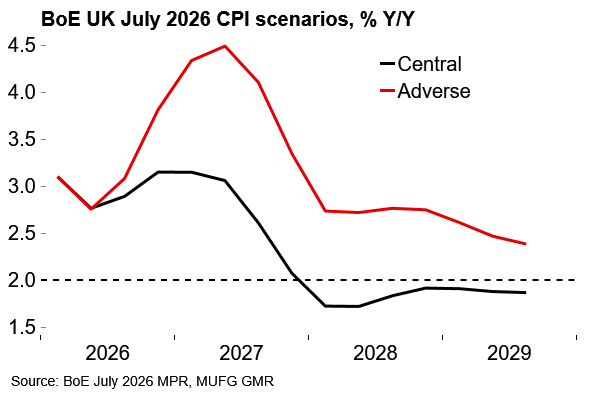
On that basis, we now assume a similar UK inflation profile over the near-term to the BoE’s adverse scenario presented in July, with direct energy effects pushing the headline rate above 4% following January’s energy price cap reset. That would be the highest rate since 2023 and comes after the government-policy driven peak of 3.8% seen last year.
Another deterioration in the outlook will increase concerns about unanchored expectations and non-linear effects. Energy prices are rising at a time of year when they are especially salient to households and when firms are considering annual pay settlements for 2027.
The BoE’s adverse scenario looks increasingly appropriate over the near-term, but we expect less persistence further ahead
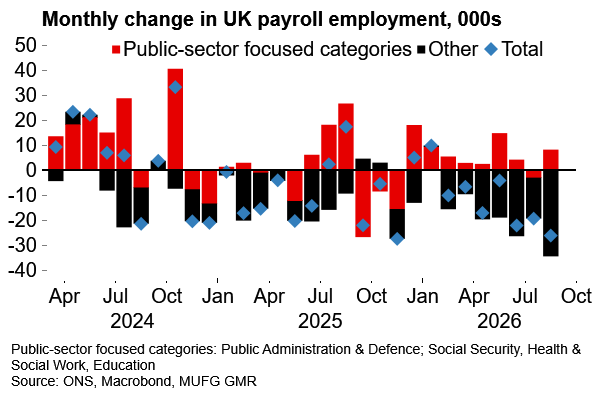
There is plenty of slack in the UK labour market with the private sector continuing to shed jobs at a steady clip
BoE implications – When does an ‘active hold’ become too passive?
Against that background we expect the BoE will deliver a fairly hawkish hold at tomorrow’s meeting and provide a signal that a rate hike in November is on the cards if energy pricing remains elevated. We have pencilled in a 6-3 vote again, but a 5-4 split would be no surprise, with Lombardelli being the most likely to join the dissenters. For now, a majority on the MPC is likely to believe that a ‘wait-and-see’ approach is still tenable. As noted, there is no sign of an increase in domestically-generated inflation pressures. Yesterday’s labour market data continued to suggest a gradual increase in slack, with payroll employment falling again in August. Tighter financial conditions following the global bond sell-off are also doing some of the work for the BoE.
But unless there is a retracement in energy prices, it will become tougher to maintain that the current ‘active hold’ (i.e. not cutting as expected prior to the conflict) is sufficient by the following meeting. BoE chief economist Huw Pill’s argument for a more proactive response on a risk management basis (which he again set out earlier this month – see speech here) is likely to gain traction.
In terms of our call, we now see 50bp of BoE tightening. Pill argued that some tightening would manage upside risks to inflation and “need not be the start of a prolonged and aggressive series of increases”. Indeed, current market pricing for 100bp of hikes looks overdone to our minds given the soft labour market and lack of any broadening price pressures. While the BoE’s adverse scenario mentioned looks valid over the near-term, we see the 1pp of second-round effects embedded by end-2027 as unlikely.
On timing, if the threshold for pre-emptive tightening is deemed to have been reached by November, then a back-to-back move in December would certainly be plausible. That would tally with our current view on the ECB path (see here: Neutral no longer looks enough). However, unlike the ECB, the BoE already has rates in restrictive territory – just about – and the UK labour market is soft. It is also reasonable to assume another year-end slowdown in UK growth over coming months as Budget speculation reinforces any drag on sentiment from energy pricing. That could support a slightly more patient approach with quarterly hikes, i.e. in November and February – but ultimately it is energy market developments which will likely be the critical factor.