

Macro focus – The challenging geopolitical backdrop will test the resilience of the UK economy and may further raise fiscal risks: We focus again on the UK this week. The data flow has been broadly positive this week with another downside surprise in CPI and signs of resilience in the PMI survey. But the backdrop has become significantly more challenging follow re-escalation in the Middle East which has lifted oil and gas pricing. If sustained, this could drive UK inflation back towards 3.5% this autumn and bolster the argument for precautionary BoE tightening.
Meanwhile, new PM Burnham has been busy announcing various small-scale cost-of-living measures. It’s small-scale stuff so far, but we expect he will continue to probe around the edges of the UK’s fiscal constraints to see how much market tolerance there is for his policy platform. Burnham has talked of using all the “flexibility” in the current fiscal rules which unnerved investors. There might be some scope for more capex, but ultimately borrowing is borrowing. The UK Autumn Budget looks set to be a key risk event once more, while speculation around possible tax measures to fund current spending (e.g. on more energy support) has the potential to once more weigh on UK activity in H2.
What we’re watching next week: Alongside the BoE meeting, it will be a busy week of GDP and inflation data in the euro area. We expect Q2 GDP growth will come in at a relatively resilient at 0.3% Q/Q despite ongoing geopolitical uncertainty and higher energy costs, while headline inflation is likely to remain broadly unchanged. However, renewed energy price pressures suggest the current period of stability may prove to be the calm before the storm. If current pricing is maintained, it would amplify the delayed pass-through from the initial shock and likely push headline euro area inflation above the peak of 3.2% recorded in May.
Macro Focus: Challenges ahead for the new UK PM
Better domestic UK data; more difficult geopolitical backdrop
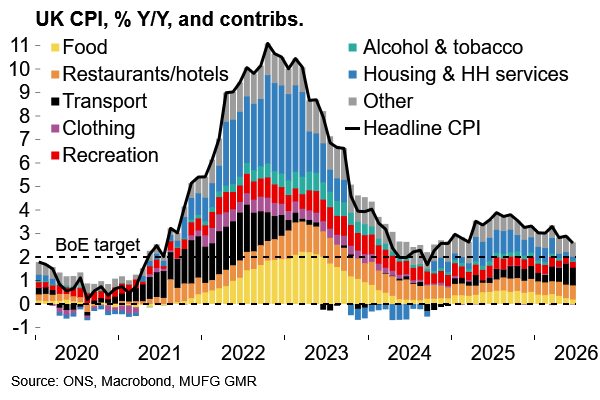
It’s been another busy week in the UK with plenty of data and the small matter of a new PM. Looking across the domestic releases, there was further evidence that Andy Burnham is inheriting an economy which continues to show signs of resilience to the initial US-Iran energy shock. The flash PMI for July reached a 3-month high and retail sales surprised to the upside in June. The UK labour market remains soft, but the latest payrolls figures point to some stabilisation in employment at least. Meanwhile, headline inflation surprised once again to the downside at 2.6%, the lowest figure since last March. Alongside easing PMI price components, the BoE’s DMP and Agents survey looked benign with further moderation in expected inflation and wage growth.
The problem is that this survey data is already stale on release given the backdrop of re-escalation in the Middle East. The conflict has widened with Houthi forces opening a second front by attacking shipping in the Red Sea, and there is no sign of any diplomatic progress to cool tensions. This has pushed Brent above 100 USD/bbl. There are concerns that the market enters this period of re-escalation with much less of a buffer in terms of inventories and so prices may prove to be stickier on the upside from here. The added complication is the increase in European natural gas prices to YTD highs amid concerns around storage buffers, as we noted yesterday when discussing the ECB outlook (here).
UK inflation eased again in June…
…but Middle East re-escalation has changed the outlook
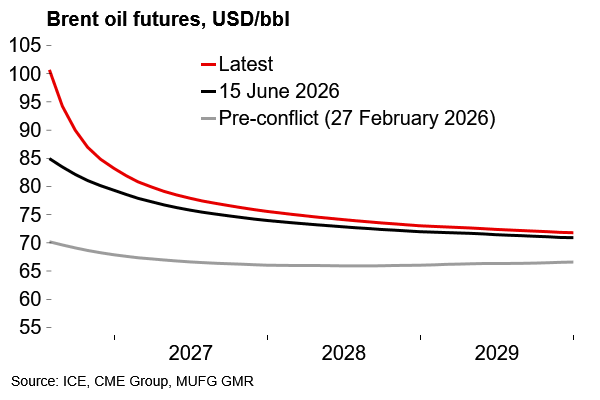
A period of heightened geopolitical uncertainty would be another test of resilience for the UK economy. The rise in energy prices, if maintained, would see the October price cap increase dwarf the modest disinflationary effect of Burnham’s temporary VAT cut (see below). On our current tracking, headline UK inflation could reach around 3.5% in the autumn.
BoE to remain on hold next week but our call for unchanged policy this year is being challenged by the energy price backdrop
In terms of the central bank response, markets are now pricing ~45bp of BoE rate hikes this year. We do not anticipate any change in rates at the BoE meeting next week (we will release our preview on Monday) but there are clearly hawkish risks to our call for unchanged policy this year. BoE officials have not shown much urgency after the run of soft data meant that the hawks effectively lost the argument for pre-emptive tightening. However, another sustained energy price rise would raise fears that inflation expectations could become unanchored and strengthen the argument for a pro-active approach.
Even if oil remains around the current level we see various hurdles to a September hike. The BoE has been stressing its data-dependent approach and to justify a move in September might require leaning on data it has previously looked past, such as rising PMI output prices, which would bring accusations of cherry-picking. The benefits of waiting until closer to year-end include having greater visibility on (i) likely 2027 annual pay awards and (ii) Burnham’s fiscal policy platform. The BoE would certainly be sensitive to any regulatory changes that might reinforce domestic inflationary pressures.
Burnham seems keen to probe away at his fiscal constraints
On the fiscal policy front, Burnham has already announced several immediate measures: (i) the abolition of VAT on domestic electricity consumption from 1 October, (ii) a £2 cap to bus fares in England and (iii) business rates relief for hospitality firms. These are relatively popular policies which reveal a bit more about Burnham’s focus on ‘cost of living’ and interventionist instincts, but they are small beer in fiscal terms.
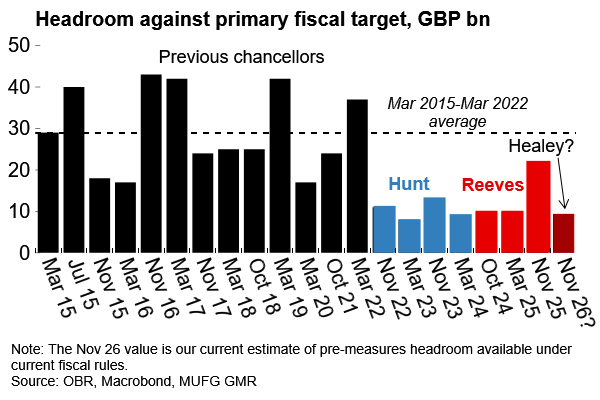
Our current tracking points to a sharp fall in headroom
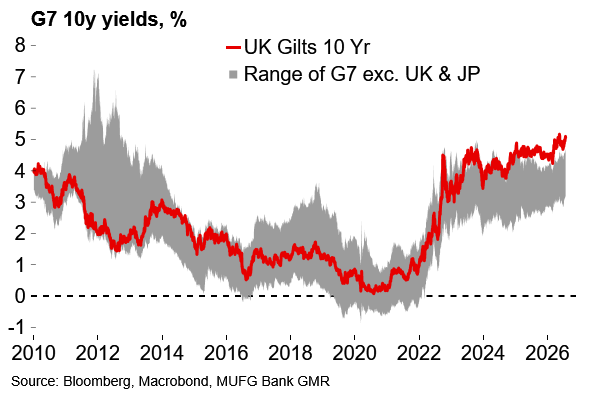
UK borrowing costs remain relatively elevated
Looking across Burnham's broader agenda, areas of focus include substantial devolution of economic powers, a major social housing programme, increased public oversight of utilities and stronger domestic procurement rules. It also seems likely that there will be a significant increase in UK defence spending given the appointment of John Healey as chancellor who previously broke with Starmer’s government over the topic. He must have had some assurances and we think it’s reasonable to conclude that defence spending will be put on a credible path to 3% of GDP.
These ambitions raise obvious questions about funding and renewed escalation in the Middle East raises risks that Burnham will consider more generous fiscal support. Markets responded negatively to Burnham’s comment this week that he would use any “flexibility” within the fiscal framework.
The latest borrowing figures for June were better than expected (another piece of positive data this week) which provides some breathing space. But we still see significant deterioration in the fiscal outlook, driven primarily by higher borrowing costs. On current conditions, we estimate that the £24bn headroom figure from March will be reduced by at least half. That puts the new chancellor on the back foot from the start.
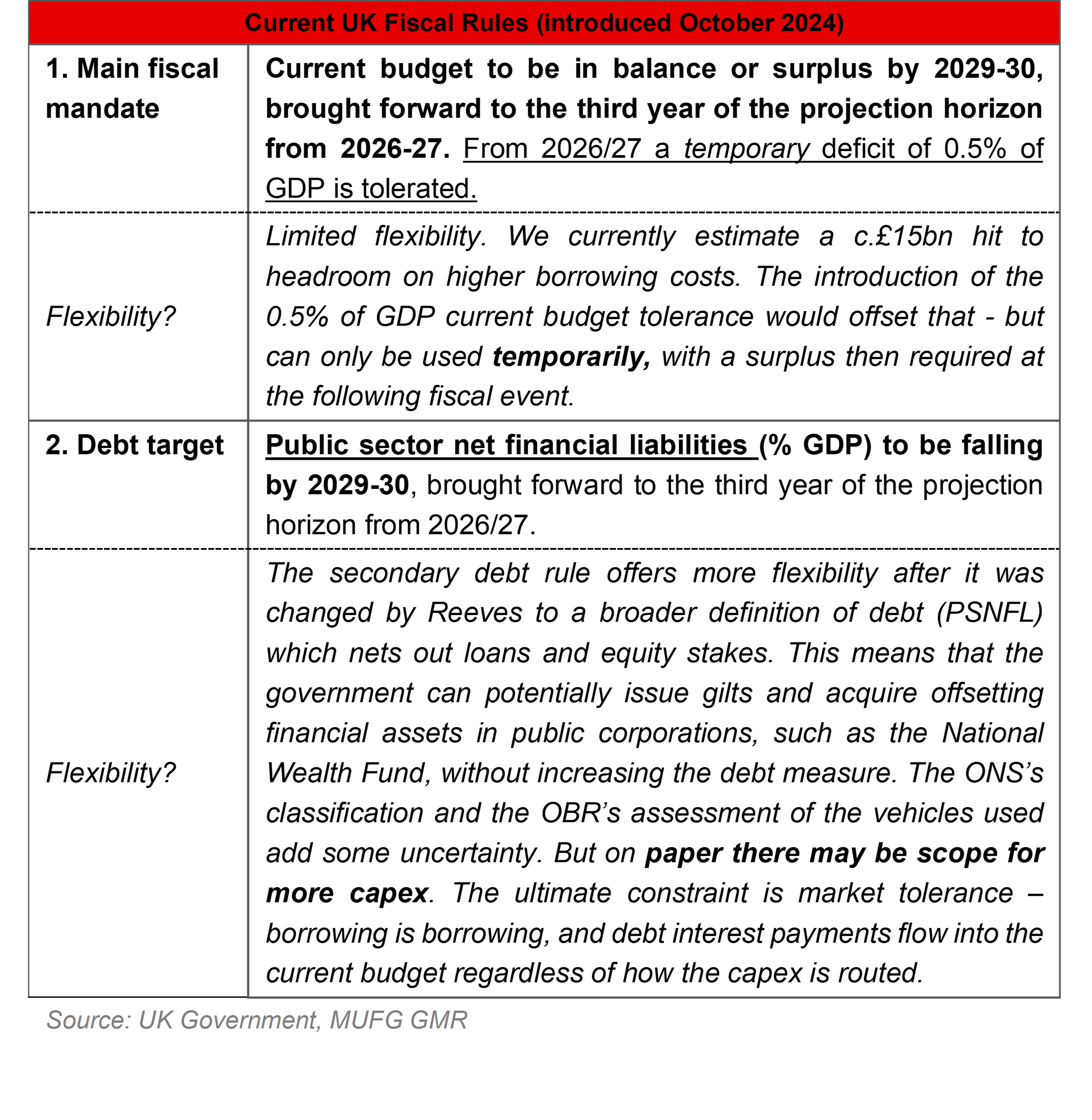
On the “flexibility” question, there is potentially some room on the investment side. The shift to a broader definition of debt for the fiscal rules under Reeves creates scope to funnel public investment through vehicles such as the National Wealth Fund without increasing the debt measure. In practice, however, market tolerance remains the ultimate constraint: borrowing is still borrowing. Gilt issuance must still be absorbed by investors, while higher debt interest payments ultimately feed back into the current budget.
Burnham’s commitment to the fiscal rules and Labour’s pre-election manifesto pledge to maintain key tax policies certainly constrain what he can do. Our sense is that the government will spend the coming months probing the limits of these constraints to gauge how much of their policy platform is plausible, meaning that actual details may remain limited until the Autumn Budget. There is a clearly risk that speculation around that event weighs on UK activity in H2, as it has done in the last two years. Our core view is that Burnham’s government will deliver some moderate spending increases combined with modest tax measures and a bit more borrowing, but it’s a narrow path – and the energy-driven sell-off in global bond markets is not helping.
UK fiscal rules – and scope for “flexibility”
What we’re watching next week
Euro area GDP and HICP in focus
As well as the BoE meeting, discussed above, our focus next week will be on the flurry of euro area GDP and inflation data. Hard data has held up fairly well in Q2, despite geopolitical uncertainty and elevated energy costs, and we expect that resilience will be reflected with a relatively solid 0.3% Q/Q reading for euro area GDP. As ever, the volatile Irish numbers could prove to be a distortion. A favourable revision to the Q1 Irish GDP number lifted the Q1 euro area aggregate to 0.0% Q/Q, from the previous estimate of -0.2%. We are currently tracking 2026 annual average euro area growth at 0.5%. On the inflation front, we expect the headline numbers will remain broadly unchanged in what feels like it could be the calm before the storm. The renewed uptick in energy prices changes the dynamic and, if maintained, would amplify delayed pass-through from the initial shock and push headline inflation back up above the peak of 3.2% recorded in May.
Key data releases and events (week commencing Monday 27 July)
Day | Time | Region | Event | Period | Consensus | MUFG | Previous |
Tue 21 Jul | 9:00 | GE | IFO Business Climate | Jul | 86 | 86.5 | 85.6 |
Mon 27 Jul | 9:00 | EC | ECB Wage Tracker | - | - | - | - |
Thu 30 Jul | 9:00 | IT | GDP WDA QoQ | 2Q P | 0.0 | 0.1 | 0.3 |
Thu 30 Jul | 9:00 | GE | GDP SA QoQ | Jul P | 0.1 | 0.1 | 0.3 |
Thu 30 Jul | 10:00 | EC | Economic Confidence | 2Q P | 96 | 97 | 95 |
Thu 30 Jul | 10:00 | EC | GDP SA QoQ | 2Q P | 0.2 | 0.3 | -0.2 |
Thu 30 Jul | 10:00 | EC | Unemployment Rate | Jul | 6.2 | 6.3 | 6.2 |
Thu 30 Jul | 12:00 | UK | Bank of England Bank Rate | 2Q A | 3.75 | 3.75 | 3.75 |
Thu 30 Jul | 13:00 | GE | CPI EU Harmonized YoY | Jun | 2.8 | 2.9 | 2.4 |
Fri 31 Jul | 7:45 | FR | CPI EU Harmonized YoY | 30-Jul | 2.1 | 2.0 | 2.0 |
Fri 31 Jul | 8:55 | GE | Unemployment Change (000's) | Jul P | 5.0k | 8.0k | -1.0k |
Fri 31 Jul | 10:00 | EC | CPI Estimate YoY | Jul P | 2.9 | 2.9 | 2.8 |
Fri 31 Jul | 10:00 | EC | CPI Core YoY | Jul | 2.4 | 2.4 | 2.4 |
Note: All times are GMT+1 (London). Source: Bloomberg, MUFG GMR