

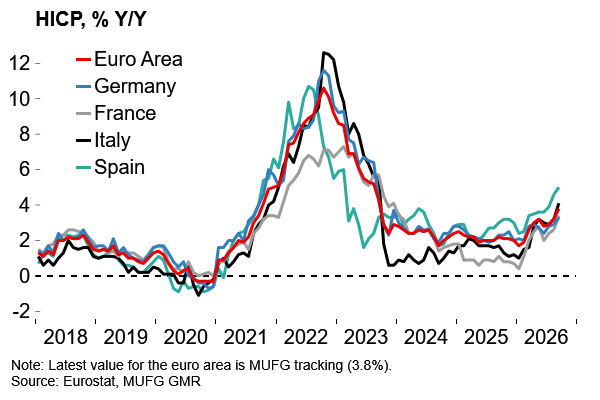
Euro area inflation surprised to the upside in September, with the main national figures all coming in above expectations. We raise our tracking estimate for the aggregate headline HICP rate up to 3.8%, which would represent the highest reading since September 2023, and a sharp acceleration from 3.2% in August. However, the increase remains primarily an energy story, with core and services pressures still broadly contained. Indeed, despite the uptick in headline inflation, the bar for an October ECB rate hike has moved higher after a more measured tone from President Lagarde earlier this week and the recent retracement in gas prices. We continue to see October as a live meeting but acknowledge that, in the absence of a renewed leg higher in energy prices, the balance of risks has shifted towards a pause at the next meeting.
Euro area inflation on course to reach a three-year high
There has been a flurry of hotter-than-expected September inflation figures in the euro area this week with the main national numbers all surprising to the upside. We are now tracking the euro area aggregate headline HICP figure at 3.8%, up from our prior forecast of 3.7% (see here). That would be an increase from 3.2% in August and the highest rate since September 2023. The flash euro area aggregate estimate will be published on Friday ahead of the full release on 16 October.
By country, the largest upside surprise came in Italy with HICP rising sharply to 4.1% from 3.2% prior. Core inflation in the national CPI measure increased from 1.4% to 1.6%, with a 0.3pp rise in the services component. Elsewhere, the German headline HICP rate increased from 2.9% to 3.3%. However, the national CPI figures show core unchanged at 2.4% with the services component actually easing slightly to 2.7% (although that does imply an uptick in the core goods component which is not published). In France, HICP came in at 3.4%, up from 2.6% in August. The national CPI figures showed that food inflation increased 0.4pp to 1.5%. Services inflation picked up 0.3pp to 2.2% but that may have been tourism-related after weaker demand during the summer heatwave.
Reading across the preliminary national releases, the main takeaway is that the uptick in inflation remains primarily an energy story. Where services inflation has risen, the increase appears concentrated in tourism-related categories that tend to be volatile month-to-month. There are some signs that food inflation is starting to pick up, reflecting higher input costs and effects of the summer heatwave. Core goods inflation also seems to be drifting upwards on indirect energy effects. But, broadly speaking, the key message is that any broadening of inflationary pressures beyond energy remains limited in scope.
Euro area inflation is reaching three-year highs
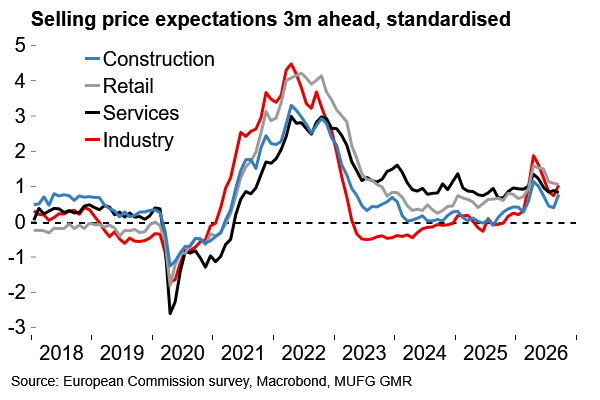
Surveys still point to limited non-energy price pressures
The ECB has dialled back the urgency
Indeed, despite this week's upside inflation surprises, our conviction around the pace of ECB tightening has weakened. After the last ECB meeting, we added 50bp of tightening to our call (see here: Neutral no longer looks enough). We maintain that policy will need to be pushed into restrictive territory to lean against risks but acknowledge that the call for an October hike looks shakier, despite these inflation figures. Market pricing has moved sharply lower this week. It was seen as a 50-50 call – now markets assign less than 30% probability of a back-to-back hike.
The main shift has been the dovish slant to President Lagarde’s comments on Monday when speaking to the European Parliament. She indicated that rising long-term yields will “slow growth and reduce pass-through [from energy to broader inflation] by more than projected in September”. This was a shift after Lagarde declined to place too much weight on tighter financial conditions doing the ECB’s work for it when asked at the last policy meeting. Since the time of the last meeting, front-month TTF pricing has decreased by over 10% which has reduced the urgency for policymakers to respond on a risk management basis.
We also had the European Commission survey for September this week. The release painted a softer picture compared to last week’s PMIs (see our take on those here). While the broad picture of economic resilience remains, the headline economic indicator number eased a touch. Employment expectations also softened, led by the retail sector (which is not covered in the PMI). Selling price expectations also softened marginally in both the retail and services sectors, supporting the view that domestic inflation pressures remain relatively contained.
An October hike is still plausible. The headline inflation number will still make uncomfortable reading from an ECB perspective, especially when set against the backdrop of resilient economic activity in the euro area. Higher energy and food prices are salient for informing household inflation expectations, which surveys suggest have already drifted higher over the summer. From the ECB's perspective, the concern is around the risk that another prolonged period of elevated energy prices prevents inflation expectations from fully re-anchoring.
In terms of upcoming data, there will also be another batch of PMIs before the policy meeting on October 29. That will be watched closely for signs of rising output prices in the services sector. But with energy prices off recent highs and financial conditions having tightened further it does now seem that renewed upward pressure in energy markets over coming weeks would be required for the hawks on the Governing Council to win the case for proactive action at the next meeting. We would not dismiss that risk given the still-fragile geopolitical backdrop.