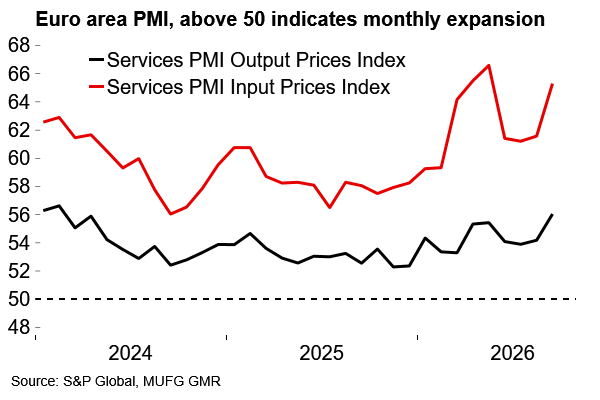

The euro area PMI comfortably beat expectations in September, pointing to continued resilience in the face of higher energy prices. Manufacturing sentiment remains firm and there was a marked improvement in the services sector. The survey reinforces the view that the euro area economy is coping well with geopolitical uncertainty and higher energy costs. More importantly for the ECB, the PMI showed some signs that energy-driven price pressures may be broadening into the domestic economy. The services output price gauge increased to the highest level since early 2024. All told, today’s release bolsters the hawkish case for further tightening and is consistent with our view that the deposit rate will be lifted from the current 2.50% to 3.00%. We continue to see scope for policy action in October but acknowledge it will ultimately hinge on energy market developments.
The story of resilience continues
The euro area composite PMI rose to 53.1 in September, a 41-month high, with both manufacturing and services remaining comfortably in expansion territory. It was a notable upside surprise relative to the consensus for a small deterioration. The headline indices improved in both Germany and France, suggesting broad resilience to the energy price shock.
By sector, the manufacturing sector has remained in reasonable shape since the start of the US-Iran conflict, supported by strong AI-related capex demand and increased European defence spending. New orders rose to 52.3, the highest since March 2022, pointing to continued momentum. More notable was the improvement in services sentiment, with the services PMI rising to a 10-month high, despite higher energy prices. While encouraging, we would caution that the end to summer heatwave disruption may have provided a temporary boost to activity. Separate data yesterday showed that euro area consumer confidence data weakened in September which could indicate rising pressure on household purchasing power.
We are tracking euro area GDP growth (ex. Ireland) at around 0.2% Q/Q in Q3. The September PMI is consistent with stronger growth (~0.4%). However, activity earlier in the quarter was likely held back by heatwave-related disruption, including low Rhine water levels (see here). Looking ahead, we have pencilled in a similar (i.e. relatively modest) growth rate in Q4, with headwinds from political/fiscal uncertainty and elevated energy pricing (see e.g. here). Still, the broad resilience of the euro area economy so far to the energy shock, higher interest rates and supply chain disruption is unarguable. Annual average growth of 1.0% this year, our base case, would certainly be a good result given the circumstances.
The case for further ECB tightening has been bolstered
On prices, there has been scant evidence in the HICP numbers of any second-round inflation effects so far, despite the resilient growth picture. However, today’s PMI release gave a clear indication that energy prices could be starting to spill over into broader domestic price pressures. The PMI output price gauge in the services sector increased to 56.0, the highest level since February 2024. That certainly bolsters the hawkish argument for further ECB tightening – it is this sort of survey evidence which policymakers would lean on to justify pushing rates on into restrictive territory. The flash PMI release for October will be released just before the next policy meeting.
Our expectation is that the ECB will lift the deposit rate from the current 2.50%, the upper end of the neutral range, to 3.00%. We have a move in October in our call (see here). In our view, today’s PMI strengthens the case for a more proactive approach, but whether the ECB does indeed go back-to-back will primarily hinge on energy market developments. Markets currently assign a ~50% probability to an October hike.
Euro area business sentiment has steadily improved since the onset of the US-Iran shock
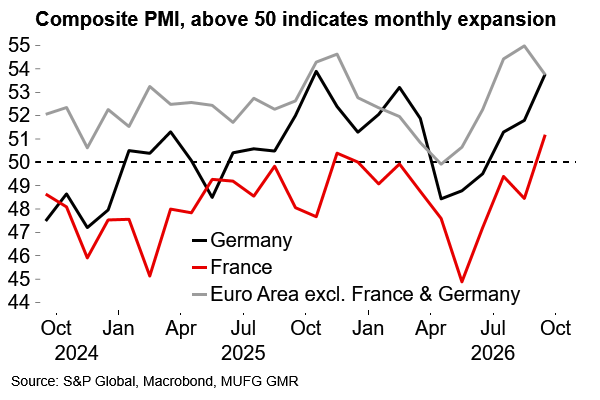
There are signs that inflationary pressures may be broadening beyond energy effects