

The BoE's 'active hold' has run its course. We expect a 25bp hike to 4.00% on Thursday, with Taylor and Dhingra the only dissenters in a 7-2 vote. The case for action has become increasingly compelling, despite the move in energy prices on hopes for US-Iran talks. UK inflation, already at 3.5%, is heading materially higher, the economy has outperformed expectations, and the labour market seems to have stabilised. Bailey has been explicit that the MPC cannot wait for conclusive evidence of second-round effects before responding – we think the balance of risks has now shifted to the point where the MPC can no longer sit on its hands.
Looking ahead, we doubt policymakers will adopt any sort of ‘one-and-done’ framing and will want to retain flexibility over the timing and extent of any further tightening. Our base case remains another 25bp hike in February, taking Bank Rate to 4.25%, which we see as the terminal rate. We don’t dismiss the possibility of a back-to-back move in December with plenty of key data releases between meetings.
Market pricing of around four hikes by mid-2027 still looks rich to us. It would require more concrete evidence of broadening inflation risks. Our base case remains that tightening is conducted on an insurance basis to lean against risks of price pressures broadening. If second-round effects remain contained, we see scope to gradually reverse some of that tightening later in 2027.
The ‘active hold’ has reached its limit
The BoE is set to raise Bank Rate by 25bp to 4.00% on Thursday. We see a 7-2 split with the dovish duo of Taylor and Dhingra voting for no change. It would be the first hike since August 2023. Unlike the Fed and the ECB, the BoE has managed to resist tightening policy since the start of the US-Iran conflict. Until now the BoE has instead relied on an ‘active hold’ strategy – markets had expected a degree of easing before the conflict, so taking those cuts off the table effectively represented a tighter stance.
We think that approach has reached its limit. After the last meeting we wrote that the threshold for a hike was close to being met (see here), and the MPC seems to be there now. Bailey has since noted that “the longer the pattern of higher energy prices persists, the more difficult this situation becomes”. Lombardelli has argued that policy is “increasingly likely to need tightening”, while Ramsden has acknowledged that “there could be a case for increasing Bank Rate” as inflation pressures build.
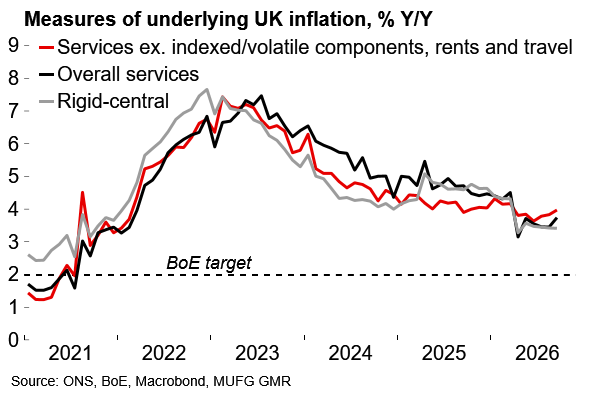
While energy prices have retreated in recent days, the inflation backdrop has worsened materially since the September meeting. Headline CPI, which has already averaged 3.2% since the start of 2025, is on course to move markedly higher when the Ofgem price cap increases in January by ~25-30%. In September the BoE noted it expected inflation to peak “slightly above 4%” in Q1. We expect that the peak will be revised to 4¾% at this week's meeting following the increase in gas prices during the MPR projection window.
The longer energy prices remain elevated and volatile, the greater the risk that higher headline inflation begins to influence broader wage and price-setting behaviour. To be clear, there have so far been relatively few signs of that pass-through process actually taking hold. The readings from the BoE’s DMP survey remain essentially benign.
But as Bailey has previously argued, the BoE cannot afford to wait for conclusive evidence of second-round effects before responding and the balance of risks has shifted to the point where it no longer seems tenable for the MPC to continue sitting on its hands. Indeed, at this point we are reminded of outgoing ECB President Lagarde’s comment in March that it’s hard to understand a reaction function that does not react.
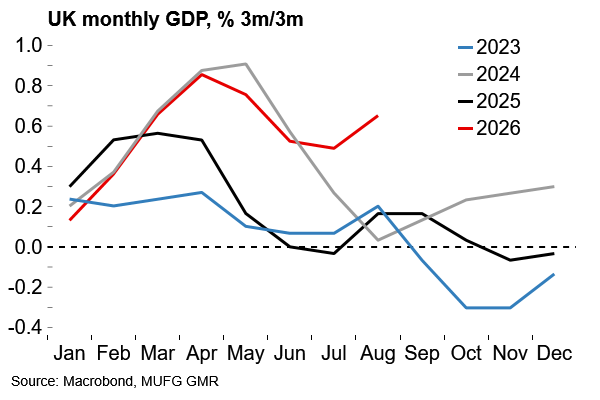
Recent activity data has made the decision easier for the MPC. The economy has performed markedly better than would have been expected given the energy backdrop. In September the BoE’s Q3 GDP projection stood at 0.4%. We expect that tracking will be revised up to 0.7% Q/Q following the August monthly GDP. That points to upward revisions to the annual estimates from the 1.1% for both 2026 and 2027 presented in July (we now have 1.5% for both years). There has also been a modest upside surprise in spot inflation, and the labour market is showing signs of stabilisation (see here).
It’s also worth flagging that the UK Budget was navigated without incident. As we noted last week, the Budget changed very little for the BoE. Policy measures were limited and have not materially altered the outlook for aggregate demand. The 3.9% increase in the National Living Wage is close enough to prevailing pay settlement expectations that it should have only limited implications for the inflation outlook.
The economy is carrying solid momentum
Measures of underlying inflation remain stubbornly high
Further tightening ahead – but current market pricing looks overdone
What next? In terms of policy guidance, we doubt there will be any sort of ‘one-and-done’ framing. Of course once central banks begin hiking it rarely consists of a single isolated move. That is one reason why our central case is for a further 25bp hike in February, the next projection meeting, which would take Bank Rate to 4.25%. It’s likely that the BoE will leave the door open to further tightening while stopping short of providing any strong steer on timing. Indeed, the recent retracement in oil and gas on hopes for US-Iran talks is a reminder that the energy situation remains volatile and uncertain.
Is December live? We certainly don’t discount the possibility of a back-to-back hike. There will be a lot of data between now and then. Before year-end, policymakers will receive two inflation reports, two labour market releases, GDP data, another DMP survey and two further PMIs. The closer we get to year-end, the more informative survey evidence on 2027 annual pay settlements will become. If these indicators start pointing to a broadening in price pressures then the ‘why wait?’ question would become harder to ignore.
Currently market participants price around four rate hikes by the middle of next year, which still looks rich to us (see here), despite the challenging short-term inflation profile. Even Huw Pill, the MPC’s lead hawk, argued last month that this seems overdone and would require more concrete evidence of broadening inflation risks. As Bailey has previously noted, the curve might partly reflect risk premia for elevated uncertainty. That said, we don’t see any obvious need to directly push back against current pricing – but nor do we expect that policymakers will validate it. Flexibility remains the order of the day amid high uncertainty.
Further ahead, it’s worth stressing that at this point any policy tightening is being conducted on an insurance or risk management basis rather than in direct response to a broadening in inflation pressures. Our base case is that 4.25% is the terminal rate. If second-round effects remain contained then we see scope for a gradual reversal of that tightening later in the year if the all-clear can be declared.