

Macro focus – Revisiting the UK’s growth outlook: UK GDP data for August delivered another upside surprise, with monthly growth of 0.1% M/M defying expectations of a contraction and lifting the 3m/3m rate to a solid 0.7%. Annual growth has now exceeded 2% for the first time since the post-pandemic rebound. We are tracking 2026 full-year growth at 1.5%, above the IMF's latest estimate. Growth is not broad-based: professional services and IT continue to do much of the heavy lifting, while consumer-facing sectors look soft amid a range of headwinds such as higher energy prices and mortgage rates. But the strength of knowledge-based sectors could suggest tailwinds from relatively quick adoption of AI-related technologies in the UK. We remain cautious about drawing firm conclusions but there is certainly a possibility that the UK's supply side is proving more adaptable and dynamic than many have assumed.
What we’re watching next week: The focus in Europe next week will be on UK data, including jobs and inflation, and the flash October PMIs. Beyond the usual growth and inflation signals, we will be watching for any evidence in the surveys that budget uncertainty in the UK and France is weighing on business sentiment.
Revisiting the UK’s growth outlook
The economy continues to expand
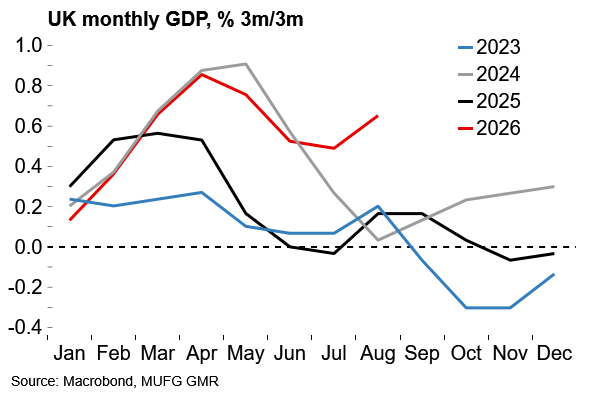
The UK economy is on a good run. Monthly growth of 0.1% M/M in August defied expectations of a slowdown (we had pencilled in a figure of -0.2% M/M) and, alongside upward revision to previous numbers, leaves the 3m/3m growth rate at a solid 0.7%.
Like most observers, we have spent much of the year describing the UK economy as a story of resilience. The latest numbers certainly reinforce that narrative with annual growth exceeding 2% for the first time since the post-pandemic rebound period.
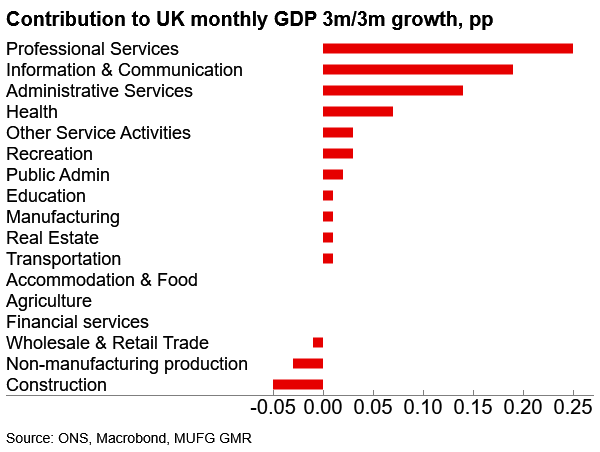
We’re still hesitant about overstating things here. Growth remains far from broad-based with a few sectors, namely professional services and IT, doing most of the heavy lifting. Consumer-facing services continue to underperform, manufacturing was boosted by a surge in the volatile pharmaceutical sector and construction remains stuck in the doldrums.
Plenty of headwinds remain. Geopolitical uncertainty remains elevated. Fuel prices are up 30-40% Y/Y and households are facing a sizeable (~25%) increase in the energy price cap from January, leaving headline inflation on course to reach 4%. Fixed mortgage rates have increased by around 1pp since February.
Against that background it was not surprising that the PMIs showed confidence softened in September. But the economy is still carrying more momentum into the autumn than it has done at this point in previous years. It felt notable that concerns around the upcoming Budget featured in the flash PMI release but were absent from the final report. Firms seem more focused on energy prices, borrowing costs and global developments.
Fiscal speculation has been a major drag on activity in H2 in recent years. While this year’s uptick in borrowing costs has certainly cut into fiscal headroom, the government has been trying to convey a less gloomy message, and it seems there have been fewer trial balloons of policy ideas in the media. A period of speculation and ‘wait and see’ deferment on spending/investment choices is inevitable around any Budget, but it feels like it could be shorter and less damaging for growth this year. (Note we will release our full UK Budget preview next week).
The economy is carrying stronger momentum into autumn
Professional services and ICT are driving the expansion
When does resilience become something more?
In terms of the growth outlook, we note that the IMF upgraded its 2026 figure to 1.3% earlier this week. We think that is too conservative. We are pencilling in a small contraction in the September monthly figure, but the Q3 growth rate as a whole still looks set to come in around 0.6-0.7% Q/Q. Even then assuming a subdued Q4 figure, we are now tracking 2026 annual average growth at 1.5%, which would be the fastest rate since 2022.
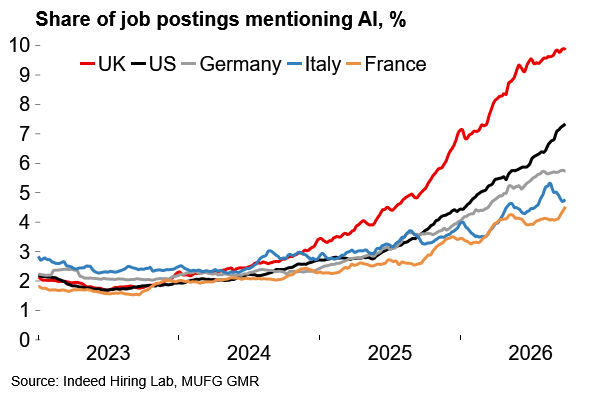
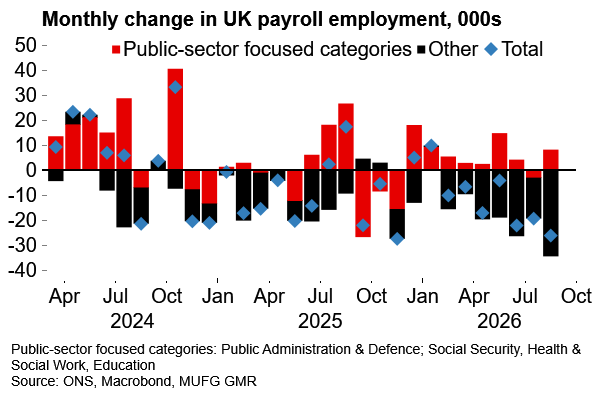
We also see scope for a similar growth rate (~1.5%) in 2027 given stronger momentum into the new year and more credible hints of a productivity improvement. On the latter, we don’t think it’s a coincidence that the strongest contributions to growth are coming from knowledge-intensive parts of the economy. The rapid growth in AI-related job postings suggests that UK firms are embracing AI technologies relatively readily compared with other major advanced economies. It is plausible that higher employment costs in the UK have strengthened firms’ incentives to invest in labour-saving technologies. Admittedly, weaker employment growth would not be an unambiguous positive story if sustained, eventually weighing on household income growth and consumer spending. For now, though, output is holding up considerably better than labour demand, perhaps reflecting relatively healthy household balance sheets.
Putting it all together, we see at least some circumstantial evidence that the diffusion of AI through the UK's services-orientated economy may be occurring relatively quickly. While it remains difficult to quantify the direct contribution to growth, we lean on the side of optimism when it comes to the scope for productivity gains. We are always cautious about putting too much weight on monthly UK GDP numbers, as volatile and prone to revision as they are. But growth has exceeded expectations for long enough that we are open-minded about the possibility that the UK's supply side is proving more adaptable and dynamic than has been assumed.
There are signs that AI adoption is occurring relatively fast in the UK’s services-orientated economy
Private sector hiring remains subdued despite relatively firm economic activity
What we’re watching next week
Flash PMIs and UK inflation
Next week will bring a busy run of UK data ahead of the Budget on 28 October. Wednesday’s CPI figure will attract most attention. We expect an uptick to 3.5% on the back of higher energy costs. There will also be data on the labour market, retail sales and public finances next week, as well as the flash PMIs for October. We will be watching the survey closely for i) any signs of broadening inflation pressures and ii) evidence of slowing activity around the Budget.
The euro area data calendar is a bit lighter with the PMIs being the highlight. Again, the focus will be on whether the general theme of resilience remains and whether there are signs of second-round effects on inflation ahead of the ECB’s meeting on 29 October. Energy costs remain elevated with natural gas around YTD highs, but we dropped our call for a back-to-back hike after policymakers dialled back the urgency by starting to highlight the impact of tighter financial conditions.
Key data releases and events (week commencing Monday 19 October)
Day | Time | Region | Event | Period | Consensus | MUFG | Previous |
Tue 20 Oct | 07:00 | UK | Private Earnings ex Bonus 3M/YoY | Aug | 3.0 | 2.9 | 2.9 |
Tue 20 Oct | 07:00 | UK | ILO Unemployment Rate 3Mths | Aug | 5.0 | 4.9 | 4.9 |
Tue 20 Oct | 07:00 | UK | Payrolled Employees Monthly Change | Sep | -10k | -14k | -26k |
Tue 20 Oct | 10:00 | GE | ZEW Survey Expectations | Oct | 30.0 | 32.0 | 34.7 |
Wed 21 Oct | 07:00 | UK | CPI YoY | Sep | 3.4 | 3.5 | 3.1 |
Wed 21 Oct | 07:00 | UK | Public Sector Net Borrowing | Sep | 24.0b | 23.0 | 18.3b |
Thu 22 Oct | 15:00 | EC | Consumer Confidence | Oct P | -17 | -15.2 | -16.5 |
Fri 23 Oct | 00:01 | UK | GfK Consumer Confidence | Oct | -15 | -14.0 | -13 |
Fri 23 Oct | 07:00 | UK | Retail Sales Inc Auto Fuel MoM | Sep | -0.2 | -0.4 | 0.5 |
Fri 23 Oct | 08:15 | FR | S&P Global France Composite PMI | Oct P | 50.5 | 49.9 | 51.1 |
Fri 23 Oct | 08:30 | GE | S&P Global Germany Composite PMI | Oct P | 53.5 | 53.0 | 53.8 |
Fri 23 Oct | 09:00 | EC | S&P Global Eurozone Composite PMI | Oct P | 52.7 | 52.0 | 53.1 |
Fri 23 Oct | 09:00 | EC | ECB 1 Year CPI Expectations | Sep | 3.2 | 3.2 | 3.0 |
Fri 23 Oct | 09:30 | UK | S&P Global UK Composite PMI | Oct P | 51.7 | 51.4 | 52.0 |
Note: All times are GMT+1 (London). Source: Bloomberg, MUFG GMR