

ECB review: Hike, then hand over
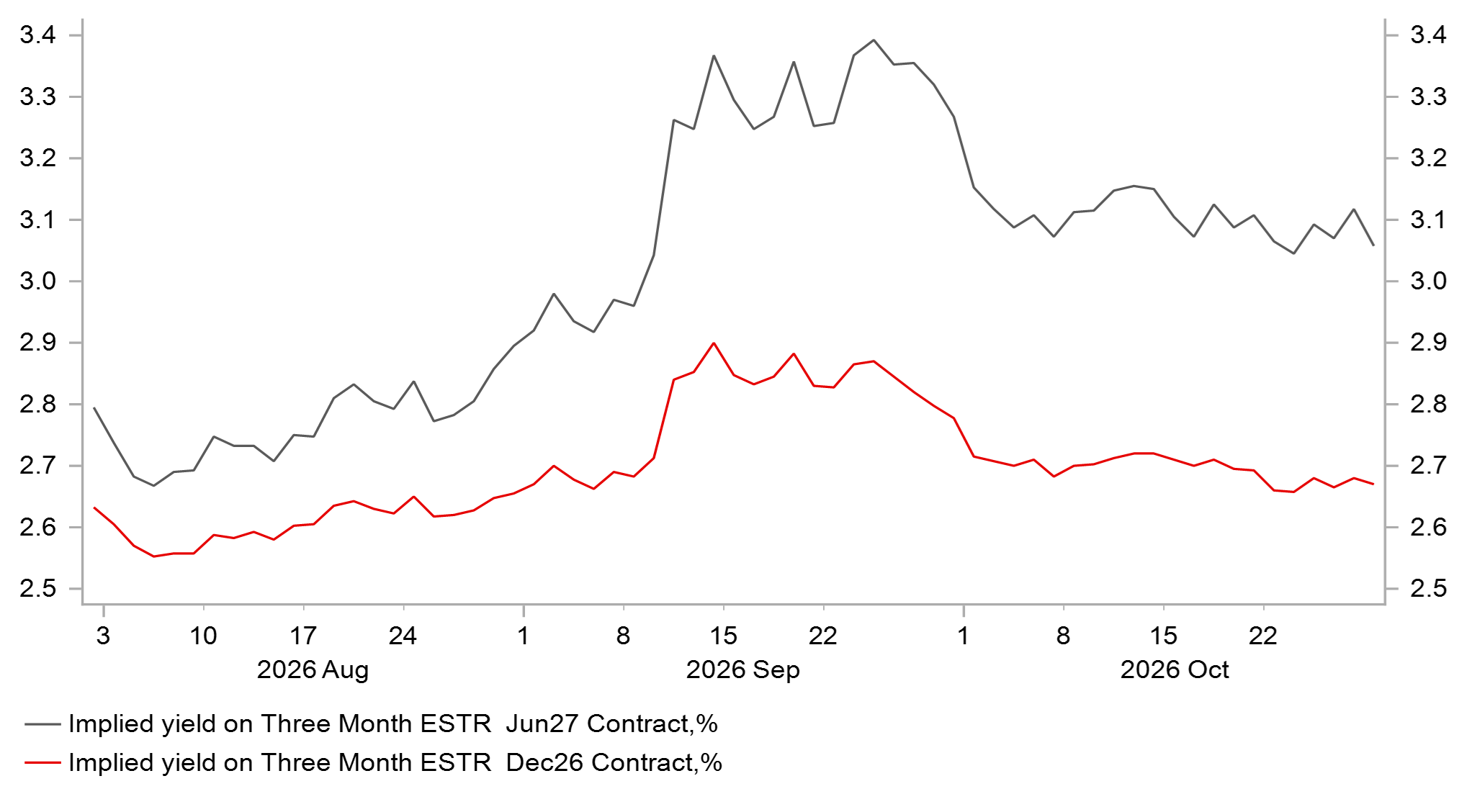
Macro view: The ECB left the deposit rate unchanged at 2.50%, as expected, and retained its standard flexible guidance. The statement reflected the recent tension between a deteriorating energy backdrop and materially tighter financial conditions, while highlighting the absence of meaningful second-round inflation effects. The Q&A had a firmer tone. Lagarde strongly hinted that further tightening is coming barring significant developments between now and the December meeting. We continue to expect 25bp hikes in December and March, taking the deposit rate to 3.00%. That would move policy modestly into restrictive territory and, in our view, represents a reasonable response to rising inflation risks.
The meeting came after an announcement that Lagarde will leave the ECB in February, eight months ahead of schedule. Attention now turns to the succession process, with Hernández de Cos and Knot the front-runners. The leadership transition adds a further layer of uncertainty around the extent of tightening beyond December.
Markets view: The EUR initially fell as the ECB highlighted tighter financing conditions, stable underlying inflation and limited wage pressures, but recovered as President Lagarde signalled that further policy tightening remains likely. Her comments support our forecast for another hike in December, with scope for rates to reach 3.00% in 2027. Lagarde also acknowledged higher long-term borrowing costs but provided few details on how the ECB might address government bond-market stress, while the renewed sell-off in US AI stocks, lower oil prices and a relatively cautious Fed update are also helping to curb USD strength.
Macro view: The door is wide open for further tightening
An uncomfortable pause
Let’s start with the policy decision. The ECB held the deposit rate at 2.50%, as expected, with unchanged guidance. The statement highlighted both sides of the debate which we set out in our preview here. There was emphasis on the larger and longer-lasting energy shock but also a new explicit reference to the impact from tighter financial conditions and the lack of second-round effects. That gave the statement a cautious tone but overall it reads like justification for a pause at this juncture rather than an argument against further tightening.
That was certainly backed up by Lagarde’s comments in the Q&A. She revealed that, although the decision to hold was unanimous, policymakers debated whether to hike at this meeting and suggested that current conditions “could have warranted” further tightening. While stopping short of pre-committing to December, Lagarde’s remark that the ECB’s “direction of travel” is clear points to at least one more hike to come, barring significant developments or shocks. While market conditions were noted, there was little suggestion that higher market rates are viewed as a substitute for policy action. All told, given Lagarde’s comments, we see today’s decision as a hawkish pause which leaves the door wide open to further tightening.
Our call remains that the ECB delivers a further 50bp of tightening, with 25bp hikes at the next projection meetings in December and March. That would push rates into mildly restrictive territory. In line with the ECB’s assessment, we still see relatively little evidence that energy prices are generating second-round effects. But the duration of the energy shock increases the risk that price pressures will broaden. That risk will become increasingly difficult to ignore and we continue to think the argument for further action will ultimately win out, with some support from upcoming data (see below).
The outlook beyond Lagarde
The biggest development came outside of the policy decision. Prior to the meeting, Lagarde confirmed that she will leave the ECB in February, eight months earlier than scheduled. Market reaction was muted given persistent speculation that an early departure was on the cards.
On the rationale, Lagarde explained that she was bringing forward her departure because she wanted the freedom to engage on matters beyond monetary policy and no longer felt comfortable remaining neutral on issues she regards as important. The timing means the appointment process for her successor will begin before next year's presidential election while Macron remains in office. It is awkward for the ECB, not least coming when spreads have widened and questions around the possibility of intervention in sovereign bond markets are becoming more prominent.
Attention now turns to the succession process. We wrote a bit on this back in February (here) and Pablo Hernández de Cos and Klaas Knot remain the front-runners. We see Hernández de Cos as having fairly moderate/pragmatic policy instincts while Knot is known as a hawkish voice. De Cos therefore would be more of a continuity candidate. But we always stress that these appointments can produce surprises. There will be the usual horse-trading and behind-the-scenes discussions over coming months, so the emergence of a compromise candidate later in the process cannot be ruled out.
On the policy implications, as noted above, our central case remains that the ECB delivers a final hike in the new year. Unless Lagarde wants to go out with a bang at her last meeting, we expect a continuation of the established quarterly pace, which means a move at the March meeting under a new president. The Governing Council will not suddenly develop a different reaction function in February, but the prospect of a change in leadership adds further uncertainty around the extent of tightening beyond December.
Attention turns back to the data
In the Q&A Lagarde highlighted that the ECB will receive data on inflation, GDP, wages and the PMIs before the next meeting. Tomorrow we’ll see the first part of this with national inflation numbers for October and the Q3 GDP estimates (see here).
On inflation, the aggregate euro area HICP figure will be released next week and a headline figure of 4.0% is plausible, up from 3.8% in September. The focus will be on the services and non-energy goods components and whether there is any sign of an uptick after a string of benign figures (see here).
On GDP, there will be another upward distortion from volatile Irish growth, which was estimated at +5.5% Q/Q today. Excluding Ireland, we expect to see slight growth moderation, but the general resilience narrative is likely to remain. Indeed, recent survey evidence for the euro area as a whole still looks consistent with modest growth rather than outright weakness heading into Q4, despite the uptick in energy prices, tighter financial conditions and political uncertainty in France.
Lagarde also indicated that alternative scenarios will be produced again in December. Combined with updated baseline projections which are set to incorporate a significantly higher path for energy prices and the substantial amount of incoming data over coming weeks, we continue to think the balance of evidence will be sufficient to justify a hike in December.
Markets view: ECB policy update fails to reinforce EUR sell-off
ECB signals further tightening remains likely despite higher borrowing costs
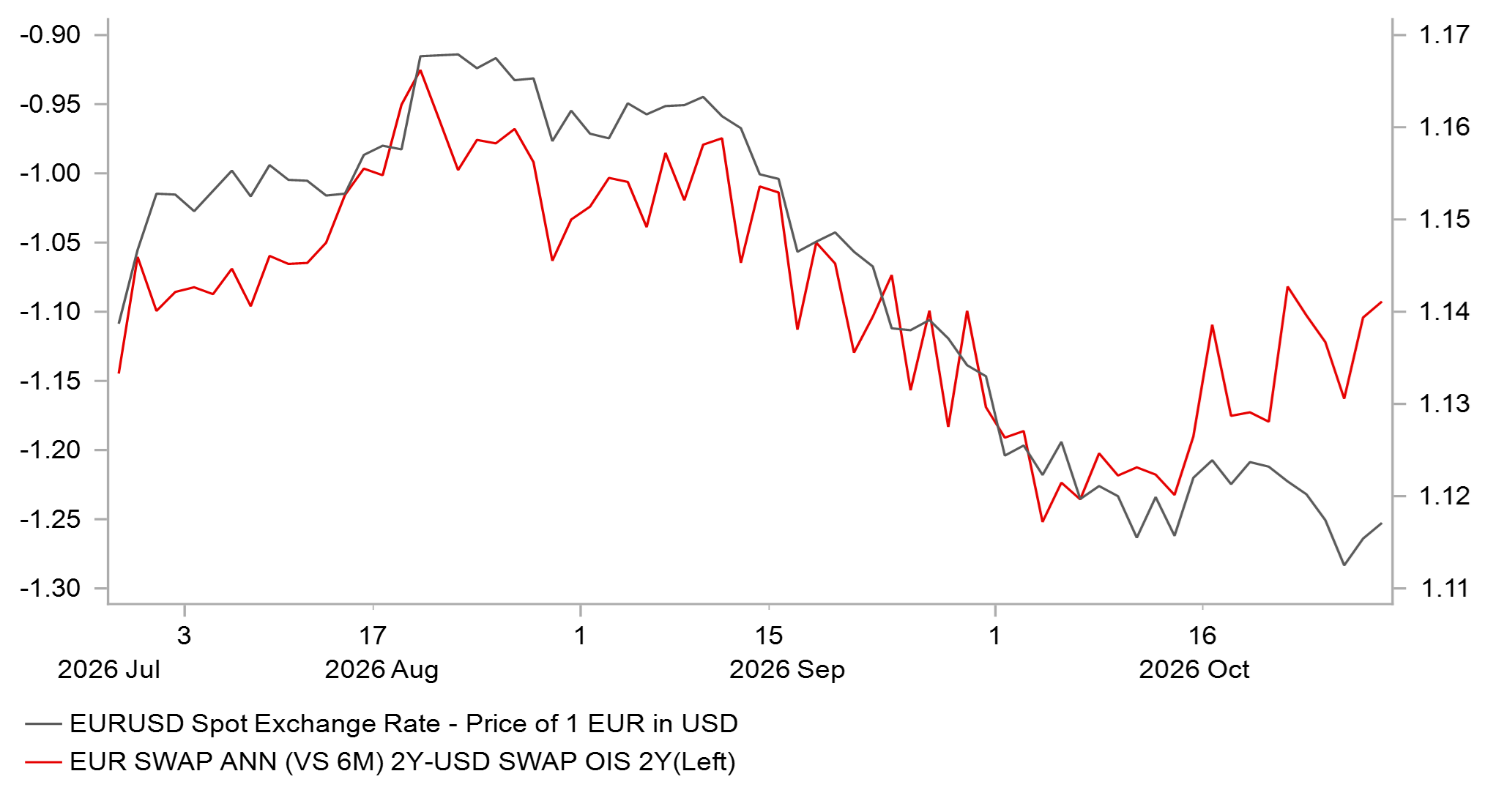
The EUR has strengthened modestly after today’s ECB policy update rising back up to 1.1170 against the USD. The pair initially fell when the policy statement was released hitting a low of 1.1105 after it referenced tighter financing conditions which are likely to weigh on inflation and growth. The statement also emphasized that underlying inflation has remained broadly stable so far and wages are not showing a material response at this stage. Together the comments indicated that the ECB would remain cautious over delivering further rate hikes. The unwanted tightening in financing conditions driven by higher government borrowing costs in the euro area helps to do some of the ECB work to bring inflation back to target without lifting the policy rate.
However, comments from President Lagarde in the press conference have since reiterated that further policy tightening remains likely in response to upside risks. She stated that the direction of travel for the policy rate is quite clear for all ECB officials unless there is a surprise. The comments have helped to provide some support for the EUR and are consistent with our forecast for another ECB hike by the end of this year in December while leaving the door open for a fourth hike to 3.00% in 2027. The ECB had indicated after the September policy meeting that the policy rate was likely to be raised into modestly restrictive territory which we assume remains appropriate.
President Lagarde did acknowledge that the cost of long-term financing had increased since September, but it was not yet sufficient to prevent further policy tightening. When asked about the sell-off in euro area government bonds, she emphasized that the ECB has the tools to address disruption to the transmission of monetary policy but did not go into further details over how and when their QT programme could be adjusted and/or the Transmission Protection Instrument (TPI) utilized. The reluctance to provide more details over the potential policy response at this stage is unlikely to offer much near-term support for euro area government bonds. The 10-year yield spread between France and German government bonds has remained above 150bps.
Government bond yields in the euro area at the short and long end of the curves have fallen at around the same time as today’s ECB policy update, but the move lower in yields was mainly driven by the sell-off in US AI-related stocks when the US equity market opened. Share prices for Caterpillar and Alphabet both opened sharply lower after disappointing earnings reports weighing on global bond yields. The renewed sell-off for US AI-related stocks could help to dampen USD strength against the EUR alongside the pullback in oil prices and the relatively cautious policy update from the Fed overnight (click here).
EUR IS TRADING AT DISCOUNT TO RATE SPREADS
Source: Bloomberg, Macrobond & MUFG GMR
ECB RATE HIKE EXPECTATIONS SCALED BACK
Source: Bloomberg, Macrobond & MUFG GMR