
The ECB is set to leave the deposit rate unchanged at 2.50% this week. While the energy backdrop has become more difficult since September, policymakers dialled back the sense of urgency following the rise in sovereign yields and broader tightening in financial conditions.
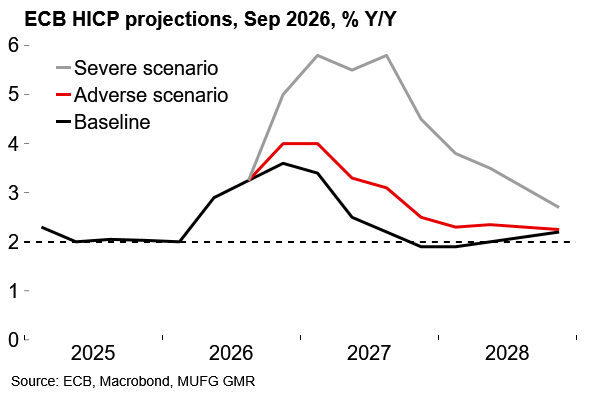
Oil and gas prices have moved sharply higher and are now tracking considerably above the assumptions used for the ECB’s adverse scenario, and headline HICP is set to move above 4% in coming months. For now, the domestic data flow remains generally benign in terms of second-round inflation effects with survey evidence still falling short of providing clear evidence that price pressures are broadening.
Looking ahead, we still expect a moderate degree of policy tightening, on a risk management basis. Our base case remains for a further 50bp of tightening, with the next move in December alongside the ECB’s updated projections. That said, we acknowledge somewhat lower conviction than a month ago following the tightening in financial conditions and renewed challenges to the growth resilience narrative.
Given the market backdrop, there will be a lot of focus on the press conference this week. Questions on France and sovereign spreads are inevitable. We expect Lagarde to stress that the Governing Council is monitoring financial conditions closely while stopping well short of any discussion of specific spread levels or intervention triggers. For now, the more important issue is whether, or to what extent, she frames the recent tightening in financial conditions as a direct substitute for policy action. Ultimately, we expect Lagarde will look to preserve plenty of flexibility amid heightened uncertainty but will be happy enough with market expectations for a December hike (currently ~20bp priced) given the inflation profile ahead.
Policy to be left unchanged after tighter financial conditions have reduced the need for urgency
No back-to-back move
Following the ECB’s hike at the last meeting in September we argued that there was little reason for policymakers to wait before pushing on into restrictive territory. Since then, the inflation backdrop has not improved. Oil and gas prices have moved sharply higher since September and are tracking above the ECB’s adverse scenario assumptions. However, policymakers dialled back the sense of urgency as sovereign yields rose sharply and financial conditions tightened. That started with comments from Lagarde at the European parliament hearing last month where she acknowledged that the sharp rise in long-term interest rates would "slow growth and reduce pass-through" (see here). We dropped our October hike call soon after and expect rates to remain unchanged this week. However, we still anticipate 50bp of further tightening, to a terminal rate of 3.00%.
Still waiting for second-round effects
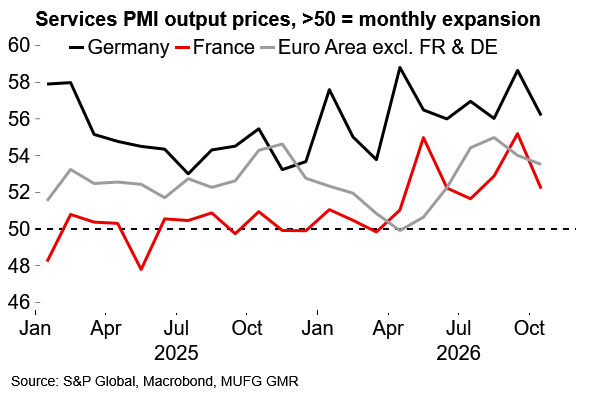
The domestic data flow has remained broadly benign in terms of second-round inflation effects. The price components of last week’s PMI showed a sharp acceleration in manufacturing input costs but this is not yet translating into a broad-based acceleration in selling prices – in fact, services sector output prices fell back in October. The ECB’s consumer survey showed medium and long-term household inflation expectations unchanged (although the year-ahead measure did edge up to 3.1%). Yesterday’s Q3 SAFE survey showed firms reporting higher inflation, wage and selling-price expectations, but the ECB included a strong caveat about a substantial change in the survey sample with first-time respondents providing a large share of answers. Accounting for that, the numbers are uncomfortable for policymakers, but still far from convincing evidence that second-round risks have risen materially.
The growth backdrop is also somewhat mixed. The ECB put out a blog highlighting the familiar theme of resilience. We believe that story remains valid despite financial conditions and the uptick in energy prices. The flash October PMIs softened, led unsurprisingly by France, but we stress that the French number is back in line with the August figure rather than anything more alarming (see here). Outside France, the German PMI release was somewhat constructive on manufacturing conditions, and yesterday’s German Ifo survey was another reminder that the broader resilience narrative remains intact, with the expectations component improving for a sixth consecutive month.
The ECB can afford to wait until December
So, the Governing Council faces a trickier set of signals to navigate than was the case a month ago. A pause here is reasonable. December looks a natural point for another hike with fresh projections which, unless energy prices reverse sharply in the meantime, will present a less comfortable inflation profile than in September. As noted above, both oil and gas pricing is now tracking above the ECB’s adverse scenario assumption in which oil prices increase to around 100 USD/barrel and gas prices to 75 EUR/MWh in Q4 (current spot: ~115 USD and 95 EUR respectively). Our commodities team continue to highlight tight physical market conditions. Headline euro area HICP is set to move above 4%, despite various national government support measures.
We therefore expect another 25bp hike before year-end, and another at the following projection meeting, taking total additional tightening to 50bp and pushing rates into moderately restrictive territory (i.e. 3.00% vs the ECB’s own 2.50% upper estimate of neutral). That seems like reasonable positioning to lean against risks of broadening price pressures. However, our conviction in the extent of further tightening is somewhat lower than a month ago given the tightening in financial conditions and still-limited survey evidence of second-round effects. Our argument has been that the ECB should tighten on a proactive/precautionary basis (and unpick moves later if second-round effects remain contained) but policymakers may start to feel that the window for such an approach is narrowing, especially if bond market conditions were to deteriorate further.
Focus on the Q&A
There will be considerable focus on any signals from the press conference. Questions on France, sovereign spreads and the ECB’s tools are inevitable, but we would be surprised if Lagarde were to offer much at all in terms of specific commentary at this stage. Current market developments, while uncomfortable, do not appear disorderly or unwarranted, and there’s little evidence of broader financial stress or fragmentation. We therefore expect references to remain general, with Lagarde likely to indicate that the Governing Council is monitoring financial conditions closely while avoiding discussion of specific spread levels or intervention triggers. We’d expect to hear something along the lines of the first responsibility resting with national fiscal authorities, not the central bank.
On monetary policy, Lagarde has already acknowledged that higher long-term rates will slow growth and reduce pass-through more than projected. To our minds, a continuation of this sort of messaging seems most likely with Lagarde acknowledging that financial conditions have tightened materially since September and that these developments form part of the Governing Council's assessment of the appropriate policy stance. But preserving optionality will remain the order of the day and we would be surprised if the president takes pricing for December out by giving any strong signal that market moves are a direct substitute for policy action. Currently ~20bp is priced.
Lagarde is also likely to face questions regarding her own future following continued speculation about a possible early departure. In the absence of any meaningful updates we suspect she will emphasise continuity and collective decision-making within the Governing Council. Still, it’s far from an ideal situation to have any uncertainty around leadership while the central bank grapples with tighter financial conditions, higher energy prices and more uncertainty around the broader macro outlook.
An uncomfortable inflation profile with energy prices now tracking above the ECB’s adverse scenario…
…but survey evidence is still showing limited signs of any broadening in price pressures