
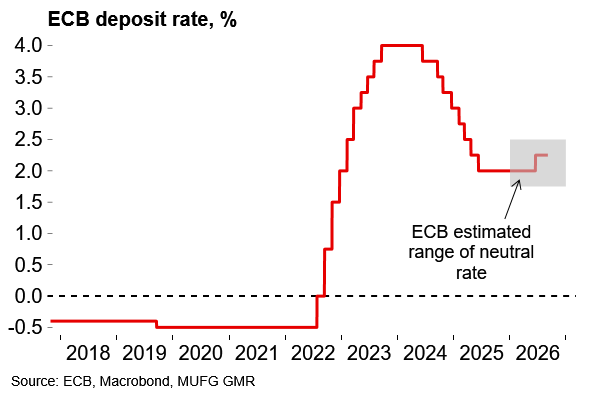
The ECB is set to raise the deposit rate to 2.50% this week, taking policy to the upper end of its estimated neutral range. The recent uptick in headline euro area inflation, alongside the energy market backdrop, has cemented the case for a September move. We expect it will be accompanied by little change in the ECB’s meeting-by-meeting guidance. While Lagarde is likely to stress vigilance in light of the energy backdrop, we expect her to remain non-committal on the future policy path.
The updated staff projections are likely to show a modest upgrade to growth relative to June. There could be a downward revision to headline inflation numbers after a Q2 undershoot – but the likely cut-off date means the projections will not capture the recent surge in gas prices or the global bond sell-off.
Looking ahead, we view the September hike as completing the ECB’s repositioning phase, leaving future decisions dependent on whether the energy shock feeds into broader domestic price pressures. For now, evidence of second-round effects remains limited, with underlying inflation metrics, wage indicators and survey evidence still looking benign. As such, our base case remains that the ECB has now completed its tightening cycle, although we acknowledge that the geopolitical backdrop leaves risks tilted towards an additional hike before year-end.
The deposit rate is set to be lifted to the upper end of the neutral range
After repositioning, the ECB moves into the next phase of its policy response
The ECB is set to raise the deposit rate by 25bp at this week’s meeting in Berlin, in line with expectations. After initially hiking in June, September seemed a likely juncture for the a follow-up move (see our take on the last meeting here). Any remaining doubt was extinguished by headline euro area inflation reaching 3.3% in August, the highest in almost three years, with the release coming against a backdrop of rising natural gas prices. A range of Governing Council officials have since endorsed a hike. Looking across recent activity data, policymakers will also be reassured that the economy has shown clear signs of resilience to the initial shock, with sentiment indicators suggesting that this trend has continued into H2.
In terms of messaging, the ECB is set to stick to its core meeting-by-meeting/data dependent guidance amid continued geopolitical uncertainty. We do not expect any material changes to the statement. But the natural gas market backdrop is plainly concerning. TTF has reached a three-year high, while storage levels are at a seasonal low. We expect Lagarde to continue stressing vigilance while remaining non-committal about the future policy path.
We do not expect major changes to the updated projections, but there will likely be better growth numbers compared to the June update. The inflation story is more complicated – the projected headline number could be revised down for 2026 after an undershoot of 0.2pp in Q2. The cut-off date for the technical assumptions is likely to be around 17 August and therefore will have preceded the recent uptick in natural gas prices, as well as the global bond sell-off, which means that these numbers will feel a bit stale on arrival. That reduces the salience of any update to the central scenario, although we assume that the ECB will again publish alternative scenarios with different energy assumptions.
Our base case remains that further tightening will be avoided
A hike this week will take rates to 2.50%, which is the ECB’s estimate of the upper end of neutral (see here). We view this hike as completing the first phase of the ECB’s response – a measured adjustment to be in a better position to react to any broadening of inflationary pressures. This approach has been consistent with Lagarde’s communication back in March: she stated that the optimal response to a supply shock is “not necessarily zero” and that it is difficult to communicate “a reaction function that does not react”.
Having reacted and repositioned – despite limited evidence of any broadening of inflation pressures – the Governing Council will now be more directly guided by incoming data and whether the energy shock is feeding into broader domestic price formation.
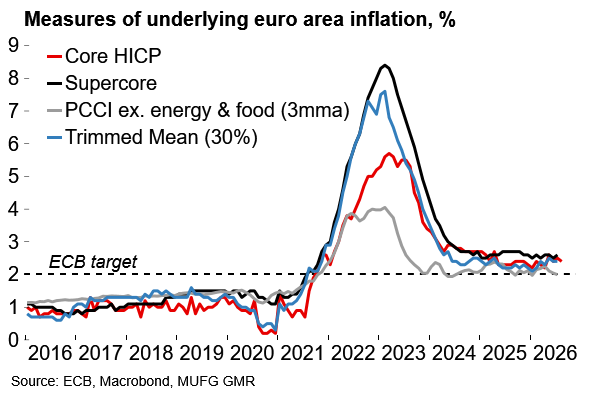
The rise in headline inflation in August was coupled with an easing in core inflation and a 0.3pp decline in services inflation. There was a rise in the core goods component, which could warrant greater attention if the trend continues in future releases. For now, an uptick in core goods can be interpreted as an indirect effect of the energy shock (e.g. through fuel) rather than any domestically-generated or second-round dynamics. Indeed, with what seemed like pointed timing, the HICP release was swiftly followed by a blog post (here) which emphasised that price pressures remain supply-side driven.
Of course, this could change and the hawks will continue to push for a more proactive response, especially while the US-Iran conflict remains unresolved. But the forward-looking survey data remains benign. The PMI services output price gauge has been stable since moderating in June, and household inflation expectations have eased. Wage growth indicators are essentially target-consistent. There are also a range of headwinds which could pose a challenge to the resilient growth narrative, such as the low level of the river Rhine and political uncertainty in France – see here.
Ultimately the economic data flow does not currently justify pushing rates into restrictive territory. At present, we do not see particular urgency to tighten further from the Governing Council as a whole, with no sign of any agreement to take a more pre-emptive stance. It’s worth noting that the ECB rejected characterising the June hike as an ‘insurance’ move. Another factor is the global rise in bond yields, which does some work for the ECB by tightening financial conditions. As such, while risks remain skewed towards an additional hike before year-end, our base case continues to be that the ECB will have completed its tightening cycle at this meeting. A sustained rise in TTF or evidence of increasing second-round effects would warrant a reassessment.
The ECB is set to lift rates to the upper end of neutral
Underlying inflation pressures remain contained