

Navigating the fallout for the FX market from bond market sell-off
Global bond yields have risen to fresh highs over the summer, driven mainly by higher energy prices & hawkish central bank repricing.
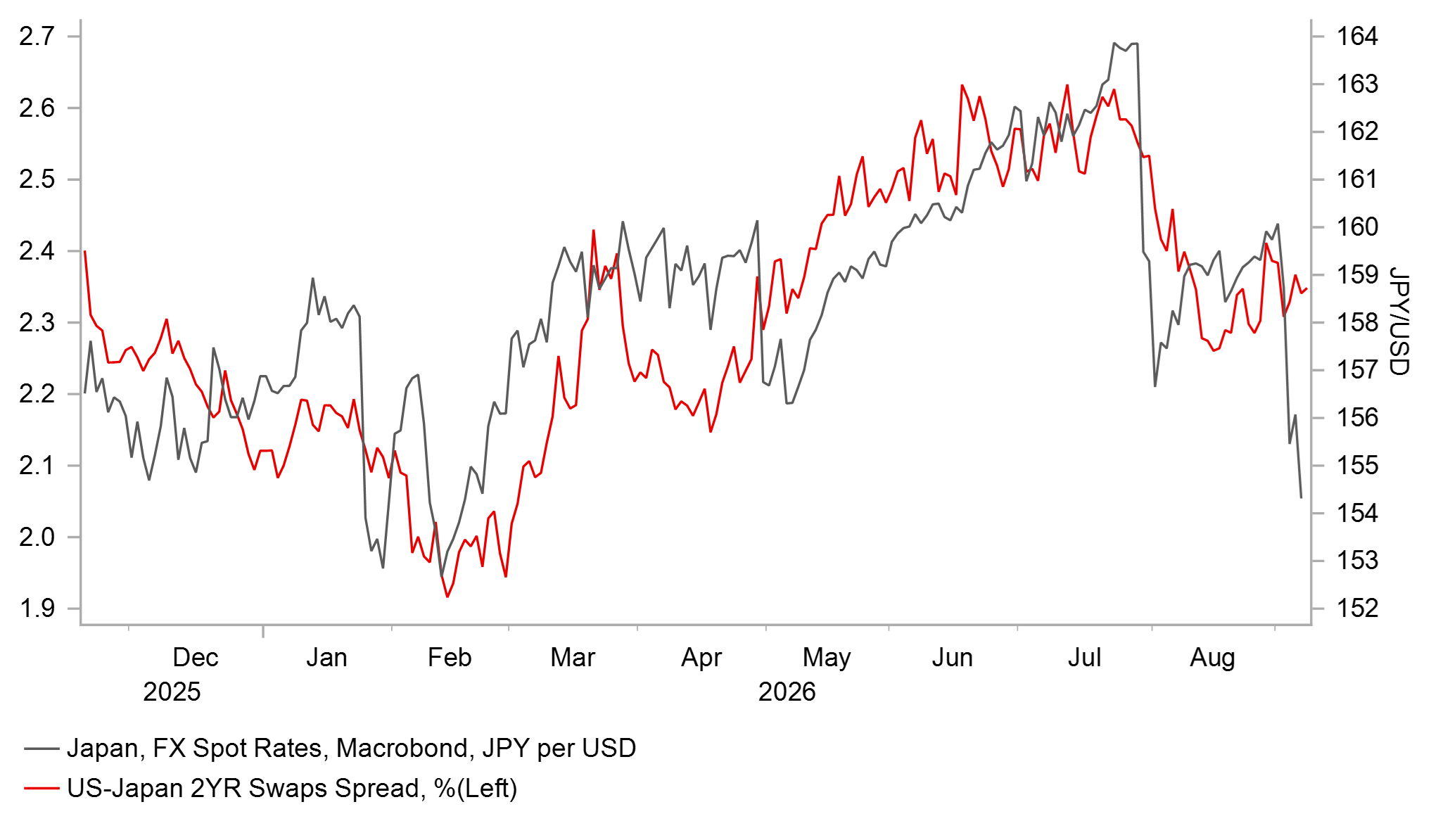
The JPY has strengthened as markets price faster BoJ hikes, helping to flatten the JGB curve and narrow yield differentials.
GPIF bond allocation speculation is also supporting JGBs and the JPY, although stronger buying has yet to appear in flow data.
US efforts to cap long-term Treasury yields have weighed on the USD, fuelling concerns over policy credibility and USD debasement risks.
Will recent JPY strength & USD weakness continue?
What has been lifting global bond yields?
Long-term government borrowing costs rise to multi-decade highs over the summer
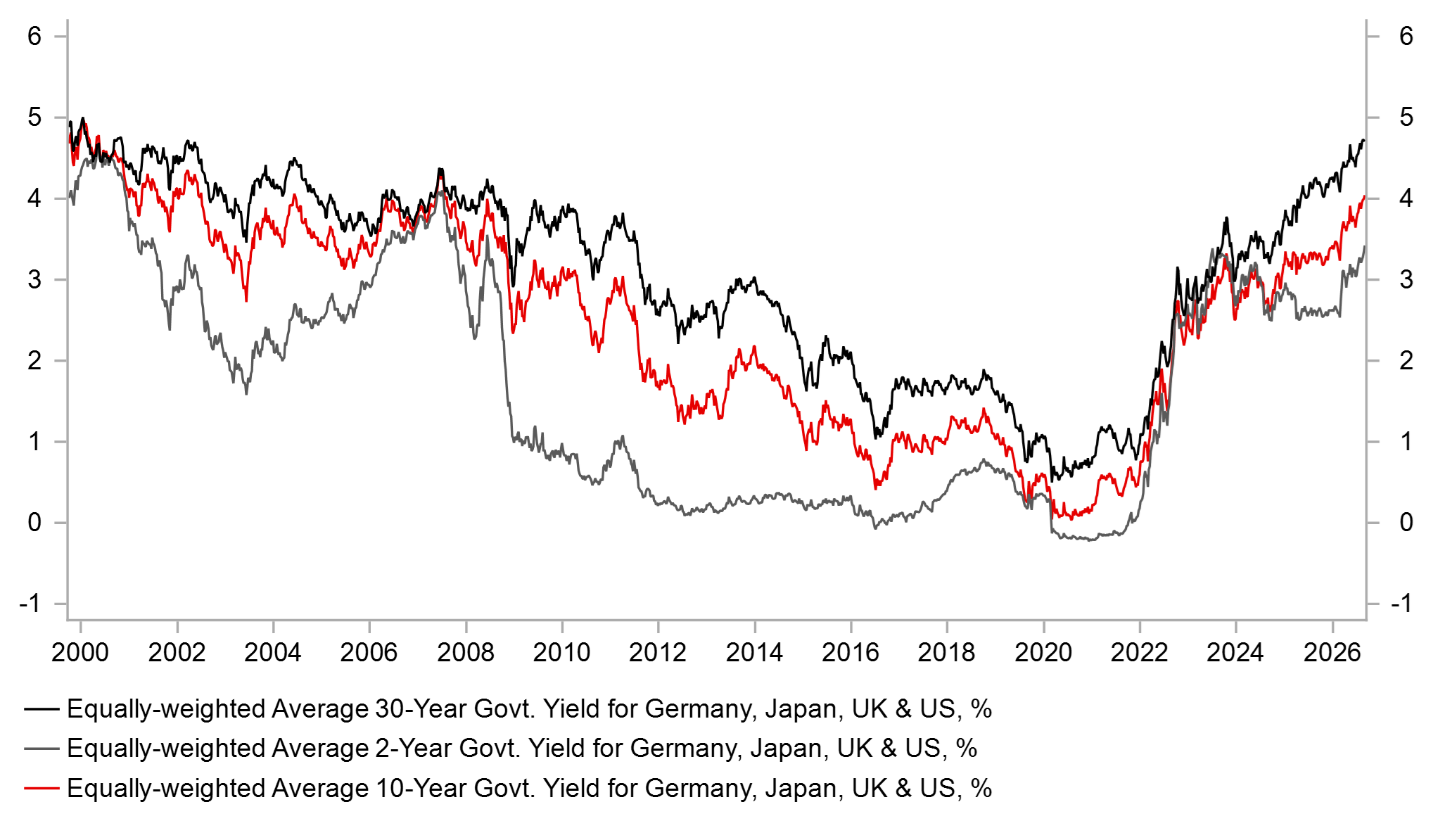
The ongoing sell-off in government bond markets has captured investor attention over the summer, particularly at the long end of the curve. Yields on 30-year government bonds in the euro area, Japan, the UK and the US have all risen to fresh multi-decade highs, fuelling concerns over the increasing cost of government borrowing. Bond yields have regained upward momentum over the past couple of months, coinciding with Brent crude oil bottoming at around USD70 per barrel in early July. Since then, Brent has climbed back to USD100 per barrel and is now almost 40% above its level prior to the US-Iran conflict. At the same time, European natural gas prices have risen to their highest levels since the conflict began, adding to upside risks for inflation.
RISING COST OF GOVERNMENT BORROWING
Source: Bloomberg, Macrobond & MUFG GMR
CHANGES IN GOVT. BOND YIELDS BY MATURITY
Source: Bloomberg, Macrobond & MUFG GMR
Hawkish repricing of central bank policy expectations lifting bond yields. Sharp flattening in JGB market stands out.
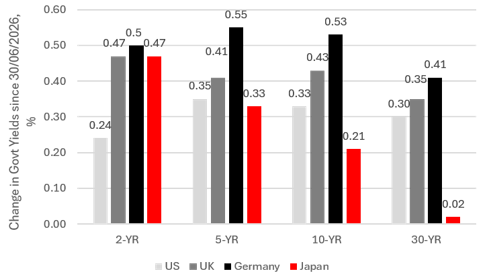
Looking at the performance of major government bond markets in Germany, Japan, the UK and the US since the end of June, several developments stand out. First, the hawkish repricing of central bank expectations has been a key driver of higher yields at both the short and long ends of the curve. Short-term yields have risen by more outside the US, reflecting expectations that the Fed will remain relatively cautious in tightening policy in response to higher energy prices.
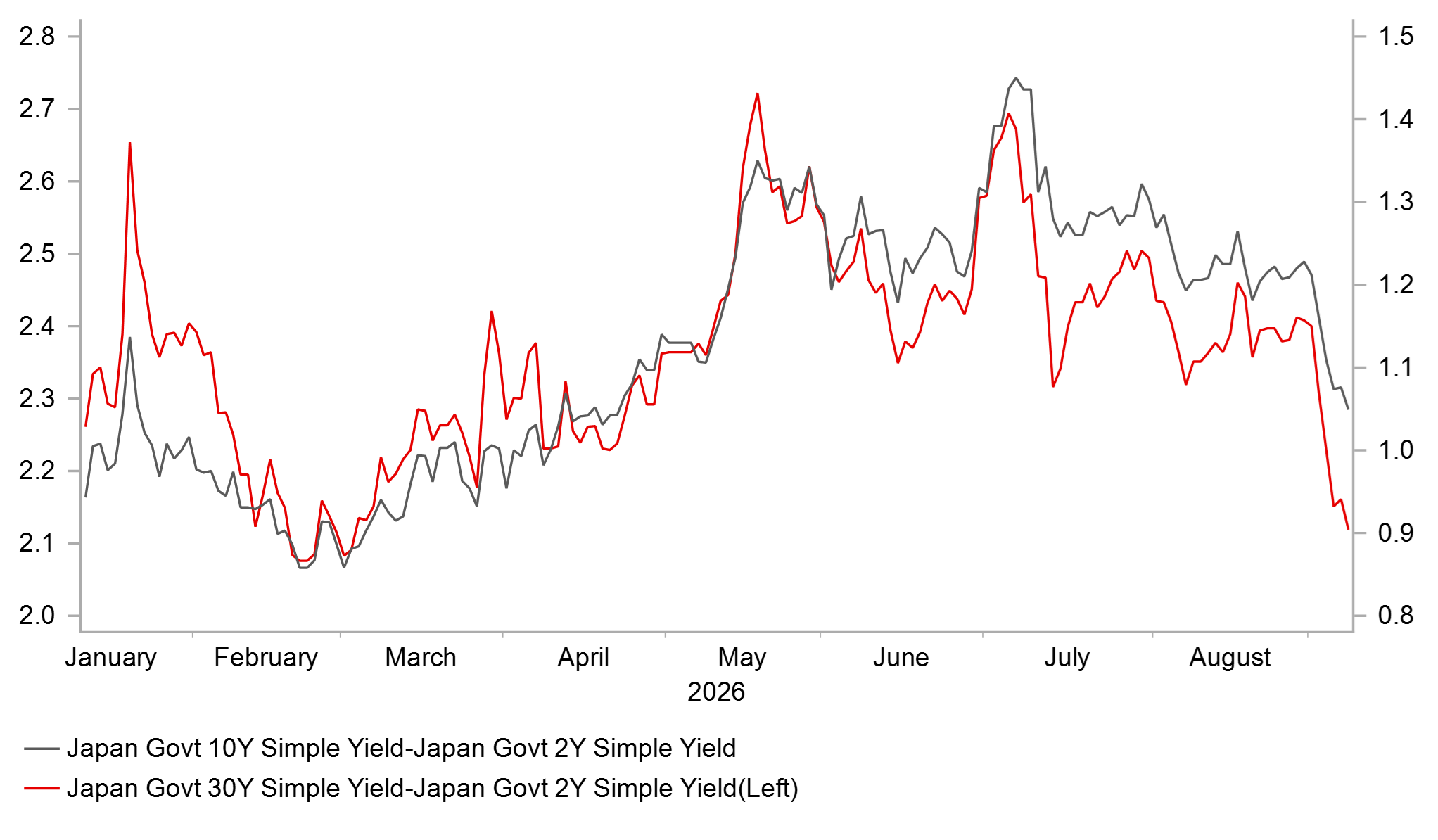
Second, the Japanese yield curve has flattened significantly as the long end has been much better anchored. While the 30-year JGB yield is little changed, the 2-year JGB yield has risen by almost 50bps. Government bond curves in Germany and the UK have also flattened, although to a lesser extent than in Japan, providing some reassurance that long-term bonds are holding up relatively well. Even so, European bond markets have experienced the sharpest sell-off over the summer, underscoring their greater sensitivity to rising energy prices. Natural gas prices have surged to their highest levels since the US-Iran conflict began, intensifying inflation concerns.
Third, long-term market-based measures of inflation expectations, such as 10-year breakeven rates, have moved higher alongside rising energy prices, although there is little evidence that inflation expectations have become unanchored.
Finally, real yields across the major government bond markets have consolidated at higher levels after moving higher in Q2. The resilience of the global economy in the face of the energy price shock has helped to support higher real yields. The build-out of AI (click here) has been helping to support demand and boosted investor optimism over the global growth outlook.
Faster BoJ hikes to provide more support for JPY & long-end of JGB curve
Joint US-Japan intervention to support JPY provided trigger for building expectations for faster BoJ hikes
Short-term yields have risen sharply in Japan over the summer, with hawkish repricing accelerating after the joint US-Japan intervention in late July to support the JPY. Since then, comments from both Japanese and US officials have fuelled speculation that an agreement was reached to accelerate the pace of BoJ tightening in order to reinforce support for the JPY from intervention. US Treasury Secretary Scott Bessent had previously expressed concern that the BoJ was behind the curve in tightening policy, contributing to JPY weakness. Those expectations were strengthened by comments he made overnight, stating: “I am the house now, so when we intervene with the Japanese yen, I have pretty good insight into what the Japanese, what the Bank of Japan is going to do, what Japanese policymakers are going to do.” As a result, the Japanese rates market has moved closer to our own forecasts, with investors increasingly pricing in another BoJ rate hike as soon as this month and a cumulative 75bps of tightening by the middle of next year.
JGB CURVE HAS FLATTENED SIGNIFICANTLY
Source: Bloomberg, Macrobond & MUFG GMR
NARROWING YIELD SPREADS SUPPORT JPY
Source: Bloomberg, Macrobond & MUFG GMR
Faster BoJ hikes to provide more support JPY and long-end of JGB curve as fears that the BoJ is behind the curve ease.
Growing investor confidence that the BoJ is set to accelerate the pace of policy tightening already appears to be helping to stabilise the long end of the JGB curve, and there are tentative signs that higher yields in Japan could mark a turning point for the JPY. The currency has strengthened sharply over the past week, driven by improving fundamentals rather than intervention-related gains. A decisive break below the 155.00 level, which previously held following intervention-driven JPY rallies in late April/early May and again in late July/early August, would reinforce market expectations for a more sustained JPY recovery. Such a move could pave the way for a sharper decline in USD/JPY, potentially towards 145.00 to 150.00.
Renewed speculation over potential for GPIF asset allocation shift providing support as well.
At the same time, long-dated JGBs and the JPY have been supported by renewed speculation that Japan’s Government Pension Investment Fund (GPIF) could increase its allocation to domestic bonds. The speculation gained momentum after confirmation that the GPIF’s management committee held an unusual meeting on 21st August, marking the first publicly announced meeting during a holiday month in seven years. According to media reports, the agenda included a presentation from a team responsible for operational matters such as asset allocation, despite the GPIF having concluded in March that a review of its portfolio was not required. The development has fuelled market expectations that the GPIF may be reconsidering its asset allocation strategy, providing support for both JGBs and the JPY.
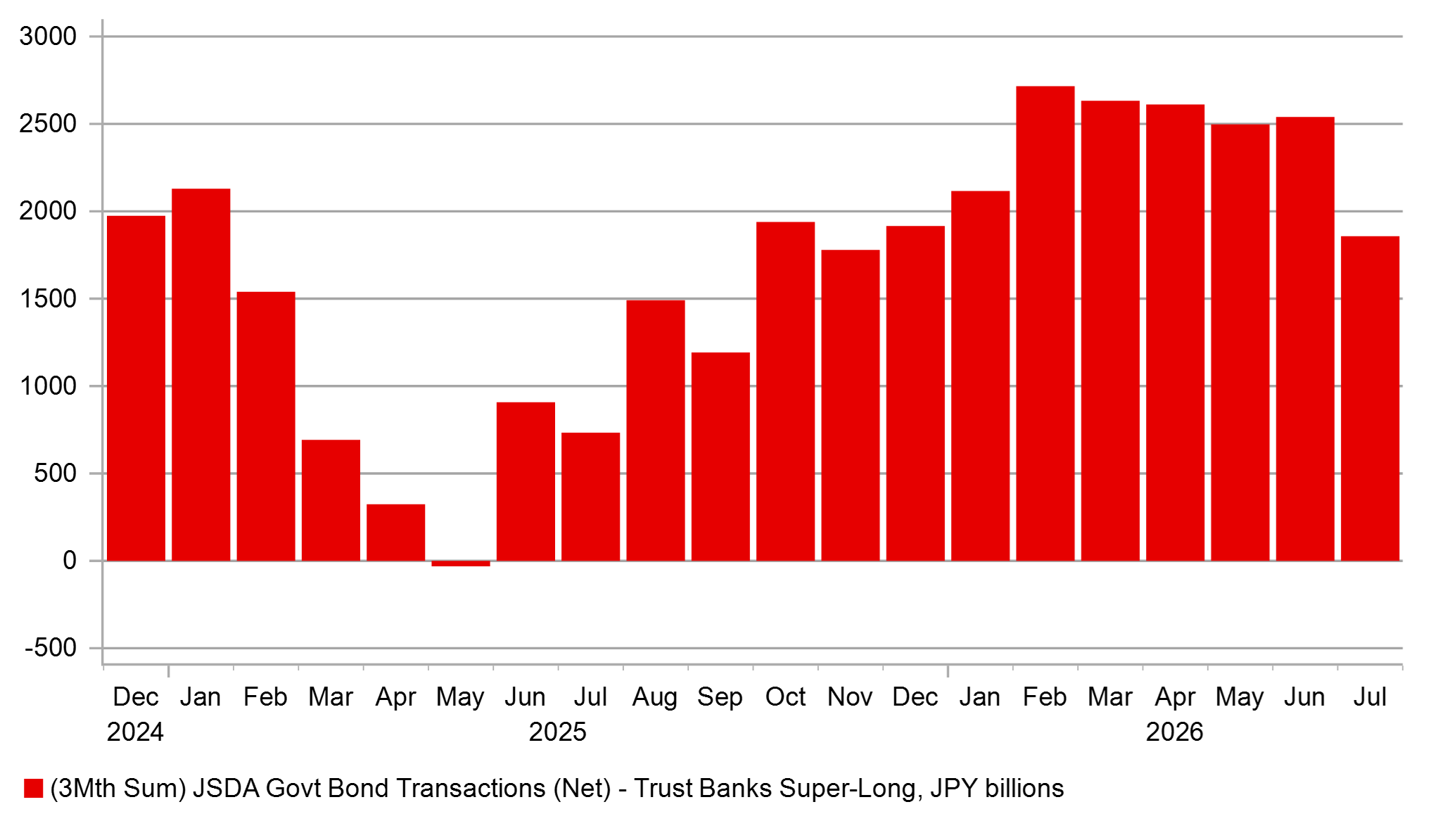
No evidence yet in monthly flows of pick-up in demand for JGBs from GPIF
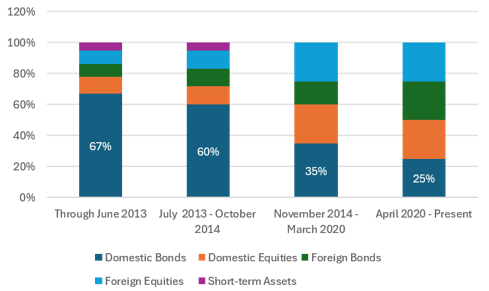
The speculation follows comments made in July by Japanese Prime Minister Takaichi and Finance Minister Katayama indicating that the government wants to encourage greater investment in Japanese financial assets by the GPIF and other public-sector funds. At the end of Q1 2026, the GPIF held 25.6% of its JPY320.4 trillion portfolio in domestic bonds and 24.5% in domestic equities, both close to their respective target allocations of 25% with a ±6% deviation band. While there has been no official confirmation that the GPIF will increase its allocation to domestic bonds, market participants will be closely monitoring the monthly JSDA investor flow data for any signs of stronger demand for JGBs. So far there has been no reported pick-up in demand from Trust Banks which is used as a proxy measure for GPIF transactions.
GPIF HAS SCALED BACK JGB ALLOCATION
Source: Bloomberg, GPIF & MUFG GMR
PROXY MEASURE FOR GPIF JGB PURCHASES
Source: Bloomberg, Macrobond & MUFG
US Treasury unease of rising long-term US yields weighs on USD
Joint intervention indicated US Treasury unease over rising US yields from Japan liquidating holdings
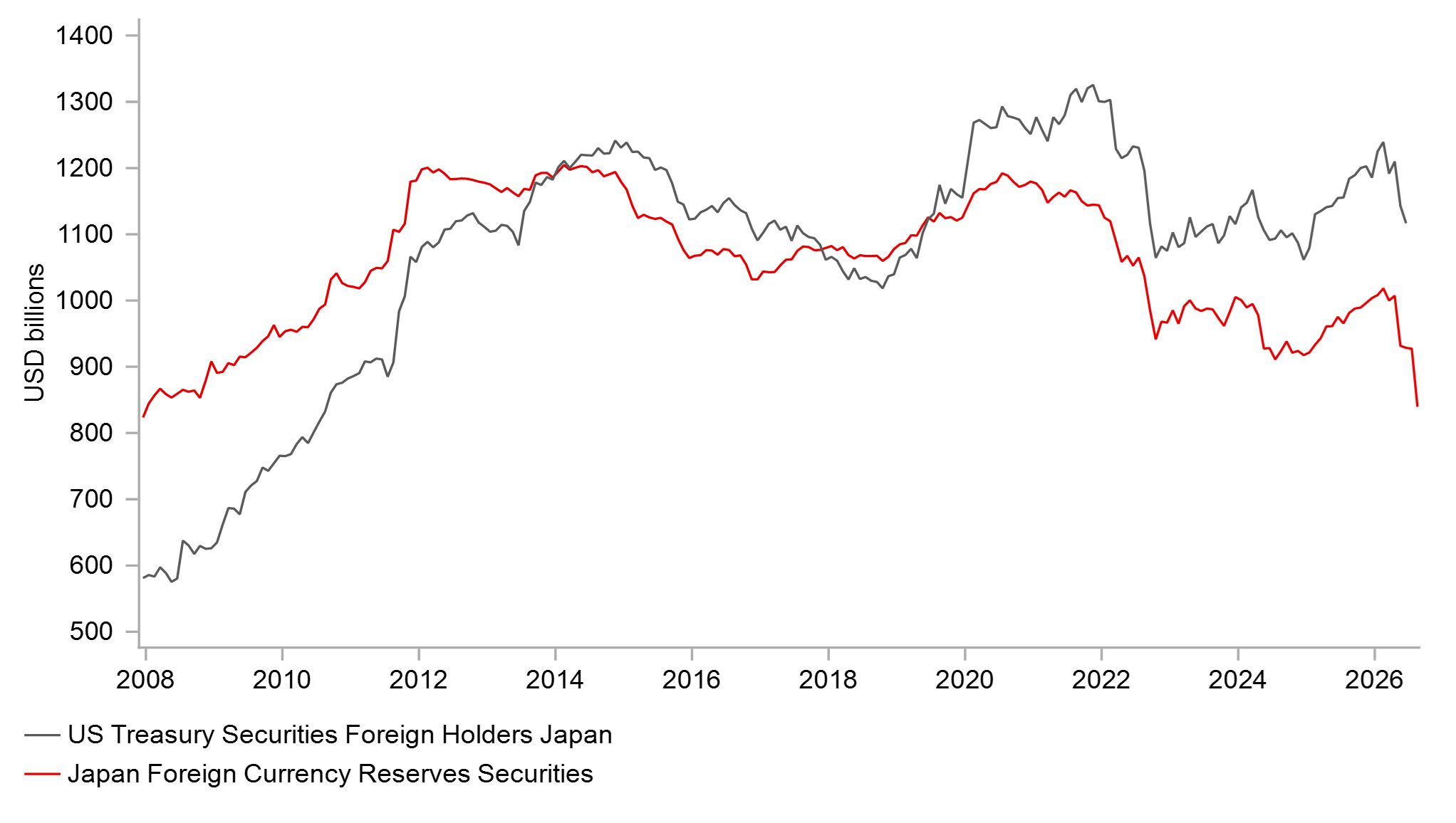
The US Treasury’s decision to intervene alongside Japan to support the JPY at the end of July was driven in part by concerns over potential spillovers into the US Treasury market. Japan’s latest FX reserve data, released this week, revealed that record intervention has been finance through the sale of foreign securities, including US Treasuries. The value of Japan’s foreign securities holdings fell by USD87.7 billion to USD839.6 billion in August, while foreign currency deposits declined by only USD6.9 billion to USD155.4 billion. The move coincided with record intervention by Japan totalling USD98.6 billion.
Since the start of the year, Japan’s foreign securities holdings have fallen by USD164.2 billion. Both US and Japanese policymakers will have hoped that joint intervention would send a stronger signal to markets that further JPY weakness would not be tolerated, thereby reducing the need for additional intervention and further sales of US Treasuries by Japan.
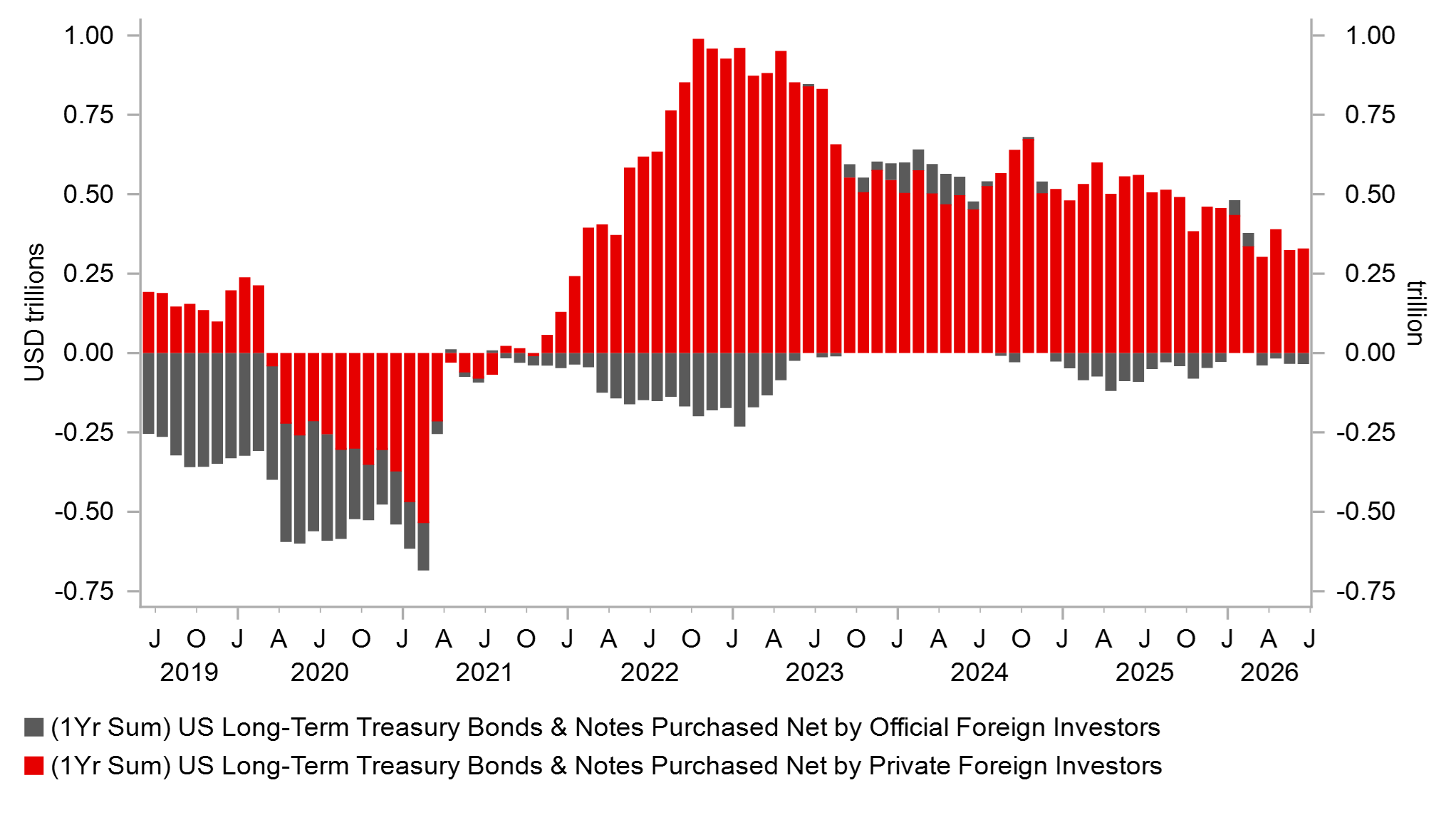
The latest US TIC data only covers the period through to the end of June, but it confirms that earlier intervention contributed to a decline in Japanese holdings (official & private) of US Treasuries. Between February and June, the value of those holdings fell by USD122.6 billion.
US opposition to Japan liquidating UST holdings could raise concerns amongst other FX reserve holders adding to risks for USD reserves.
At the same time, Japan announced alongside the confirmation of joint intervention that it intends to make use of the Fed’s Foreign and International Monetary Authorities (FIMA) Repo Facility in the future. The facility would allow Japan to obtain USD liquidity by temporarily repoing its US Treasury holdings with the Fed rather than selling those securities outright in the market. The Fed describes the facility as a backstop source of USD liquidity that can help reduce the need for disruptive Treasury sales during periods of market stress. This is one reason why the facility is deliberately priced above prevailing market funding rates.
If Japan were to utilise the facility, it would signal that preserving its Treasury holdings is viewed as more important than minimising funding costs. The US Treasury’s preference for Japan to retain its Treasury holdings may raise concerns among other FX reserve managers, who could perceive a risk of US opposition to significant reductions in their own Treasury portfolios.
More broadly, these developments could reduce the relative attractiveness of holding FX reserves in USD assets. If reserve managers believe that liquidating US Treasury holdings may become more politically sensitive, it could encourage greater diversification away from USD-denominated reserves over time.
JAPAN HAS BEEN SELLING USTS FOR INTERVENTION
Source: Bloomberg, GPIF & MUFG GMR
FOREIGN OFFICIAL SELLING OF USTS
Source: Bloomberg, Macrobond & MUFG
US Treasury’s extended bond buyback announcement for long-term debt viewed as a smaller version of Fed’ s ‘Operation Twist’ from 2011-2012
The US Treasury also signalled discomfort with rising long-term yields over the summer when it announced plans to increase the maximum size of bond buyback operations in the 10-20 year and 20-30 year maturity sectors from USD2 billion to at least USD4 billion per operation. The larger operations are scheduled to begin today and represent an expansion of the Treasury’s regular buyback programme, which was first launched in May 2024. While the Treasury stated that the change was intended to provide greater liquidity support for longer-dated securities, many market participants have interpreted the move as an attempt to dampen or cap long-term yields.
In that respect, it bears some resemblance to the Fed’s Operation Twist programme in 2011-12, under which the Fed bought longer-dated Treasuries and sold shorter-dated Treasuries in an effort to reduce long-term yields without expanding its balance sheet. The Fed initially announced purchases totalling USD400 billion through mid-2012 before extending the programme by a further USD267 billion through to the end of 2012. However, the Treasury’s expanded buyback programme is much smaller in scale than Operation Twist. Between August and November, the Treasury has scheduled five buyback operations in the 10Y-20Y sector and four in the 20Y-30Y sector. If all nine operations had been conducted at the higher USD4 billion limit, total purchases would have increased from USD18 billion to USD36 billion per quarter. Two of those operations had already been completed in August at USD2 billion.
Bigger bond buybacks are dwarfed in size by US debt issuance limiting ability to dampen yields
The US Treasury’s latest quarterly refunding statement revealed plans to issue USD231 billion of 10Y-30Y Treasury securities between August and November, broadly in line with issuance in the previous quarter. This highlights the challenge facing the Treasury in its efforts to dampen long-term yields, as even the expanded bond buyback programme, worth up to USD36 billion per quarter, is dwarfed by the scale of new issuance. Treasury Secretary Scott Bessent acknowledged this limitation overnight, stating: “I don’t believe that I can change the equilibrium price. But nothing’s ever in equilibrium.” Instead, he explained that the decision to double the size of bond buybacks was intended to help “push yields back towards equilibrium”. Bessent expressed concern that long-term yields risked overshooting to the upside during the summer amid what he described as a “fever” in the bond market. While the Treasury’s ability to materially lower long-term yields appears limited, the announcement may have helped to stabilise market sentiment. Since the buyback expansion was unveiled, the 30-year Treasury yield has been consolidating at higher levels.
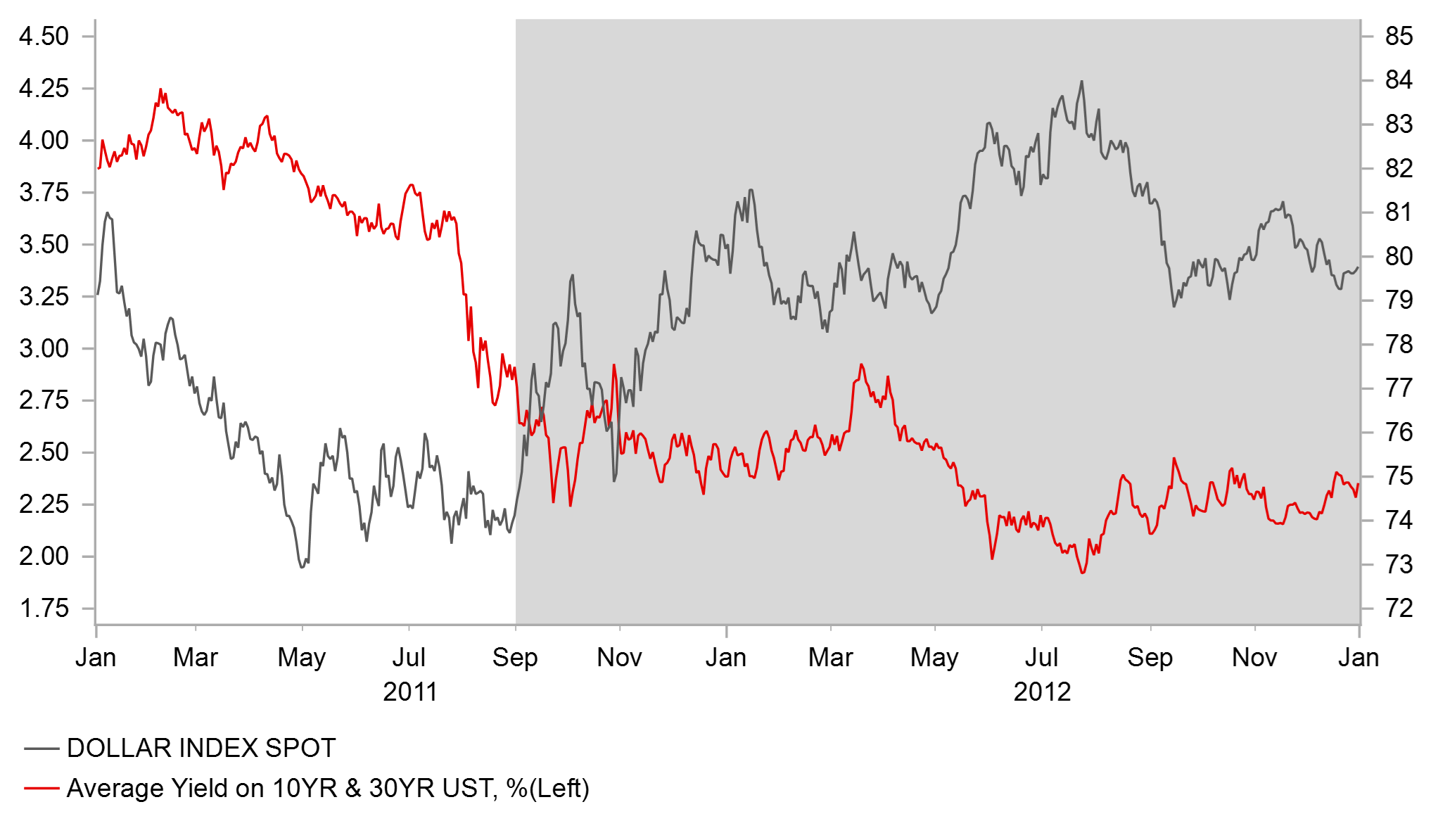
OPERATION TWIST DID NOT PREVENT STRONGER USD
Source: Bloomberg, Macrobond & MUFG GMR
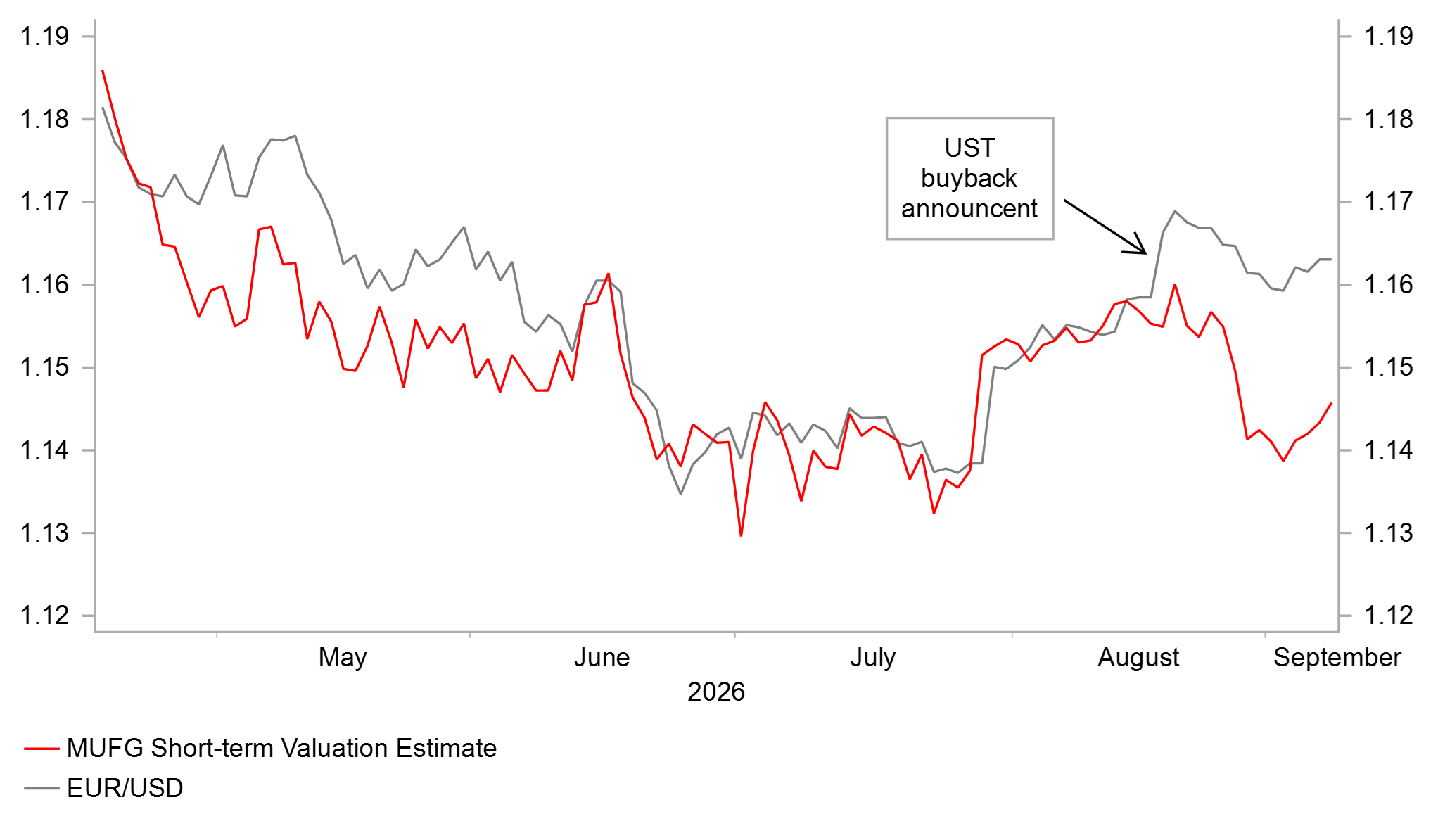
PRICING IN HIGHER US POLICY RISK PREMIUM?
Source: Bloomberg, Macrobond & MUFG GMR
US Treasury plans to lower/cap US yields have undermined confidence in USD alongside rising inflation risks. The performance of the USD during ‘Operation Twist’ highlights that other factors can be more important drivers
While the announcement may have provided some support for long-term US Treasuries, it has undermined confidence in the USD. The dollar index remains around 1% lower since the Treasury’s bond buyback announcement on 19th August, despite short-term fundamentals moving in favour of a stronger dollar. Higher energy prices and the hawkish repricing of Fed rate expectations following Fed Chair Kevin Warsh’s Jackson Hole speech have helped lift the 2-year Treasury yield by almost 25bps.
As a result, EUR/USD has diverged from our short-term fair value estimate by around 1.5%, suggesting that market participants have moved to price in a higher US policy risk premium into the USD. The Treasury’s efforts to contain long-term yields at a time when inflation expectations are rising have reignited concerns over potential USD debasement (click here).
Looking back at how financial markets responded to the Fed’s Operation Twist programme, we can see that lower long-term US yields did not prevent the USD from strengthening. Between September 2011 and December 2012, the dollar index rose by around 8%, encouraged by the worsening euro-zone sovereign debt crisis that undermined confidence in the EUR. Similarly, a further deterioration in the current energy price shock could still ultimately boost demand for the USD.
Fed policy action to address rising inflation risks could help to quickly restore confidence in USD. Downside risks for USD would increase the longer the Fed leaves rates on hold.
One way for US policymakers to quickly restore confidence in the USD would be for the Fed to act this month to address growing concerns over upside inflation risks. If the Fed begins raising rates and signals that further tightening is likely, it will provide additional support for the USD and could help reverse the recent sell-off. The US rates market is already pricing in two to three rate hikes over the year ahead, meaning the Fed would need to convince investors that any initial move is part of a broader tightening cycle rather than a one-off adjustment.
In contrast, if the Fed leaves rates unchanged or signals that policy tightening will be modest, it could raise doubts over the Fed’s commitment to fight inflation under new Chair Kevin Warsh. Such an outcome would likely continue to weigh on both the USD and long-term US Treasuries. In that sense, a rate hike could be viewed positively by markets if it helps reinforce the Fed’s inflation-fighting credibility thereby reducing upward pressure on long-term yields.
Our current forecasts (click here) for a weaker USD are based on the assumption that the Fed will remain relatively cautious in tightening policy. However, the risks to that outlook will increase to the upside if the Fed embarks on a more prolonged tightening cycle over the next 6 to 12 months.