

BoE Review: Watchful but unhurried
Macro view: The BoE left rates unchanged at 3.75%, as expected. The 6-3 vote split was tighter than anticipated with Mann joining the dissenters in pushing for a hike. That hawkish shift was more than diluted by messaging highlighting the strength of domestic disinflation. Across the MPC we see some daylight between the 3 dissenters and the rest and remain comfortable with our call for an extended hold. The bar for a September hike looks a bit higher after today. Further ahead, we believe that second-round effects will ultimately remain contained given the soft macro backdrop. But the BoE will continue to watch for broader pass-through in the survey data, while the argument for pre-emptive tightening will strengthen with each new escalation in the Middle East.
Markets view: The rates market reaction to today’s BoE announcement has been relatively modest – the 2-year Gilt yield is down about 3bps. There was no notable fresh news and nothing today provides a justification for changing our view that the rates market as overpriced for what the BoE delivers. The 2-year yield is 60bps above the official bank rate and given the description of domestic economic conditions, numerous rate hikes being delivered is unlikely. Yields will ultimately fall back and that is a factor in our view of pound depreciation. The pound gain today was more versus the US dollar but going forward see the retracement of market rates as the catalyst for a move higher in EUR/GBP.
Macro view: The BoE currently places more weight on domestic disinflation than geopolitical re-escalation
A tighter vote comes with dovish messaging
The Bank of England held Bank Rate at 3.75% at its July meeting, in line with expectations, and the core guidance of vigilance in the summary was maintained (i.e. “The Committee stands ready to act as necessary”). The 6-3 vote split was tighter than both we and the consensus expected. But the overall tone from the meeting is dovish. The BoE has weighed up domestic disinflation against recent re-escalation in the Middle East and decided that, for now at least, there is no urgency to tighten policy. The bar for a September hike seems higher than it did coming into the meeting.
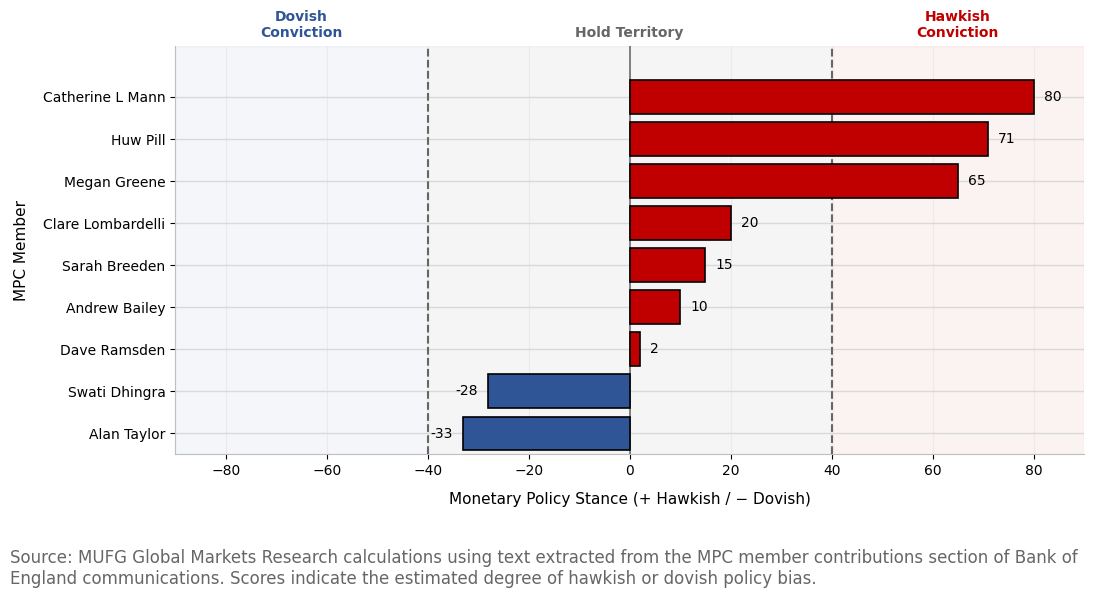
On the vote split, it was Mann who joined Pill and Greene in voting for a hike, citing the collapse of the US-Iran MoU and broadening of the Middle East conflict as the key change. But Mann dissenting hawkishly is never a great surprise, as we flagged in our preview (see here: Active hold, active debate). Crucially, there seems to be some daylight between the three dissenters and the rest. There was no indication from any of the other MPC members that they had considered the possibility of a hike at this meeting. Lombardelli, who we thought most likely after Mann to shift her vote, said that “it wasn’t a close judgement” in the Q&A.
There was some further clarity from Governor Bailey, who will always be the key swing voter on a divided MPC. He pushed back on the suggestion that tightening is likely. Specifically, he endorsed the consensus view in the MaPS survey which is that an extended hold is most likely, saying: “market participants find it most likely that Bank Rate will remain at its current level throughout this year while investors, quite reasonably, require a premium to compensate for the risk that Bank Rate may have to go up should inflationary pressure from the energy shock prove to be more persistent.” He added “That seems a reasonable position for now” and said to journalists that it is not reasonable to assume that the BoE is edging towards a hike. This is not a Governor who is working to tee up a September move.
The BoE sees inflation returning to target by end-2027 in its central forecast
Our hawk/dove sentiment analysis suggests some daylight between the 3 hawks and the rest
An extended hold remains our base case
Bailey’s apparent endorsement of the consensus tallies with our view that an extended hold is most likely after we dropped our call for 50bp of front-loaded tightening in June (see BoE review – A higher bar for action). As we see it, the hawks lost the argument for an insurance hike and the domestic data flow has continued to be soft in a weak-ish growth environment. Domestic inflation pressures have eased, as the BoE stressed today (e.g. “The Committee agreed that there had been little evidence of material second-round effects so far.”)
But the BoE will remain watchful. Table A in the MPR highlights the sorts of ‘monitoring indicators for second-round effects’ the BoE will focus on: mostly survey measures on price and wage expectations, e.g. from the DMP. Our assumption is that hawkish signals from these will remain contained given a relatively soft domestic growth and labour market backdrop.
For now, the burden of proof will remain on this domestic data but we assume that there is a point at which energy developments would bring an insurance hike back into play – indeed Bailey said “If the conflict in the Middle East persists for an extended period, it’s likely that we will have to tighten policy”. A cycle of sporadic Middle East re-escalation and then retracement probably doesn’t cut it, at least for September. An absence of credible de-escalation by Q4 coupled with a general trend towards higher energy pricing would likely be enough to nudge wavering MPC members towards pre-emptive action. By the autumn the MPC will also have more visibility on annual pay settlements for 2027, as well as Burnham’s policy platform, which adds to the case for patience for now.
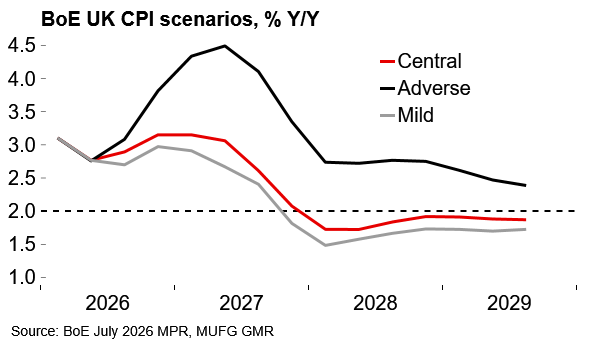
Lastly, the meeting was also accompanied by the BoE’s quarterly MPR projections. As expected, the MPC returned to a central forecast, presented alongside risk scenarios (echoing the ECB with “Adverse” and “Mild”). In the main forecast, the BoE sees headline inflation returning to target by Q1 2028 (see chart above), which is consistent with what was presented in April. The numbers are somewhat stale on arrival given that the energy price assumptions are conditioned on gas and oil futures in the 15 working days to 20 July, which doesn’t capture recent moves.
On the near-term CPI peak, the BoE sees headline inflation peaking at around 3.2%. That is in line with the message from the June meeting. However, we see a good chance of a reassessment at the next meeting – we track a peak closer to 3.5% on current energy pricing. If that is valid by the time of the next meeting it would bolster the hawkish argument about risks of structural shifts in expectations. But the bottom line is that swing voters will focus on energy developments and domestic data. If energy risks subside and second-round risks remain contained then an extended hold remains the most likely outcome.
Markets view: Limited FX & Rates impact
Domestic disinflation risks vs international inflation risks
The financial market impact to today’s BoE policy announcement has been modest – the 2-year Gilt yield is down about 5bps at 4.34% with not a lot of fresh news to focus on. The 6-3 vote was always a possibility given Catherine Mann’s known hawkish leaning and with the re-escalation of the conflict that was an obvious risk. Reading all nine individual views on the policy stance and outlook there was a clear consistency in each member needing to make a judgement between the relatively weak domestic conditions and the positive disinflation backdrop, and the elevated inflation risks relating to the conflict in the Middle East. Six members leaned more on the domestic economic backdrop, three leaned on the international inflation risks.
With that in mind, is the rates market accurately priced? We think not and the BoE’s communication in our view underlines the fact that the UK rates curve is mispriced. Most of the descriptions of domestic economic conditions appeared to us to highlight diminishing inflation risks and helps explain the drop in front-end yields. Two to three rate hikes do not appear very likely given the MPC members updated description of domestic economic conditions. The 2-year Gilt yield is trading a little over 60bps above the key policy rate, which looks over done to us. Yes, the curve should incorporate a risk related to energy inflation and geopolitics, but it is hard to envisage a need for the MPC hiking 2-3 times over the next 10mths.
FX reaction has also been muted given the modest move in rates but the FX market also has the fallout from the FOMC meeting last night to contend with. Fed credibility is in question after more tough talking from Fed Chair Warsh combined with no explanation why action wasn’t taken. That’s helping support the pound versus the US dollar today. But the lack of any notable fresh information today is reflected in the unchanged EUR/GBP rate.
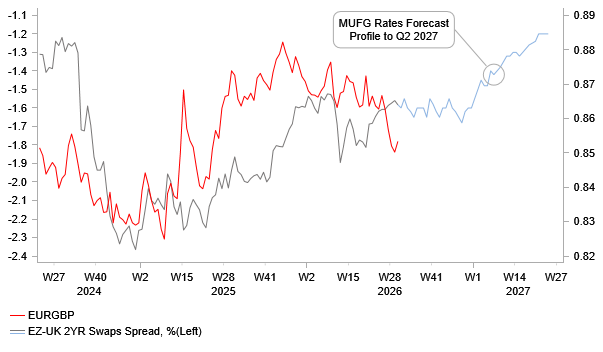
Going forward, based on our view that the UK rates curve is overpriced for BoE tightening, we still see downside scope for the pound with EUR/GBP set to rebound back to the 0.8900-level as the BoE remains sidelined. If we are wrong and say the US-Iran conflict drags on longer and energy inflation feed-through forces the BoE to hike, we doubt that would necessarily be currency positive. The description of the UK economy is certainly not aligned with the need for monetary tightening, and a rate hike could therefore reinforce weak economic conditions and prove counter-productive for the pound. It’s also worth adding that favourable financial market conditions (low volatility) tends to be pound supportive (current account deficit funding is less onerous) and if G4 yields continue to drift higher there is a danger of a turn higher in volatility as asset valuations become more stretched in a higher yield environment. That too would be a scenario in which the pound would underperform.
MUFG's current 2-year yield forecasts (BoE on hold) consistent with higher EUR/GBP
Source: Bloomberg, Macrobond & MUFG GMR