

The BoE is set to hold Bank Rate at 3.75% this week, with the 7-2 vote split from June likely to be repeated. We expect the guidance to remain largely unchanged with an emphasis that policymakers “stand ready to act as necessary”. The most likely outcome is a repeat of the previous 7-2 vote split with Pill and Greene again backing a hike. We will also be watching the fresh quarterly projections for the expected CPI peak and the speed of the anticipated return to target.
Our base case remains an extended hold. While renewed US-Iran tensions and higher energy prices have increased the argument for an insurance hike, we continue to see domestic conditions as inconsistent with further tightening. Inflation is well below the BoE’s April projections, wage growth is subdued, and there is little evidence of second-round inflation effects in surveys or expectations data.
We do, however, see September as a live meeting if energy market volatility persists, but the MPC may prefer to wait for greater visibility around (i) annual pay settlements for 2027 and (ii) the broader policy backdrop under the UK’s new PM.
On hold, unchanged vote split
The BoE is set to hold Bank Rate at 3.75% at this week’s meeting as domestic inflation pressures still look contained despite the volatile energy price backdrop. The current guidance, which is limited and non-committal but has a tightening bias (e.g. the MPC “stands ready to act as necessary”) is likely to be left unchanged.
We expect a repeat of the 7-2 vote split from the previous meeting, with Huw Pill and Megan Greene again dissenting in favour of a hike. Catherine Mann, who is most likely to move over to the hike camp, has signalled a willingness to support an “activist” hike if inflation expectations and wage settlement data deteriorate. Under that framework we don’t see the data supporting a hike at this juncture, unless she shifts her focus to spot energy developments.
Energy markets – turbulent but not decisive amid soft domestic data
It has certainly been a turbulent ride for energy since June. Brent was trading at ~80 USD/bbl at the time of the last BoE meeting. After slipping back to 70 on US-Iran progress and then reversing sharply to 100 as the ceasefire collapsed, it has since pulled back below 90 USD/bbl at the time of writing. That’s around 10% above where it was on the day of the June meeting. UK NBP natural gas, meanwhile, is currently almost 50% above the June meeting level.
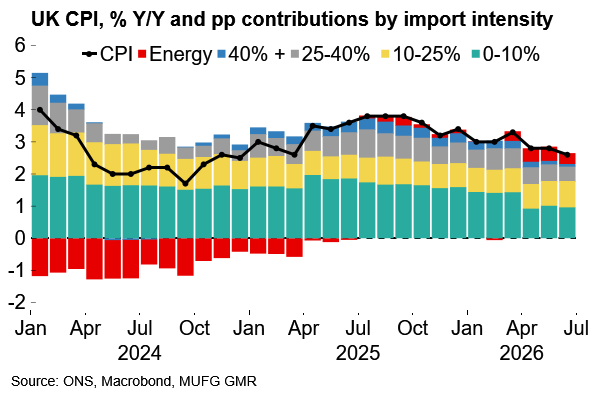
The BoE will not want to pre-commit to anything against that backdrop. Instead, we expect talk of ‘vigilance’ and a somewhat hawkish tone. But developments are not severe enough to alter the near-term outlook. The hawks essentially lost the argument for proactive tightening after a string of dovish domestic data followed the initial energy shock, and the data flow remains soft. After another downside surprise in June, headline inflation is 0.5pp below the BoE’s April projection.
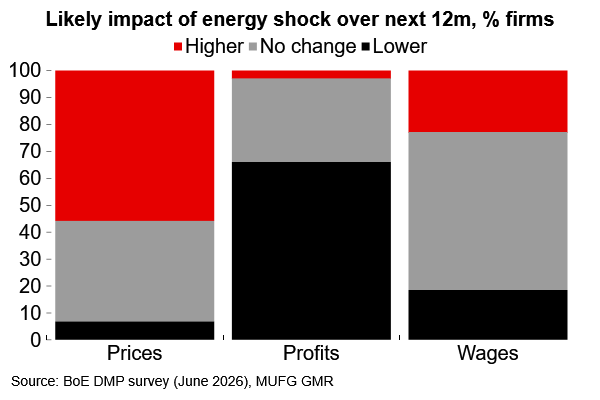
Meanwhile, the labour market continues to show plenty of signs of slack. Private sector regular pay growth, at 2.9% Y/Y in the latest release, looks consistent with slightly sub-target inflation. More significantly, there has been scant evidence of any indirect or second-round inflation effects. Looking across survey data such as the BoE’s DMP figures, the Agents survey, PMIs and household inflation expectations, there is essentially nothing which is ringing any alarm bells.
Domestically-generated inflation continues to ease
Survey evidence points to contained second round risks
Our call remains an extended hold
It is on the basis of this data flow that we dropped our call for 50bp of pre-emptive tightening this year in June (BoE Review – A higher bar for action). Instead, we see the BoE continuing to lean on the ‘active hold’ – that is, that the absence of expected cuts is itself a tightening relative to the pre-war baseline. Bailey said earlier this month that before the conflict it was “not unreasonable” to expect 50bp of easing.
We are admittedly less comfortable with our call following renewed US-Iran escalation. The argument for an insurance hike would re-emerge, we think, if energy pricing became consistent with headline inflation moving to ~4% or higher (on our current tracking, we see headline inflation peaking around 3.5% in the autumn). Around that point, concerns of non-linear effects on price- and wage-setting behaviour would certainly increase. But there is a case that protracted volatility in energy prices may lower that threshold and weaken anchoring even if price levels do not shift drastically higher.
Is September in play?
It’s this line of reasoning that would likely be used to justify a hike in September (~14bp priced). In the absence of greater focus on energy market dynamics, the MPC might still struggle to find the figures to justify a data-dependent move. There is a chance that a move in September would have to be underpinned by cherry-picking the sorts of data which were ultimately looked through earlier this year, such as rising PMI output prices or household inflation expectations.
If the BoE is minded to hike to lean more clearly against risks, then we see reasons for waiting until closer to year-end (i.e. the November or December meeting). These include having greater visibility on (i) likely 2027 annual pay awards and (ii) Burnham’s policy platform. On the latter, the BoE would certainly be sensitive to any regulatory changes introduced around the Budget that might reinforce domestic inflationary pressures.
Quarterly forecasts – what to watch
Thursday’s meeting will also be accompanied by fresh quarterly forecasts. Given extreme uncertainty the BoE presented three scenarios in April rather than a central forecast. Our assumption is that the BoE will now return to a central forecast while also presenting some risk scenarios. Abandoning the scenario framework could provide a signal that the MPC has greater conviction on the inflation path. Whether that is hawkish or dovish depends on where the central forecast lands relative to the April scenarios.
Looking at the numbers, current energy pricing is around the Scenario B assumptions, but domestic inflation dynamics look closer to Scenario A (i.e. minimal pass-through). In April inflation was projected to return to target in Q4 2027 and Q1 2028 for A and B respectively. If this path is broadly maintained it would be supportive of our call for an extended hold.
We will also watch the expected near-term peak for CPI. In June the BoE noted it expected inflation to “pick up to a little over 3¼% in Q4”. As mentioned above, we are tracking a little above that. The higher the peak, the stronger the hawkish argument about risks of structural shifts in expectations.