

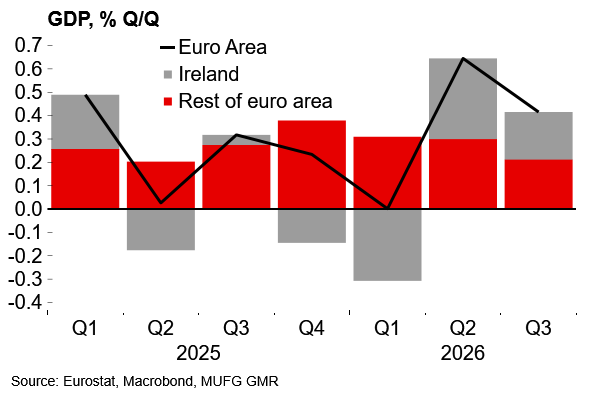
Macro focus – The first signals from the ECB's "mine of information”: Yesterday the ECB placed significant emphasis on the incoming flow of data ahead of the December meeting. Today’s flurry of releases broadly reinforced the existing narrative. Euro area GDP growth surprised to the upside at 0.4% Q/Q in Q3, although around half of that reflected another sizeable boost from Ireland. Looking through the Irish distortion, underlying growth remained broadly steady despite higher energy prices and disruption over the summer. The national releases were somewhat encouraging too, with signs that domestic demand held up reasonably well across the larger economies. By country, Germany surprised to the upside, Spain remained the standout performer and weakness in France and Italy was largely concentrated in net trade.
On inflation, the picture was mixed. Headline inflation eased in Germany and Spain but surprised to the upside in France and Italy. Based on national releases covering around 80% of the euro area inflation basket, we estimate headline HICP will rise to 4.0% next week while core inflation looks set to hold at 2.5%. The uptick remains primarily an energy story. Evidence of any meaningful broadening in underlying price pressures remains limited, although the duration of the shock means risks are moving in the wrong direction and that will likely prompt ECB action at upcoming meetings.
What we’re watching next week: The focus shifts to the BoE, where a 25bp hike to 4.00% looks effectively a done deal. We expect a 7-2 vote split. Recent data on activity and inflation have reinforced the case for action, as has the energy backdrop. Today's BoE Agents and DMP surveys were also hawkish at the margin. We continue to see a final 25bp hike early next year.
The first signals from the ECB's "mine of information”
Further signs of growth resilience, with caveats
Yesterday’s ECB meeting clearly left the door open to further tightening in December (see our review here), but Lagarde placed significant weight on the flow of incoming data before then. She described the coming weeks as a “mine of information”. That begins today with a heavy run of euro area GDP and inflation releases.
On growth, aggregate euro area GDP expanded by 0.4% Q/Q in Q3. That marked a 0.2pp slowdown from Q2 but was above consensus and our own expectation (0.2%). There’s no point dwelling on the headline number here. Ireland once again provided a significant boost to the aggregate after recording 5.5% Q/Q growth which on its own contributed 0.2pp to the euro area figure. Setting aside the volatile Irish numbers, the broader picture remains one of stability with growth fairly steady despite higher energy prices and weather-related disruption over the summer.
The details of the national releases are somewhat encouraging. Domestic demand appears to have remained reasonably resilient across most of the larger economies, with household consumption generally holding up better than might have been expected. That appears to have supported an upside surprise in Germany, where GDP grew by 0.2% Q/Q despite fears of disruption from low Rhine levels and weaker exports. France contracted modestly and Italy stagnated but both experienced a drag from net trade. Spain remains the standout performer among the larger economies and showed broad-based growth again. The Netherlands also recorded a strong quarter, although there seems to have been some distortions from trade and gas stock-building.
Taken together, and mindful of one-off factors, the releases remain broadly consistent with the resilience theme that has characterised much of this year. Euro area GDP data, while somewhat muted, is not showing obvious signs of a sharp deterioration in domestic spending. Where weakness emerged in Q3, it tended to come from net trade.
Looking ahead, survey data suggests that momentum might have moderated a touch at the start of Q4, with consumer sentiment looking soft. But on the business side there are more encouraging signs in some numbers, such as the reliable German ifo survey, that manufacturing and export conditions are improving. Any support from exports would be timely as higher energy costs, tighter financial conditions and political uncertainty look set to be headwinds for activity over coming months.
All told, we assume that underlying growth will be muted yet positive around the turn of the year. That leaves us tracking euro area annual average growth at 1.1% in 2026, and we see a similar figure in 2027.
Look past the Ireland distortion – underlying euro area growth has remained resilient
Energy is pushing headline inflation higher despite support measures in some countries
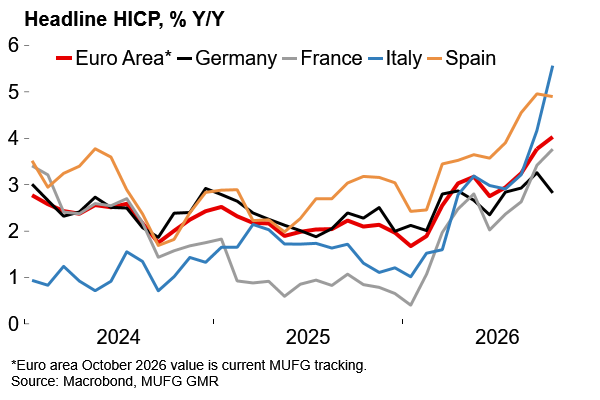
Signs of broadening inflation pressures remain limited
On inflation, the story is somewhat mixed. Headline HICP inflation eased in Germany from 3.3% to 2.8% in October, and from 5.0% to 4.9% in Spain. Government support measures helped to cushion consumers from the impact of higher energy prices in both countries. Elsewhere, there was a big upside surprise in Italy (5.6% from 4.2% previously) and a smaller one in France (3.8%, from 3.4%). These upticks were mostly driven by energy, although French inflation was boosted by some service-sector categories, while Italy also recorded a modest increase in core measures and food.
The euro area aggregate figures will be released next week. Based on national data representing ~80% of the euro area basket, our current tracking points to a headline figure of 4.0%, from 3.8% previously. We expect that the core measure will remain unchanged at 2.5%.
From the ECB's perspective, today's data are unlikely to fundamentally alter the policy debate. The growth side of the economy looks OK. Activity is modest rather than strong, but the Q3 data provide little evidence that the economy is on the cusp of a pronounced slowdown. Inflation therefore remains the key consideration for policymakers. The uptick in headline inflation is no surprise given developments in energy markets, but evidence of any broadening of price pressures remains limited. The longer the energy shock persists, however, the greater the likelihood of spillovers into wages and underlying inflation. TTF gas prices have moved above EUR 100/MWh this week and headline inflation is set to rise above 4% in coming months. Against that backdrop our call remains that the ECB delivers a further 50bp of tightening, with 25bp hikes at the next projection meetings in December and March (see here).
What we’re watching next week
BoE set to act on inflation risks
Our focus next week shifts to the BoE. A 25bp hike to 4.00% looks effectively a done deal and is fully priced by market participants. We see a 7-2 vote split in favour of a hike. Recent data has reinforced the case for action (see here), while today's BoE Agents and DMP surveys were hawkish at the margin. On our latest tracking, the surge in natural gas prices points to UK inflation peaking closer to 5% than 4% in early 2027. Policymakers will be keen to lean against the risk of broader inflation persistence, even though evidence of meaningful second-round effects remains limited. As with the ECB, we expect next week's move to be followed by a further 25bp hike at the next projection meeting in the new year. We will publish our full BoE preview on Monday.
In terms of data, attention in the euro area will remain firmly on inflation. Based on national releases we expect headline HICP to rise to 4.0% from 3.8%, while the core measure remains broadly unchanged at 2.5%. The ECB's wage tracker will be particularly important following Lagarde's comments this week, providing another indication of whether higher energy costs are beginning to feed into underlying inflation pressures. Final PMI releases and German industrial data will also provide a guide on the degree of momentum into Q4.
Key releases and events next week (2-6 November)
Day | Time | Region | Event | Period | Consensus | MUFG | Previous |
Wed 4 Nov | 9:00 | EC | ECB Wage Tracker | Oct | - | - | - |
Wed 4 Nov | 9:00 | EC | S&P Global Eurozone Composite PMI | Oct F | 51.9 | 51.9 | 51.9 |
Wed 4 Nov | 10:00 | EC | CPI YoY | Oct P | 3.9 | 4.0 | 3.8 |
Wed 4 Nov | 10:00 | EC | CPI Core YoY | Oct P | 2.5 | 2.5 | 2.5 |
Thu 5 Nov | 7:00 | GE | Factory Orders MoM | Sep | 5.00 | 7.0 | -10.6 |
Thu 5 Nov | 12:00 | UK | Bank of England Bank Rate | 5-Nov | 4.00 | 4.00 | 3.75 |
Fri 6 Nov | 7:00 | GE | Industrial Production SA MoM | Sep | -0.2 | 0.5 | 2.0 |
Note: All times are GMT (London). Source: Bloomberg, MUFG GMR