

Macro focus – Spain: the other side of Europe’s political risk story: Spain's snap election announcement this week added another layer of political uncertainty to the European outlook at a time when markets remain focused on France's fiscal challenges. There is a clear contrast. Spain has spent years living with fragmented politics, fragile governing coalitions and difficult budget arithmetic, but this hasn’t stopped it from delivering the standout growth performance among euro area economies. On current polling, a PP-Vox majority looks most plausible after the election. That could see some shifts in fiscal and migration policy which could have implications for the medium-term outlook. But Spain enters the campaign from a position of economic strength and has consistently shrugged off political uncertainty, which means the election seems unlikely to become a key near-term market issue.
What we’re watching next week: France remains the dominant market story. Attention will focus on policymakers next week, with a heavy agenda of central bank speakers and a European Council summit in Brussels. Meanwhile, UK GDP and euro area inflation data will offer fresh evidence on the resilience of growth and the evolution of underlying inflation pressures.
Spain: The other side of Europe’s political risk story
Years of political fragmentation have not undermined economic outperformance
The focus in Europe has very much been on France’s fiscal challenges, which we have covered here and here. The sense of broader political uncertainty increased this week when Spanish PM Pedro Sánchez called a snap general election for 29 November, seven months ahead of schedule, following parliamentary defeats on key housing legislation (see here).
There are some obvious parallels with France. Spain has grappled with a fragmented parliament and difficult budget politics. It has effectively been operating under rolled-over budgets in recent years. Since the traditional two-party system fragmented a decade ago, governments have been forced to rely on complex alliances involving small and regional parties, making policymaking increasingly difficult.
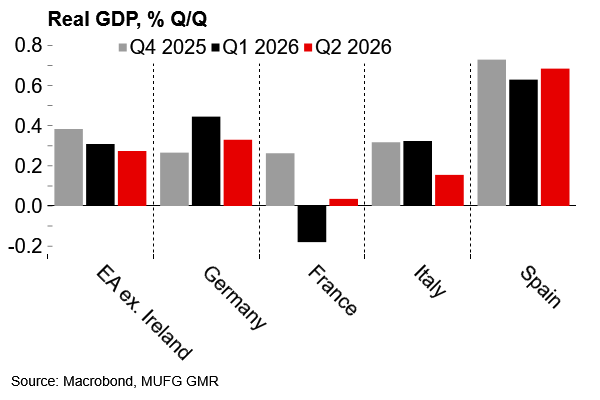
Ordinarily, this sort of uncertainty would be expected to weigh on confidence and growth. Indeed, we’d certainly argue that has been the case in France in recent years. But the Spanish economy has largely shrugged it off. Spain has consistently been the euro area’s star performer. GDP growth has averaged around 3.0% Y/Y since 2024, comfortably above the euro area average of 1.2%. The unemployment rate has fallen to its lowest level since the GFC, while government debt dynamics have improved markedly, with the debt ratio set to fall below 100% of GDP.
There have been a host of tailwinds for the Spanish economy. Strong net migration has expanded the labour force, supported consumption and eased labour shortages. Tourism, business services and EU-funded investment have provided additional support. The latest data suggest that this resilience remains intact despite rising inflation pressures. The services PMI rose to a three-and-a-half-year high this week, consistent with continued strength in domestic demand and services activity. Today the Bank of Spain revised its GDP forecasts higher, to 2.6 and 2.2% in 2026 and 2027 respectively.
Spot the start performer
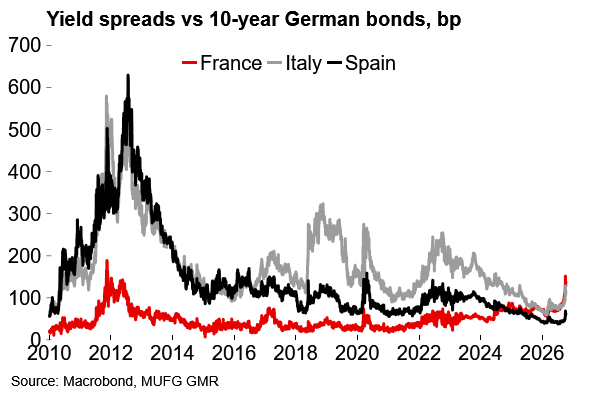
Markets continue to differentiate Spain from France
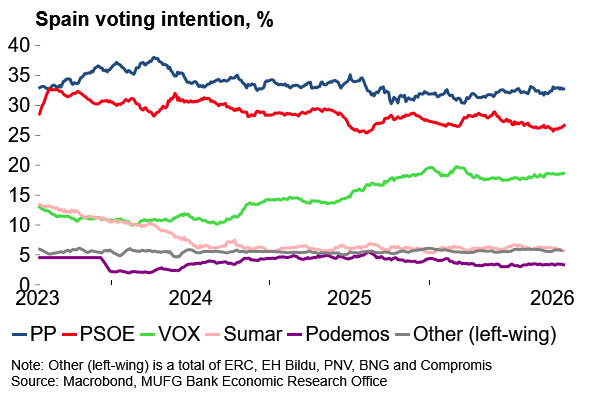
On the election, polling suggests the centre-right Popular Party (PP) is on course to win the most seats, as it stands. Together with hard-right Vox, with whom it has governed in a number of regional administrations, it appears well placed to secure a parliamentary majority. In the context of the difficulties forming governments described above, a two-party PP-Vox majority looks rather straightforward. That is not to say that it would necessarily prove durable. Housing affordability, migration and public spending priorities will remain difficult issues for any incoming government, and tensions could certainly emerge within a coalition.
In terms of policy platforms, PP has proposed various tax reductions and some expenditure savings, but also an ambition to increase spending on defence and infrastructure investment. The balance of risks would shift towards looser fiscal policy, we think, but the new government will remain constrained by EU fiscal rules. The deficit is currently running around 2.5% vs the 3% EU limit. The global bond sell-off will likely also serve as a reminder of the importance of maintaining a credible path ahead.
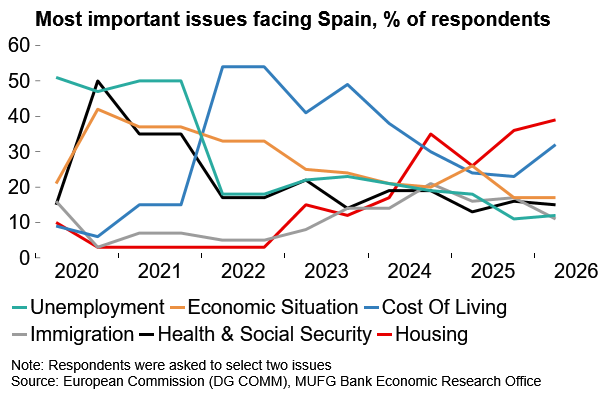
There will be plenty of focus on any shifts in migration policy. Spain has been successful at absorbing foreign workers into the labour force, boosting employment, domestic demand and tax revenues. A PP-Vox government could result in a more restrictive stance. A material slowdown in migration inflows would challenge one of the key pillars of Spain's recent economic resilience. Over time, that could result in slower growth and a less favourable debt trajectory.
For now, though, the broader point is that Spain has challenged conventional assumptions about political risk. It provides a good counter example at a time when markets are focused on fragmentation and fiscal slippage in France. Spain is the only large euro area economy which has delivered consistently robust growth, despite a challenging political backdrop. For that reason, the upcoming election does not look like a significant near-term market story. We will revisit the implications for the medium-term growth outlook in more detail after the main parties set out their platforms.
PP have consistently led the polls
Housing and inflation are core issues for voters
What we’re watching next week
Policymakers in focus as France remains front and centre
The French fiscal situation is set to remain the main story, and there will be plenty of attention on the views of policymakers. Next week sees a flurry of central bank speakers alongside the annual IMF meetings, including ECB President Lagarde and BoE Governor Bailey. The European Council also meets in Brussels. In terms of data releases, it’s a relatively light schedule. The monthly UK GDP figures for August will likely show a slowdown after the strong July reading, but the numbers are volatile and the broader story of resilience to the US-Iran shock remains valid. The other data release of note will be the final euro area HICP numbers, which will be examined for any signs of broadening inflation pressures beyond energy (so far any evidence of that has been in short supply). Lastly, euro area industrial production might have eked out a small monthly gain, with solid activity in Germany offset by some weakness elsewhere.
Key data releases and events (week commencing 12 October)
Day | Time | Region | Event | Period | Consensus | MUFG | Previous |
Wed 14 Oct | 03:10 | EC | ECB's Lagarde Speaks in Bangkok | - | - | - | - |
Thu 15 Oct | 07:00 | UK | Monthly GDP (MoM) | Aug | -0.1 | -0.2 | 0.4 |
Thu 15 Oct | 10:00 | EC | Industrial Production SA MoM | Aug | 0.1 | 0.3 | -0.1 |
Fri 16 Oct | 03:00 | UK | BOE Governor Speaks in Bangkok | - | - | - | - |
Fri 16 Oct | 10:00 | EC | CPI YoY | Sep F | 3.8 | 3.8 | 3.8 |
Note: All times are GMT+1 (London). Source: Bloomberg, MUFG GMR