

To read the full report, please download PDF.
USD/JPY intervention helped by negative NFP
FX View:
The joint intervention last week by the US and Japan to buy the JPY will certainly now be helped by the much weaker July payrolls report released today. Our message to clients following intervention is that the US involvement is significant but fundamentals still matter more. A look back at past joint intervention episodes backs up this message. USD/JPY turns in 1995, 1998 and 2011 were more about fundamentals than the joint interventions themselves. On all occasions USD/JPY breached the initial intervention levels again before the fundamental backdrop changed the direction of the JPY. Rate cuts in Japan and Germany and a pick-up in US growth provided the catalyst for a higher USD/JPY in 1995; the Fed slashing rates by 75bps in Sept to Nov 1998 triggered an unprecedented plunge in USD/JPY; and record unilateral intervention by Japan in Oct 2011 (nearly 9mths after the earthquake/tsunami) and the arrival of Shinzo Abe as PM in late 2012 were the real factors behind turning USD/JPY higher then. We also argue that USD fundamentals are indeed turning and hence USD/JPY can turn lower, albeit by much less and a lot less abruptly than in 1998!
WEAK US JOBS REPORT TRIGGERS END-OF-WEEK USD SELL-OFF
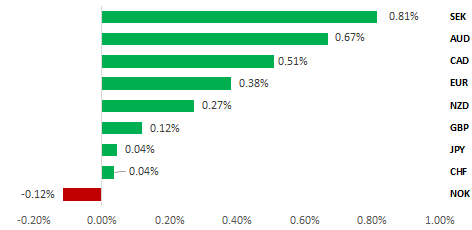
Source: Bloomberg, 14:15 BST on 7th August 2026 (Weekly % Change vs. USD)
Trade Ideas:
We are recommending a new long AUD/JPY trade idea, closing our long EUR/GBP trade idea and maintaining our short USD/BRL trade idea.
JPY Flows:
This week we analyse the weekly cross-border flows in Japan and the OTX retail FX margin positioning data that revealed the retail sector was short USD/JPY ahead of intervention.
Japan FX Intervention: When does the shock spread beyond USD/JPY? :
Intervention can reverberate across FX markets when it triggers the unwinding of yen-funded carry trades. We identify the conditions that drive contagion and the currencies most exposed.
FX Views
JPY: Joint intervention? Yes, but not as we know it!
The drop in USD/JPY from 163.30 last Thursday to a closing low of 157.28 on Friday captures the estimated intervention of JPY 14trn worth of yen buying intervention by the MoF/BoJ. For now, we assume two days of intervention, not three given the BoJ daily current account data does not indicate intervention took place on Monday despite a further notable drop. If that’s correct, then the impact of the two-day intervention buying is largely intact with about 1big figure of that 6 big figure drop retraced as of today. The US Treasury also intervened, and we do not know the size of that intervention but based on the history of US involvement in joint intervention operations, it was likely small. The US involvement is certainly significant, and we believe it alters the near-term risk-reward in buying USD/JPY on a quick retracement of the move. But the fundamentals still matter. Based on our core assumptions we expect this to deter a move back to the initial intervention levels but if the fundamental backdrop does not change in favour of lower USD/JPY then investors may start to question the resolve of the US given some key differences in the approach last week’s intervention.
The US last week was clearly keen to cite this intervention with Japan as joint intervention and in the sense that both Japan and the US purchased yen on the same day it was joint intervention. But there were notable differences. For one, market conditions on this occasion were not consistent with the market conditions previously that justified intervention. USD/JPY was stable and FX volatility was extremely low.
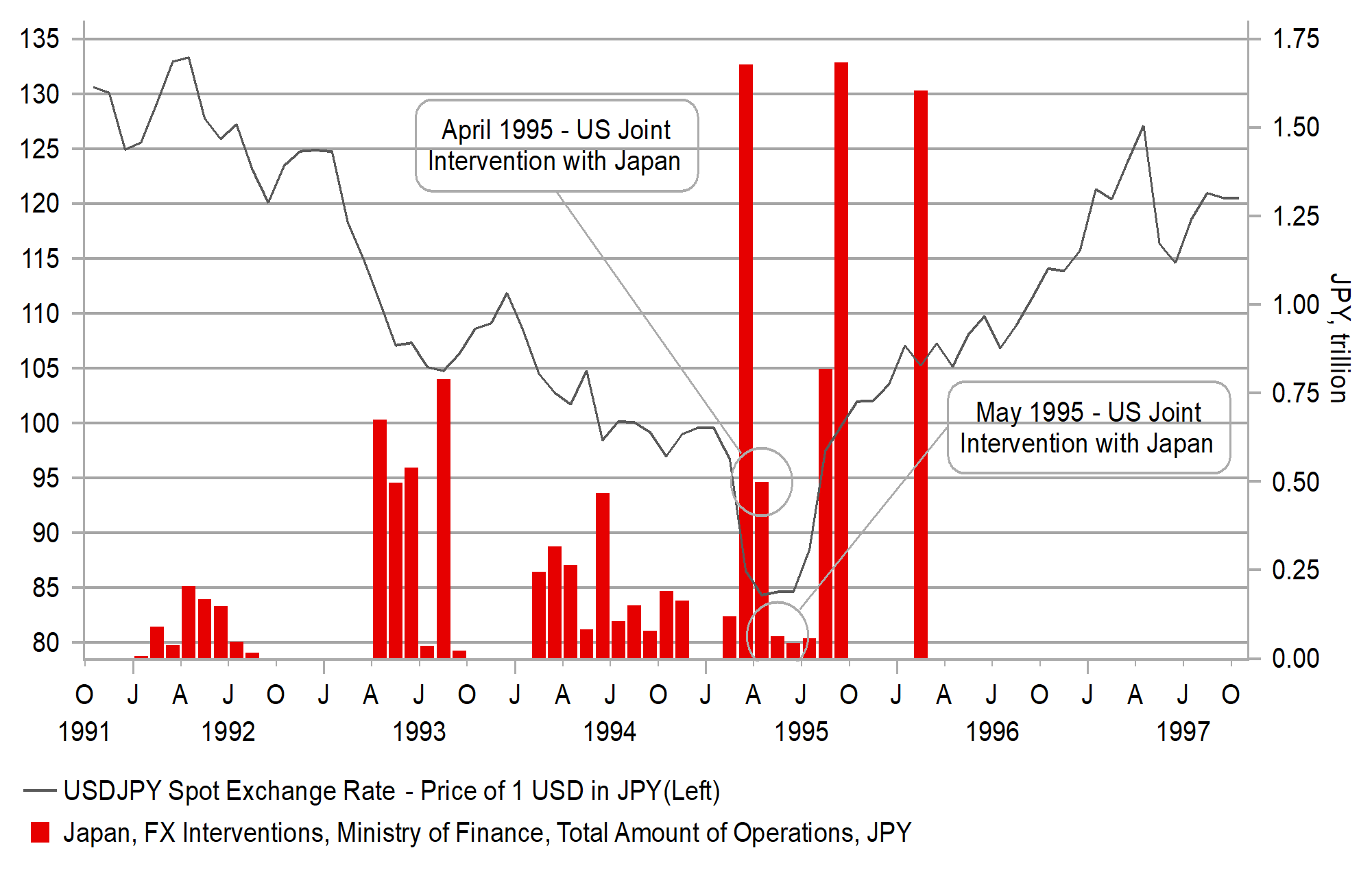
In 1995 USD/JPY plunged 15 big figures from the start of March to mid-April despite persistent, nearly daily, intervention by the MoF. The US joined the intervention on 3rd April, again on 5th April and 31st May, buying the US dollar against the yen and German mark. A G7 statement on 25th April was also released expressing concern over US dollar weakness and confirming plans to address the weakness. The BoJ cut rates by 125bps in April & Sept 1995. The Bundesbank cut its policy rate by 150bps from April to Dec 1995 and the US economy rebounded strongly in H2 1995 and confidence in the US dollar rebounded.
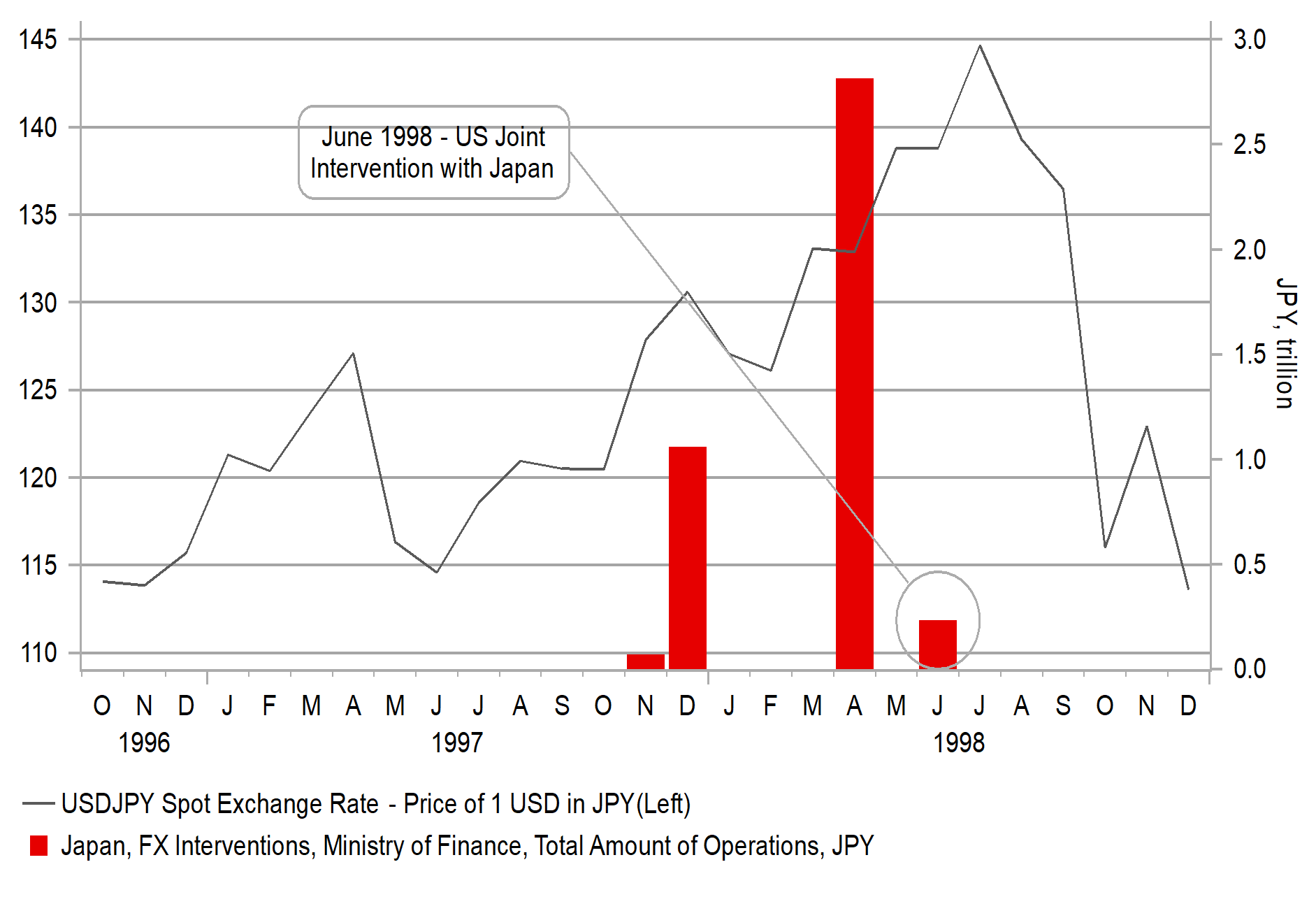
In the space of just three years Japan turned from yen selling intervention to yen buying. The Asian financial crisis resulted in a surge in the US dollar as confidence in Japan’s banking sector plunged due to NPLs related to Japan’s asset price crash. USD/JPY surged 9% in a month through to the point of joint intervention on 17th June 1998. That took place after Japan alone had intervened on ten occasions (starting in 1997) to buy the yen but to no avail. USD/JPY plunged but did in fact break back above intervention levels in August 1998 before a dramatic turn in fundamentals resulted in a sharp decline in USD/JPY. The Asian financial crisis had spread, Russia defaulted and a US hedge fund collapsed (LTCM) prompting the Fed to cut rates three times (once inter-meeting) between Sept-Nov 1998. This shift in fundamentals prompted the infamous three-day drop in USD/JPY in Oct 1998 from 135.00 to 112.00. The MoF could be intervening to sell the yen again in 1999! Like in 1995, the UST Secretary Robert Rubin released an official statement confirming intervention.
USDJPY & MOF/JOINT INTERVENTION IN 1995 – YEN SELLING
Source: Bloomberg, Macrobond & MoF
USDJPY & MOF/JOINT INTERVENTION 1998 – YEN BUYING
Source: Bloomberg, Macrobond & MUFG GMR
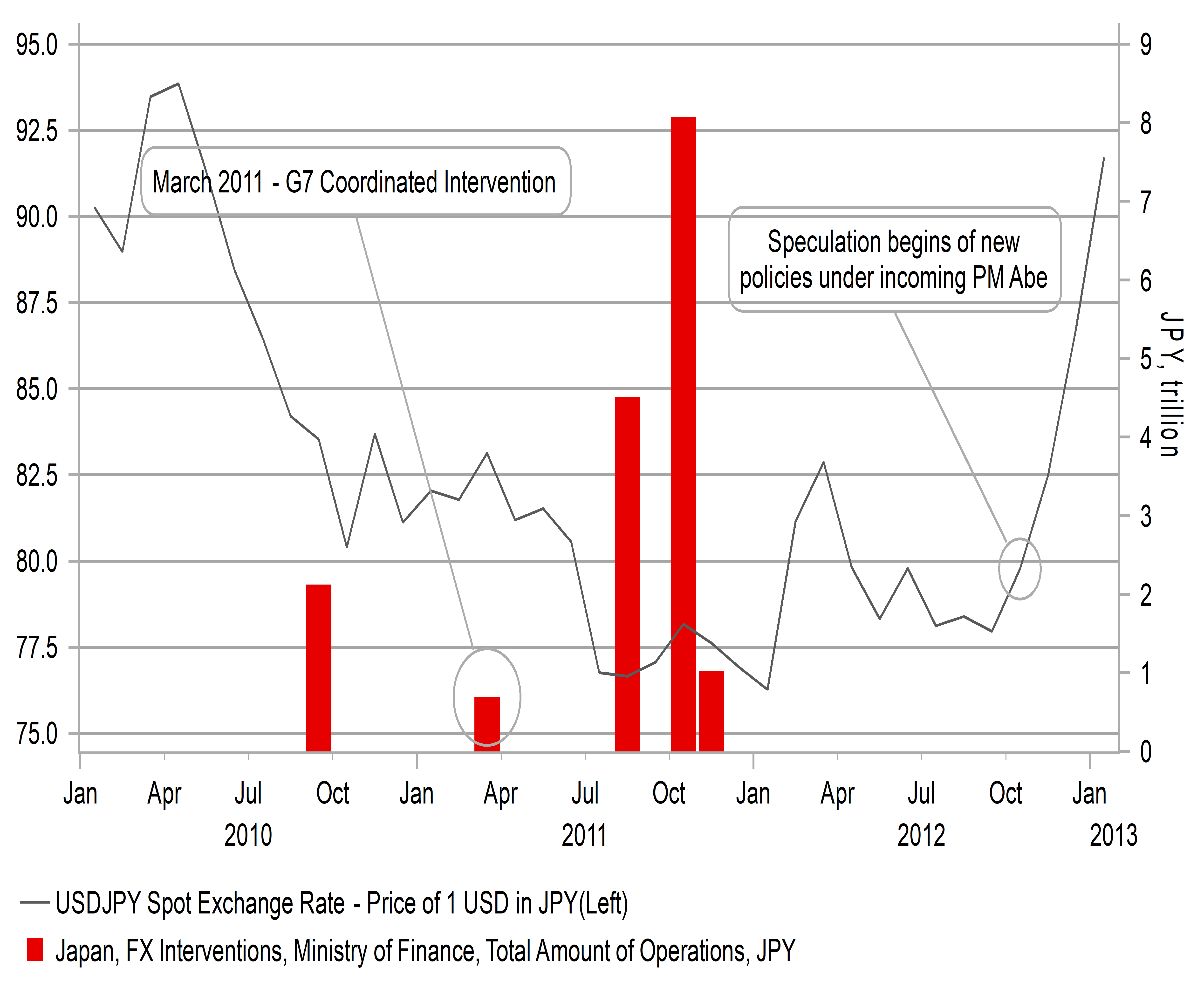
Following the tragic earthquake and tsunami in March 2011 USD/JPY plunged 8.5% in five trading days as investors anticipated insurance-related repatriation from abroad. The 2011 action was multi-lateral with a G7 statement released on 18th March confirming intervention by Japan, the US, the euro-zone, the UK and Canada. However, this was more an action in solidarity after such a terrible natural disaster and while it alleviated upward pressure on the yen, USD/JPY ultimately fell back with new USD/JPY lows recorded. Japan again intervened alone by a record one-day total (selling just over JPY 8trn) on 31st October. The following year Shinzo Abe was elected prime minister and the policies he began to pursue was ultimately what marked a turn in the sustained period of yen over-valuation.
So the reality of those past episodes of joint intervention is that a turn in USD/JPY did ultimately follow but certainly not immediately. In every example, USD/JPY breached the level following the initial (1995) or only (1998 & 2011) episode of intervention and only when the financial markets saw real fundamental change did USD/JPY turn. If Fed rate hike expectations remain priced into the curve, there is certainly a risk of a further retracement in the drop in USD/JPY. The US action was in some ways half-hearted that could reinforce a retracement. There was no formal statement acknowledging intervention. Scott Bessent described it as “reserve reallocations” and did not even inform the European authorities until the day after it sold EUR/JPY. The US concerns appear more linked to stopping UST bond sales, possibly over concerns that higher yields could prompt financial market turmoil ahead of the mid-term elections. Use of FIMA (to repo UST holdings rather than sell) involves a charge – why would Japan use such a facility?
US yields and the removal of monetary tightening pricing will be important for turning USD/JPY and the BoJ hiking rates in September to show intent is also important. The weak US jobs report and easing in rate hike pricing will certainly now help. Between 1999 and 2011, the MoF bought appox JPY 70trn worth of mainly US dollars ($640bn at avg exchange rate) and had built up a 50-big figure gain. Intervention realises those profits, recorded in the Foreign Exchange Fund Special Account. Fundamentals still matter and if our fundamental view is wrong, further MoF intervention is likely.
USDJPY & INTERVENTION & G7 ACTION IN 2011
Source: Bloomberg, Macrobond & MUFG GMR
JAPAN SALES OF SECURITIES IN FX RESERVES
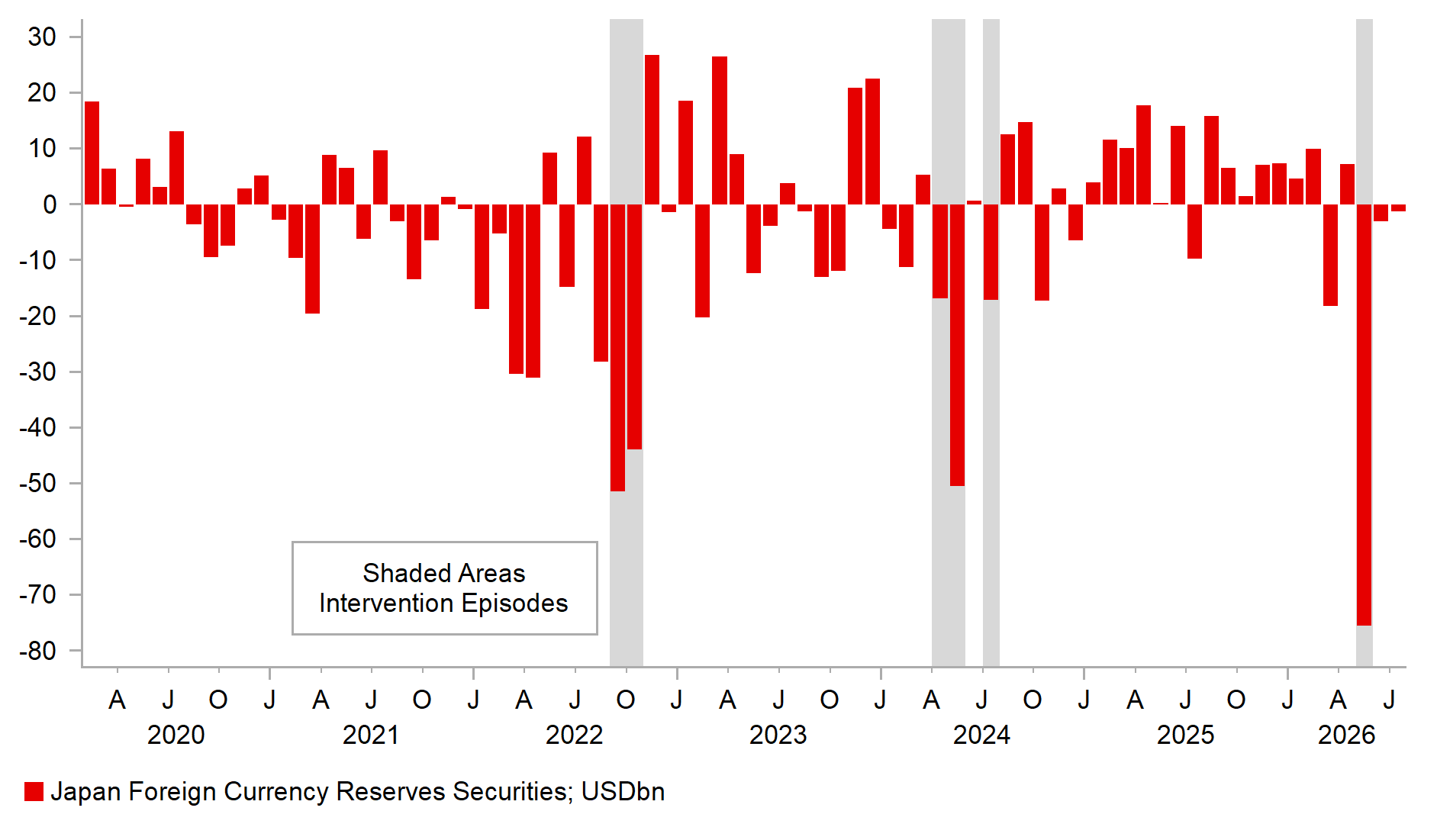
Source: Bloomberg, Macrobond & MUFG GMR
USD: Weighing up impact of Fed policy uncertainty & joint FX intervention
Looking at the performance of G10 currencies since Japan intervened at the end of last week, the JPY has been the strongest performer, appreciating by 3.7% against the USD. At the other end of the spectrum, the USD has weakened against all other G10 currencies as well. The USD sell-off was initially triggered by last week's FOMC meeting and was subsequently reinforced by intervention and today’s soft NFP report. The Fed's decision to leave rates on hold generated some initial market relief, as the US rates market had been pricing a higher-than-normal probability of a surprise hike amid limited forward guidance from new Fed Chair Kevin Warsh. Furthermore, the US yield curve steepened sharply as market expectations for Fed tightening were scaled back and the term premium embedded in longer-dated Treasury yields increased. The US 10-year term premium, as estimated by the Fed's Kim-Wright model, rose to a fresh cycle high of 0.87% at the end of July and is currently at its highest level since April 2011. The steepening of the US yield curve is a negative development for the USD. The rise in term premia may reflect increased uncertainty surrounding the future path of Fed policy and reduced confidence in the Fed's reaction function under its new leadership. Market-based measures of US inflation expectations have also moved higher, particularly the 5-year, 5-year forward breakeven inflation rate, which recently climbed to its highest level since last autumn. This tentatively suggests some erosion of confidence in the Fed's inflation-fighting credibility. Precious metals have also benefited from this backdrop, with gold and other precious metals breaking higher.
The unfavourable initial market reaction may have prompted some pushback from Fed Chair Kevin Warsh. The Financial Times reported yesterday that Warsh "would be prepared to raise interest rates at September's meeting if inflation readings released in the coming weeks are strong and markets ratchet up their expectations for higher borrowing costs", according to people familiar with his thinking. The report noted that people close to Warsh acknowledged that he had made mistakes during his first 10 weeks as Fed Chair, including failing to reinforce his commitment to price stability and creating confusion over whether his longer-term plans to reform the Fed could influence near-term monetary policy decisions. Despite these reports, the US rates market remains less convinced that the Fed will raise rates as soon as September. Pricing for a September hike has fallen to around 50:50 after NFP private employment growth remained weak adding only 30k for the second consecutive month in July. The reporting on Warsh's thinking may be an attempt to help anchor the long end of the US yield curve, thereby preserving the Fed's policy flexibility ahead of the September meeting. If longer-term Treasury yields were allowed to continue rising unchecked, it could place greater pressure on the Fed to tighten policy in order to restore confidence in its inflation-fighting credentials.
STEEPER US YIELD CURVE & WEAKER USD
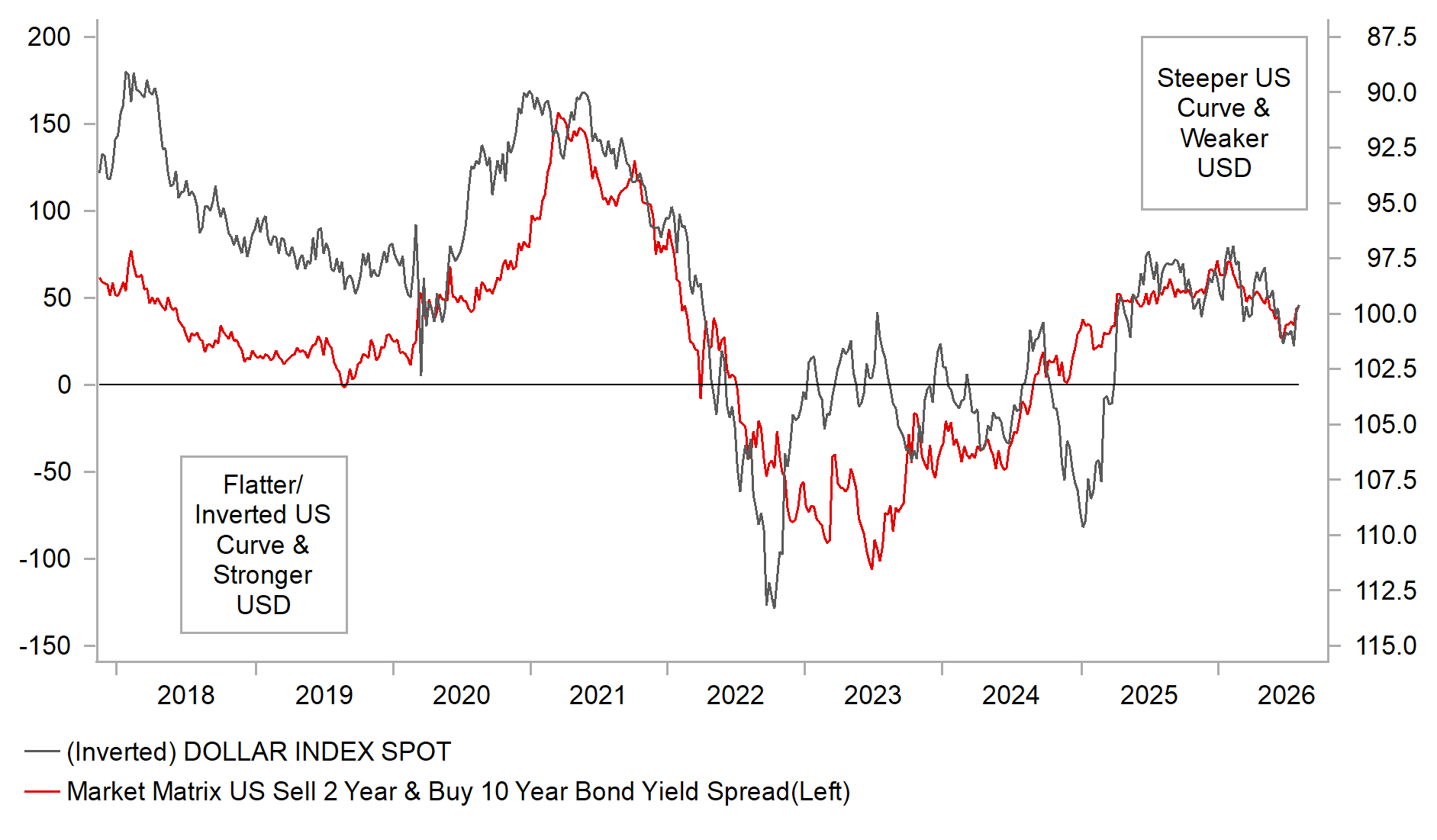
Source: Bloomberg, Macrobond & MUFG
US TERM PREMIUM CONTINUES TO RISE
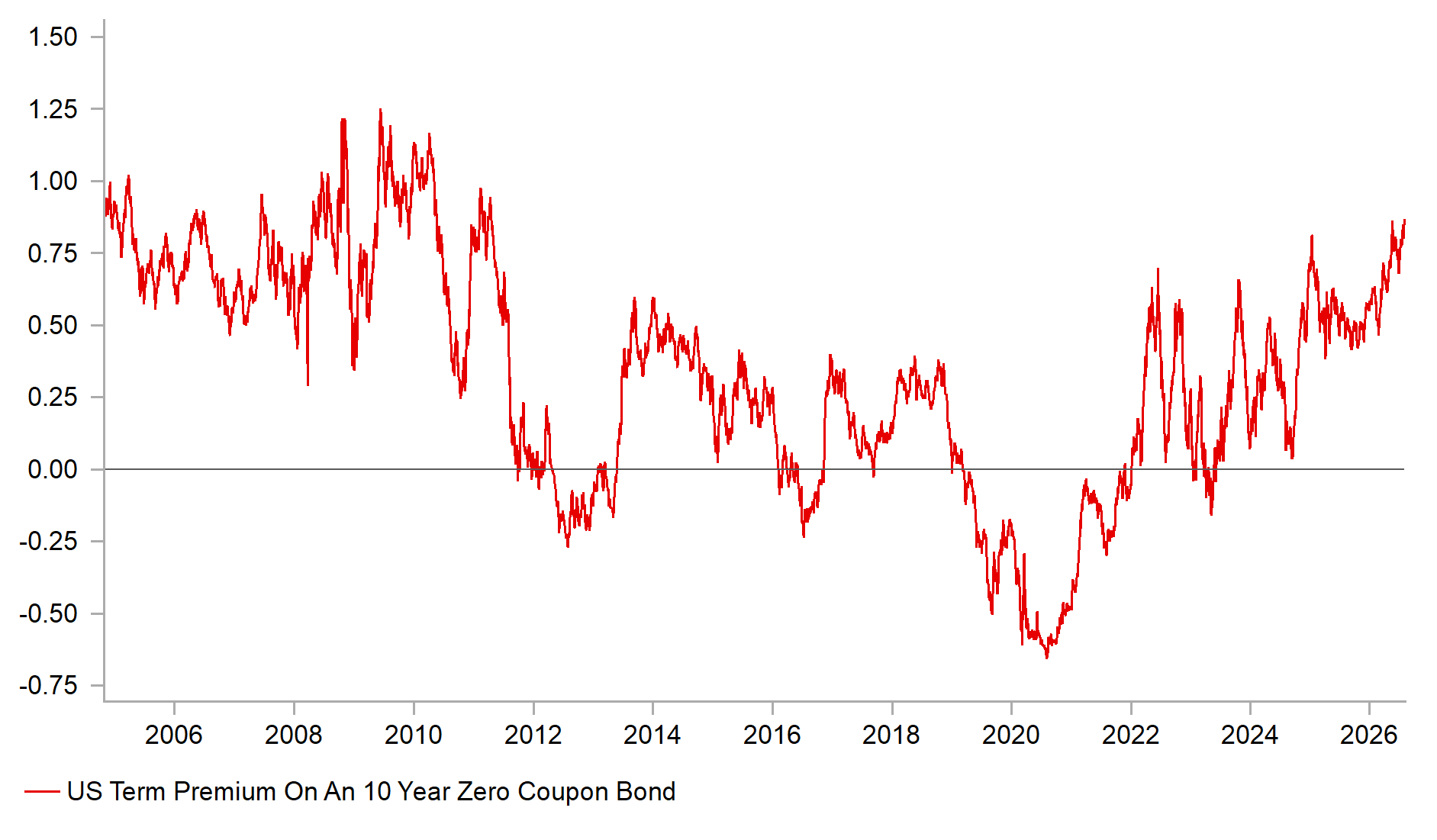
Source: Bloomberg, Macrobond & MUFG
The FT report means that market participants will be scrutinising next week's US CPI report for July even more closely than usual. The previous CPI report for June was much weaker than expected revealing broad-based disinflationary pressures. Although Fed Chair Kevin Warsh played down the importance of the softer-than-expected June inflation data when explaining the Fed's decision to keep rates on hold last month, further evidence of disinflation in either the July or August CPI reports, would help to reduce pressure on the Fed to hike. This remains a key assumption underpinning our forecasts (click here) that the Fed will keep rates on hold through the remainder of this year and that the USD will gradually re-weaken. The risk of second-round inflation effects stemming from the recent energy price shock appears limited, supported by a combination of stronger productivity growth and soft labour market conditions. The latest Q2 unit labour cost data provided further reassurance on this front. Annualised unit labour cost growth slowed to just 1.4%.
The US Treasury's decision to intervene alongside Japan to support the JPY also suggests concern about potential negative spillovers to the US Treasury market, which could prove destabilising and add to upward pressure on longer-term yields. The US and Japan will be hoping that joint intervention, even if the US contribution is relatively modest at around USD5-10 billion or less, proves more effective in discouraging further JPY selling after record sales by Japan estimated at around USD87 billion. In addition, Japan's announcement that it plans to utilise the Fed's FIMA repo facility to obtain dollars for future intervention operations, without having to liquidate its Treasury holdings, is intended to provide reassurance to the US Treasury market. By accessing dollar liquidity through the FIMA facility, Japan can support the JPY while minimising the risk of disruptive Treasury sales. The Fed’s decision to sell EURs instead of USDs also indicates that the US Treasury wanted to avoid selling their own Treasury holdings, and avoid signalling a desire for the USD to weaken more broadly.
On the other hand, if the US Treasury is seeking to discourage Japan from selling its Treasury holdings to support the JPY when intervention is required, it may prompt other reserve managers to question the attractiveness of holding US Treasuries. This point was highlighted in a recent Financial Times opinion piece (click here) by Barry Eichengreen, one of the world's leading experts on the history of the international monetary system, exchange rates, and reserve currencies. Eichengreen argued that central banks hold US Treasuries not only because of their safety and liquidity, but also because they can be freely bought and sold when reserve managers need to conduct FX intervention. If major reserve holders come to believe that selling Treasuries in support of their currencies is politically discouraged or viewed unfavourably by US authorities, the value of Treasuries as intervention assets could be diminished. Other countries may seek to accelerate USD diversification.
SLOWING ULC GROWTH HELPS EASE INFLATION RISKS
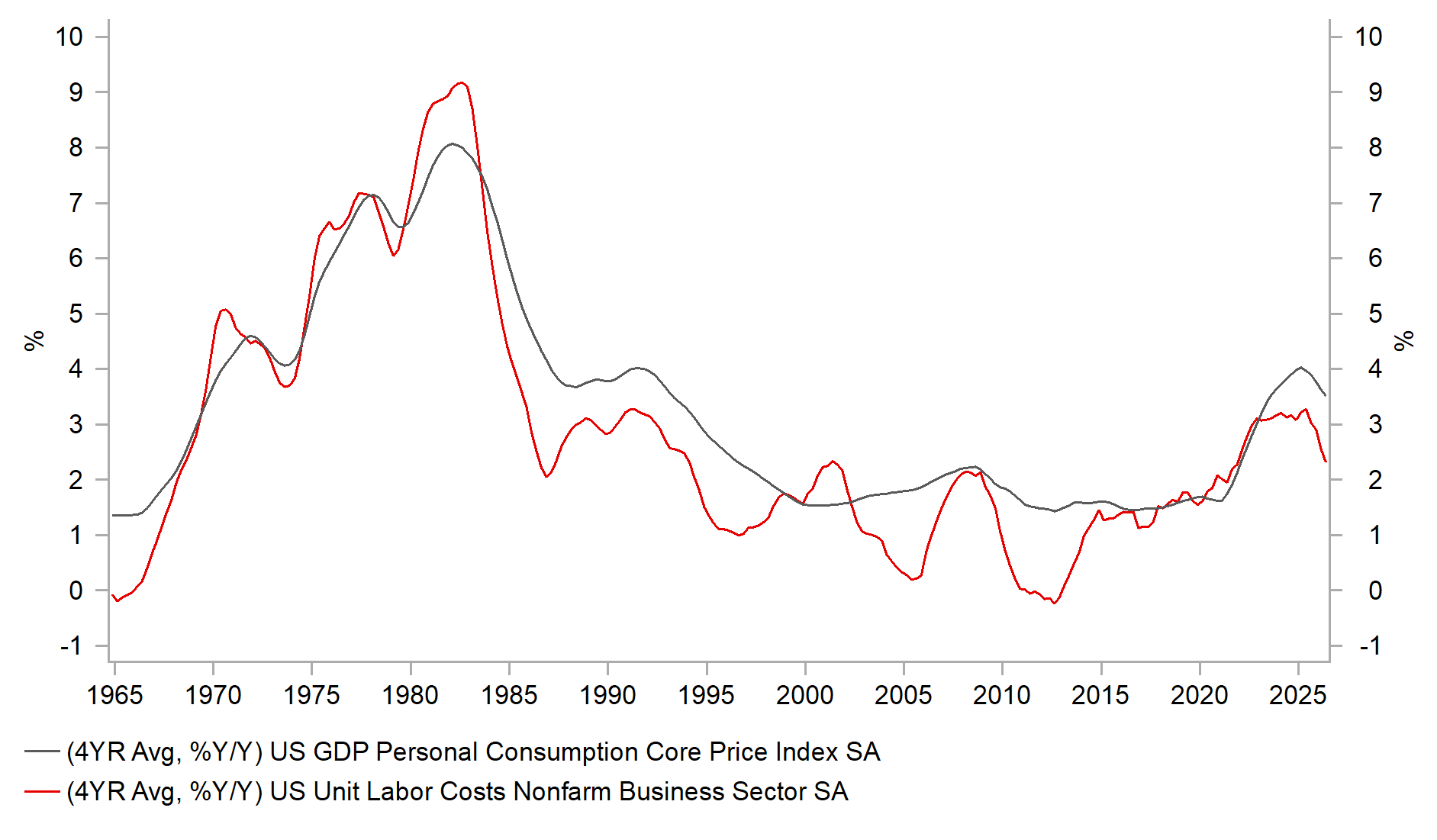
Source: Bloomberg, Macrobond & MUFG GMR
FOREIGN OFFICIAL INVESTORS LIQUIDATING USTS
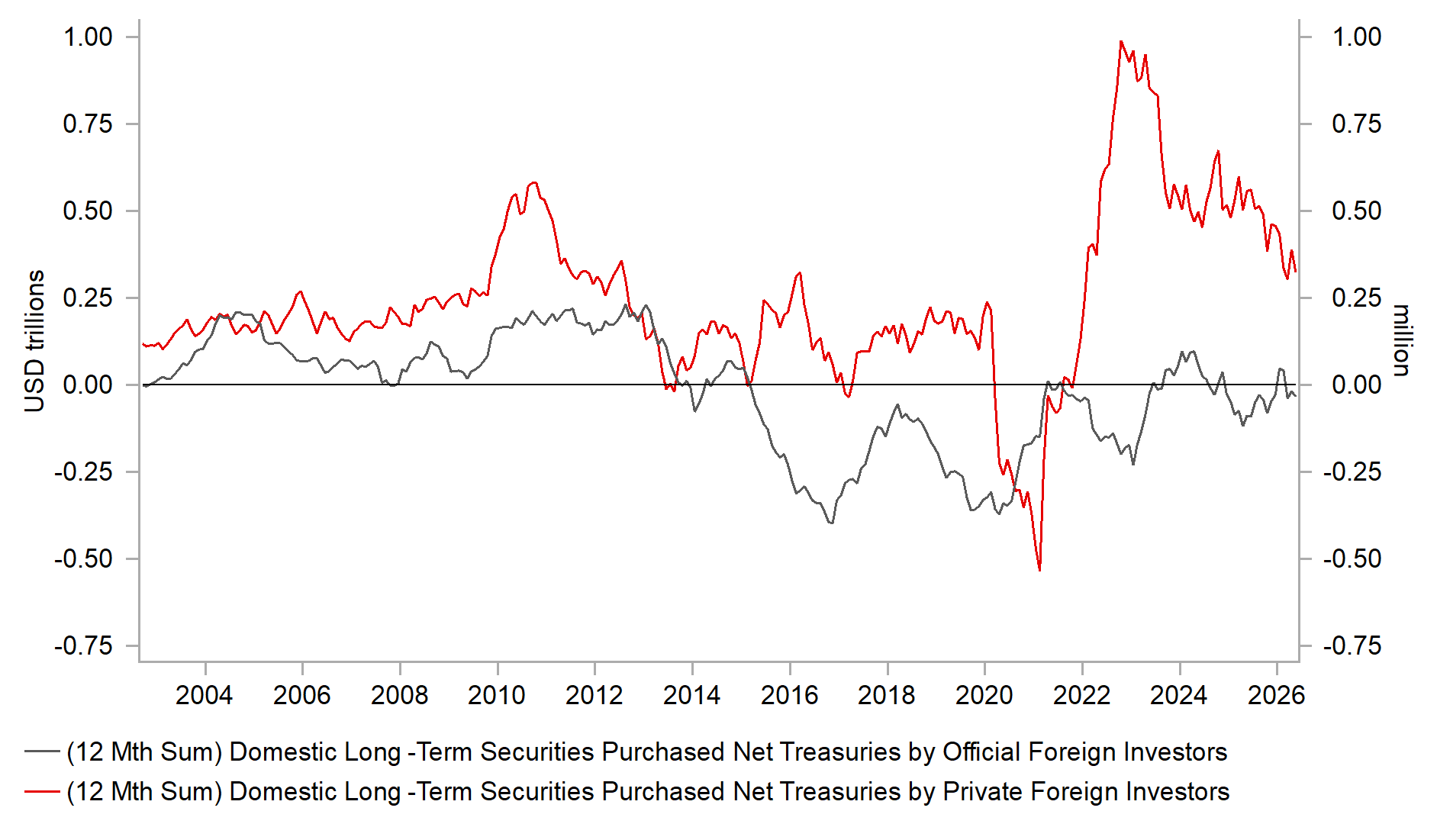
Source: Bloomberg, Macrobond & MUFG GMR
Weekly Calendar
Ccy | Date | BST | Indicator/Event | Period | Consensus | Previous | Mkt Moving |
GBP | 10/08/2026 | 00:01 | REC UK Report on Jobs | !! | |||
JPY | 10/08/2026 | 00:50 | Trade Balance BoP Basis | Jun | -¥70.2b | ¥6.9b | !! |
JPY | 10/08/2026 | 00:50 | BoJ Summary of Opinions (July MPM) | !!! | |||
NOK | 10/08/2026 | 07:00 | CPI YoY | Jul | -- | 2.7% | !! |
EUR | 10/08/2026 | 09:30 | Sentix Investor Confidence | Aug | -- | - 3.1 | !! |
AUD | 11/08/2026 | 05:30 | RBA Cash Rate Target | 4.35% | 4.35% | !!! | |
USD | 11/08/2026 | 11:00 | NFIB Small Business Optimism | Jul | -- | 97.4 | !! |
USD | 11/08/2026 | 15:00 | Existing Home Sales | Jul | 4.06m | 4.09m | !! |
EUR | 12/08/2026 | 07:00 | Germany CPI YoY | Jul F | -- | 2.8% | !! |
USD | 12/08/2026 | 13:30 | CPI YoY | Jul | 3.5% | 3.5% | !!! |
GBP | 13/08/2026 | 00:01 | RICS House Price Balance | Jul | -- | - 0.33 | !! |
AUD | 13/08/2026 | 01:15 | RBA's Kent-Fireside Chat | !! | |||
GBP | 13/08/2026 | 07:00 | GDP QoQ | 2Q P | 0.4% | 0.6% | !!! |
SEK | 13/08/2026 | 07:00 | CPI YoY | Jul F | -- | 0.2% | !! |
CHF | 13/08/2026 | 07:30 | Producer & Import Prices YoY | Jul | -- | -2.1% | !! |
NOK | 13/08/2026 | 09:00 | Deposit Rates | 4.25% | 4.25% | !!! | |
EUR | 13/08/2026 | 10:00 | Industrial Production SA MoM | Jun | -- | -0.2% | !! |
USD | 13/08/2026 | 13:15 | Fed's Hammack Speaks | !! | |||
USD | 13/08/2026 | 13:30 | Initial Jobless Claims | -- | -- | !! | |
USD | 13/08/2026 | 13:30 | PPI Final Demand MoM | Jul | 0.2% | -0.3% | !! |
USD | 13/08/2026 | 13:40 | Fed's Barkin Speaks | !! | |||
EUR | 14/08/2026 | 07:45 | France CPI YoY | Jul F | -- | 2.1% | !! |
EUR | 14/08/2026 | 10:00 | GDP SA QoQ | 2Q S | -- | 0.4% | !!! |
EUR | 14/08/2026 | 10:00 | Trade Balance SA | Jun | -- | -5.0b | !! |
EUR | 14/08/2026 | 10:00 | Employment QoQ | 2Q P | -- | 0.1% | !! |
USD | 14/08/2026 | 13:30 | Retail Sales Advance MoM | Jul | 0.3% | 0.2% | !!! |
USD | 14/08/2026 | 15:00 | U. of Mich. Sentiment | Aug P | 54.0 | 55.2 | !! |
Source: Bloomberg & MUFG GMR
Key Events:
The RBA and Norges Bank are scheduled to hold their latest monetary policy meetings in the week ahead. Expectations for further RBA rate hikes have eased recently in response to softer inflation data, giving the central bank more scope to keep rates on hold in the near term after delivering three consecutive hikes between March and May. The RBA's preferred measure of underlying inflation, the trimmed mean, remained steady at 3.6% in June, undershooting the RBA's forecast of 3.8%. Nevertheless, the RBA is expected to reiterate that it remains prepared to act as necessary to achieve its mandate, including raising the cash rate further if required, thereby keeping the door open to additional tightening later this year.
The Norges Bank is also expected to leave rates unchanged in the week ahead, although the probability of another near-term hike remains relatively high. At its last policy meeting, Norges Bank signalled clearly that the policy rate would likely be raised at one of the forthcoming meetings. Market participants view a hike in September as more likely than one in August. Although inflation came in much weaker than expected in June, with both headline and core inflation falling to 2.7%, this is not expected to deter Norges Bank from following through with its tightening plans. The latest inflation data for July will be released ahead of next week's policy meeting and could therefore have an important bearing on market expectations for the timing of the next rate increase.
The main economic releases in the week ahead will be: (i) the US CPI report for July, (ii) the US retail sales report for July, and (iii) second-quarter GDP reports from the euro area and the UK. The US CPI report will be closely scrutinised following the significant downside surprise in June to assess whether the recent disinflation trend is being sustained. For the Fed to avoid further rate hikes in response to the latest energy price shock, inflation will need to continue moderating through the summer. In Europe, the latest Q2 GDP releases are expected to confirm that economic activity has held up better than feared despite the adverse impact of higher energy prices. This resilience is helping to support expectations for further ECB policy tightening. In contrast, the BoE has indicated that it remains comfortable keeping rates on hold for now.