

To read the full report, please download PDF.
USD risk skewed by Middle East & energy
FX View:
The weaker dollar last week helped by weaker US inflation prints has not been sustained with the surge in energy prices dominating FX moves. As before during the previous stage of the conflict, NOK and AUD have outperformed with US dollar gaining versus the rest of G10. Next week will be a crucial week for the markets with the FOMC meeting on Wednesday followed by the BoE on Thursday and the BoJ on Friday. President Trump has also hinted at a possible escalation in attacks on Iran which would add further upward pressure to energy prices. Brent crude saw a low-to-high move of 18.5% this week and further gains into the FOMC meeting would raise the prospects of a hawkish communication. However, we doubt the FOMC will hike rates which remains a 35% probability. Still, a hawkish meeting and a further escalation in the conflict will keep the dollar well supported. We expect the BoJ on Friday to deliver a more hawkish communication in order to endorse current market rates – that is needed in order to avoid heavier yen selling and a pick-up in JPY volatility.
CRUDE OIL REBOUND LIFTS US YIELDS & THE DOLLAR
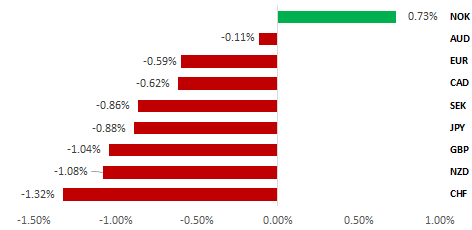
Source: Bloomberg, 14:15 BST on 24th July 2026 (Weekly % Change vs. USD)
Trade Ideas:
We are maintaining our long EUR/GBP trade idea and our short USD/BRL trade idea.
JPY Flows:
This week we analyse the monthly Balance of Payments statistics that showed Japan’s trade balance improving with Japan’s overall current account surplus at record highs.
Are FX Options Markets Pricing Central-Bank Meeting Risk?:
This week we extend our FX options analysis to assess how the FX options market is pricing the upcoming Fed, BoE and BoJ policy meetings as risk events.
FX Views
JPY: BoJ need to continue on a more hawkish path
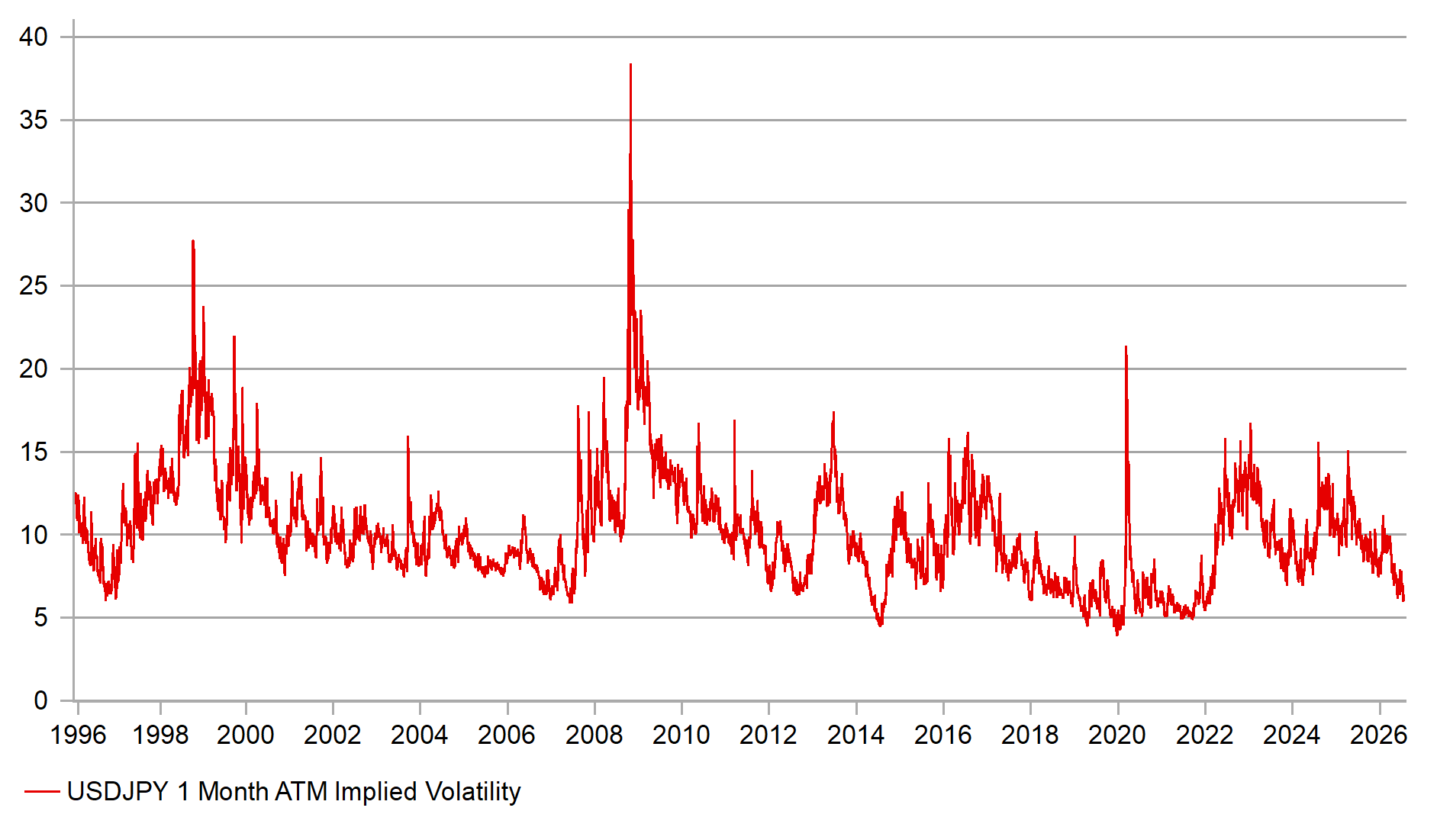
USD/JPY hit a new high yesterday of 163.99 with no let-up in the upward momentum as investors continue to focus on broader developments that are more US dollar supportive – the increased risks of military escalation and with that even higher crude oil prices lifting global rates, which feeds into the upward momentum in USD/JPY. There is also now a sense that the MoF in Japan has shifted its approach to managing yen weakness away from FX intervention. The 1-month USD/JPY risk-reversal is skewed to puts over calls but the skew has actually moderated slightly since the start of July as USD/JPY has trended modestly higher. It is difficult to justify intervention when USD/JPY vol has been trending weaker – 1-month vol fell below 6.0 last week for the first time since just before Russia’s invasion of Ukraine. The BoJ needs to play an increasing role in countering yen selling and while FX appears indifferent to the prospect of a more hawkish BoJ it is important for the BoJ to signal the potential for a more hawkish shift if inflation risks remain skewed higher.
The first point to make here is that a lot will happen next week prior to the BoJ meeting. The FOMC meeting and developments in energy markets will be important in shaping the tone for the BoJ. A hawkish FOMC meeting (stronger than expected signal of a hike in Sept seems possible) and even higher energy prices will likely provide scope for the BoJ to be more hawkish. The BoJ will also provide updates to forecasts for GDP and inflation. The current GDP projection for FY26 is 0.5% and core nationwide CPI is 2.8% and core-core is 2.6%. The GDP projection could be revised higher due to AI-related demand and fiscal policy support. Inflation projections could be marginally lowered but we would not expect any tweak lower to be accompanied with any softening of the rhetoric around inflation risks still being skewed to the upside. Excluding distortions related to government policies, the core nationwide rate is currently around 1.0ppt higher. We expect CPI forecasts for FY27 and FY28 to remain at or above the 2.0% level.
Bloomberg reported this week that the BoJ could be considering a faster pace of monetary tightening than the current every six months while recent BoJ official comment has been a bit more on the hawkish side. The rates market has moved to price in further action and hence Governor Ueda will need to back this perceived shift at the press conference. Given Governor Ueda’s track record of being more dovish in press conferences risks are skewed toward disappointment with Governor Ueda’s tone not matching the recent shift in market expectations. What kind of Middle East backdrop is in place by next Friday will also be important as Governor Ueda has tended to place greater importance on global uncertainties as reasons for caution.
1M USDJPY IMPLIED VOL APPROACHING ALL-TIME LOWS
Source: Government Pension Investment Fund
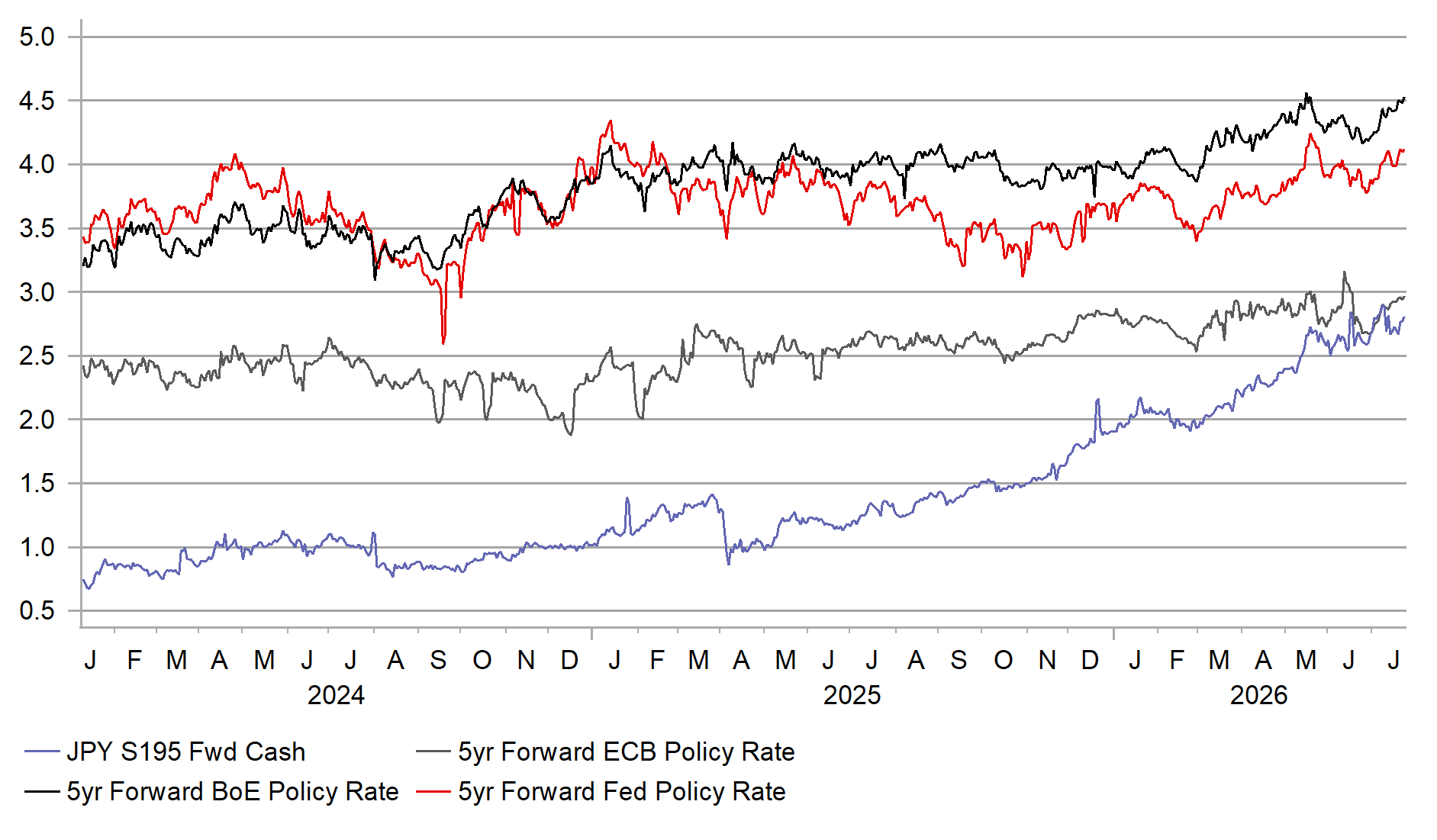
BOJ POLICY RATE EXPECTATIONS HIGHER VS G3
Source: Bloomberg, Macrobond & MUFG GMR
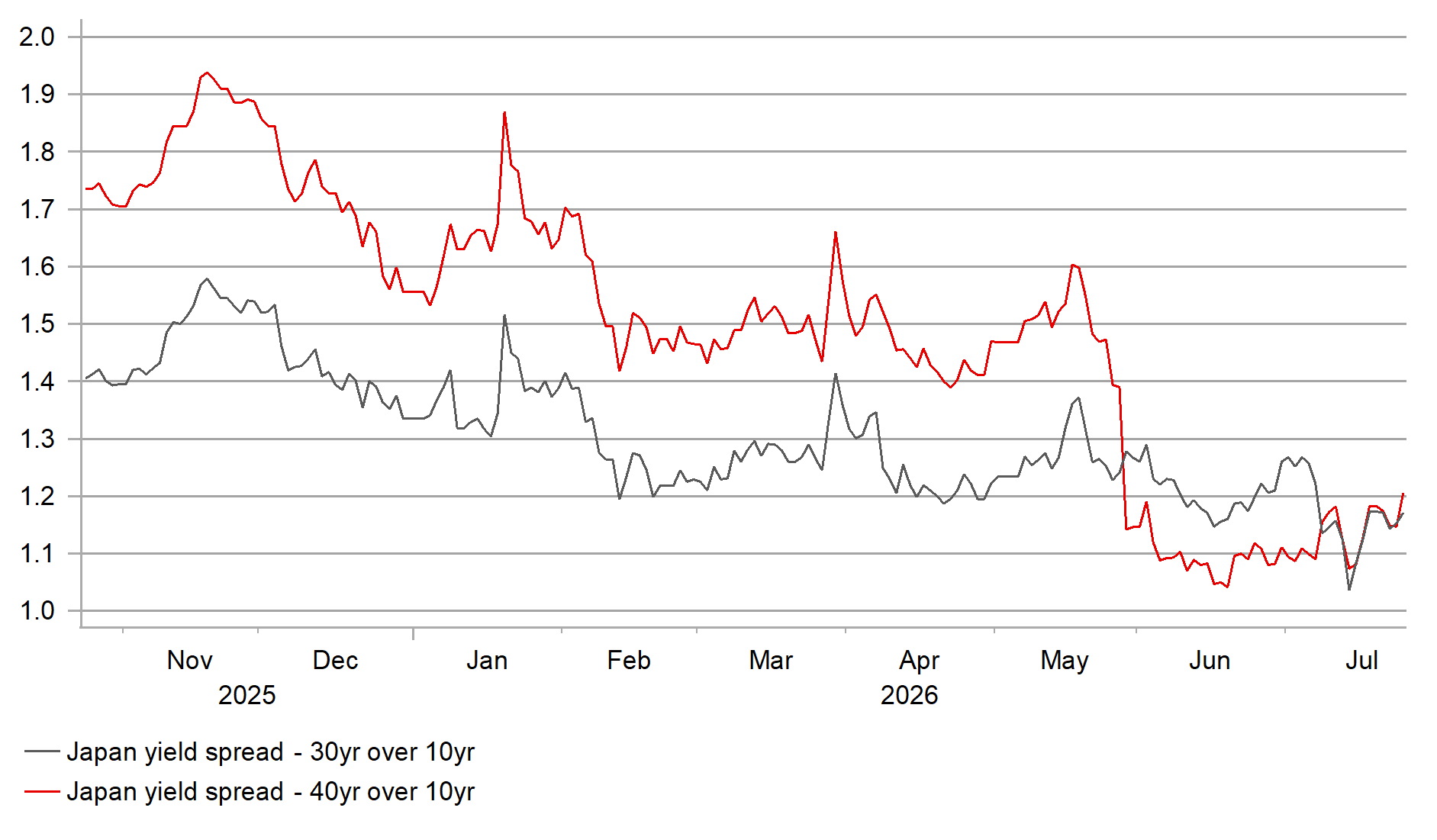
The rates market in Japan has certainly been responding to the expectations of a more hawkish BoJ. The sale of 3-month treasury bills in Japan today drew a highest yield of 1.00% for the first time in over 30yrs while JGB yields continue to hit either multi-decade or record highs. The JGB yield move looks more a reflection of BoJ monetary policy expectations than fiscal or inflation risks. The USD/JPY slide, the shift to a more hawkish tone via media reports or official comment are resulting in a bear-flattening of the yield curve that over time should prove more yen-supportive. The more hawkish BoJ has seen the 5yr forward estimate for the BoJ policy rate jump by 82bps since the conflict started, more than the rest of G4. However, the change in expected Fed policy rate was also substantial at 72bps. The JGB curve is flattening. The 40s10s and 30s10s curve has flattened notably suggesting some improved confidence in the BoJ policy outlook. Sovereign risks implied by the 30-year JGB yield over the equivalent OIS swap rate has narrowed as well. These developments have not come to support the yen but if conditions abroad were to change then the yen could respond positively.
The US Treasury yesterday released its semi-annual report on Macroeconomic and Foreign Exchange Policies of Major Trading Partners and again the report did not cite any trading partner as a currency manipulator. Ten countries remained on the “Monitoring List” including Japan. The period covered did not include a time when intervention took place but the US noted that Japan remained “exceptionally transparent” on intervention activities. The multi-year trend of yen weakness has resulted in “substantial yen undervaluation” Importantly, the report adds that “monetary policy normalisation would help anchor inflation expectations and reduce excessive exchange rate volatility”. An implicit call from the US to the BoJ to hike rates at a faster pace perhaps. Of course, we should also highlight there is little signs of excess volatility either. As mentioned above, the implied vols in certain tenors are back at lows not seen since before Russia’s invasion of Ukraine.
As is often the case, near-term yen direction is largely beyond the influence of the BoJ given current circumstances of rising energy prices and the knock-on impact of rising yields in key major economies. However, that should not mask the developments in Japan rates markets that help at the very least to contain yen selling. The onus is now on Governor Ueda to communicate a message that is consistent with current rates market pricing. If Governor Ueda falls short of that and the markets perceive his comments as dovish, it could well create heavier yen selling and the excess volatility referred to by the US. That would leave the BoJ open to criticism and prove counter-productive. We expect Governor Ueda to be more hawkish than in the past which should open up the prospect of a rate hike in September. Conditions continue to fall into place for a recovery of the yen once international conditions allow.
JAPAN’S LONG-END JGB CURVE IS FLATTENING
Source: Bloomberg, Macrobond & MUFG GMR
3MTH US-JP SPREAD CONTINUES TO NARROW
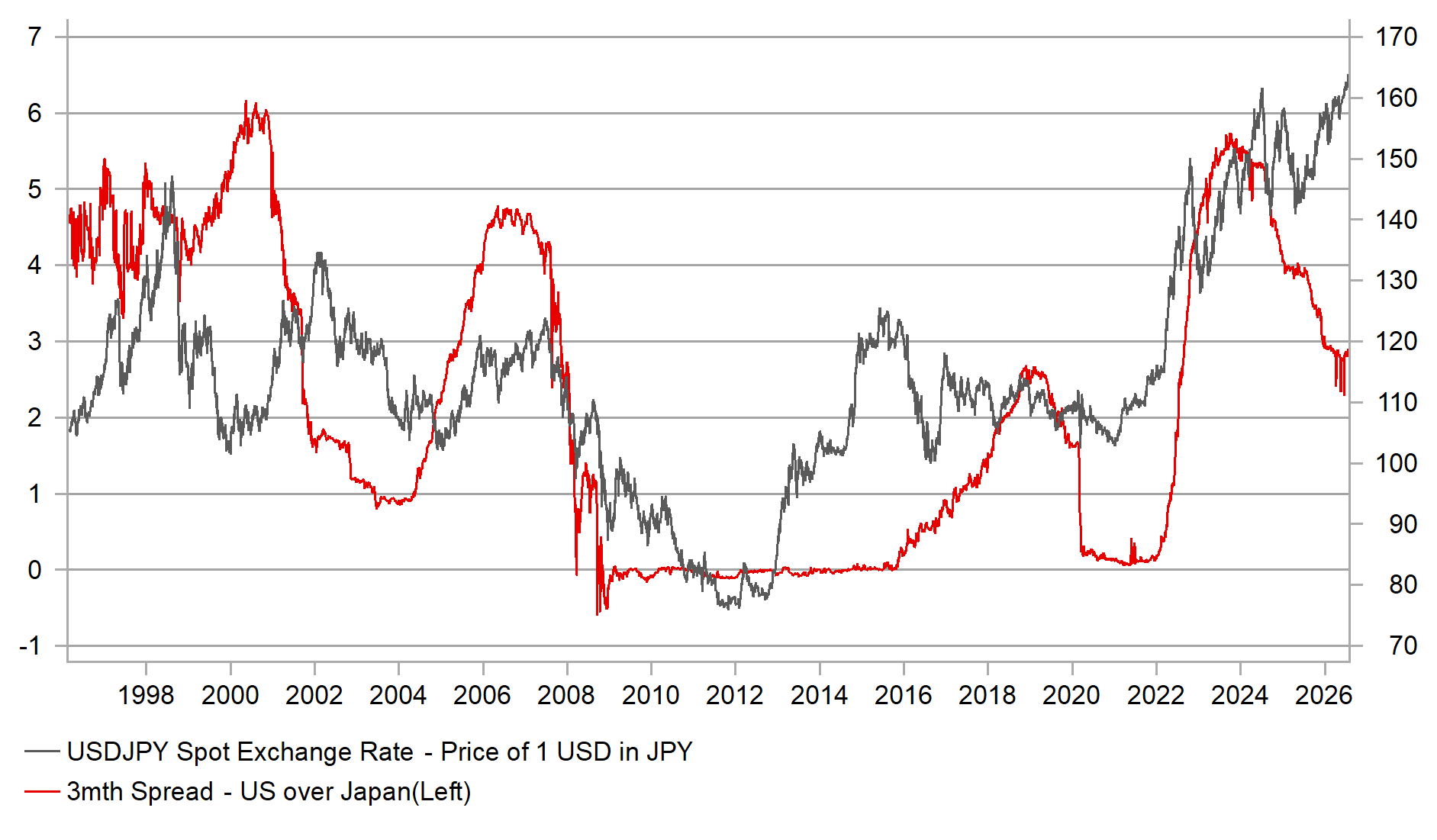
Source: Bloomberg, Macrobond & MUFG GMR
EUR/CHF: Energy shock is weighing more on CHF than EUR so far
The main development over the past week has been the sharp rebound in energy prices in response to heightened geopolitical tensions in the Middle East. Renewed tit-for-tat military strikes involving Israel and the US are on course to extend into a third week, with no clear indication yet that a ceasefire will be restored anytime soon. Global energy supplies also face a new threat from the Houthis in Yemen, who have imposed a maritime embargo on Saudi Arabia. The Houthis have since claimed responsibility for missile and drone attacks targeting two Saudi oil tankers in the Red Sea. Saudi Arabia has become increasingly reliant on Red Sea export routes via its East-West pipeline since disruptions to shipping through the Strait of Hormuz began. According to Bloomberg, around 4 million barrels per day of crude oil are currently being transported along routes that are exposed to potential Houthi attacks.
The latest developments have increased the risk of a more severe energy price shock for the global economy. Brent crude has surged back above USD 100 per barrel and is now trading more than 40% above its pre-conflict level. At the same time, European natural gas prices have climbed to their highest levels since the conflict began, adding to downside risks for the region's economies. This comes at a time when European economies had initially proved more resilient to the energy shock than expected, with economic data surprising to the upside over the past month. However, if higher energy prices persist, sustaining that resilience will become increasingly challenging. A prolonged energy shock would pose a greater threat to growth and increase downside risks to our EUR forecasts. Our baseline assumption had been for EUR/USD to move back towards 1.2000 as the energy shock gradually faded. However, recent unfavourable developments raise the risk of a decisive break below the lower end of the current 1.1400 to 1.1800 trading range, potentially ushering in a new lower range.
In recent weeks, euro area yields have risen by more than US yields as higher energy prices have prompted investors to price in additional ECB tightening, moving yield spreads in the EUR's favour. However, we remain unconvinced that a narrower yield differential will be sufficient to prevent further EUR weakness if the energy shock intensifies. At this week's policy meeting (click here), the ECB left rates unchanged following its first hike in June, while updated guidance kept the door open to another hike in September. While we continue to view a September hike as the most likely final move in the current tightening cycle, we acknowledge that persistently higher energy prices could prompt an additional increase later this year by raising concerns about second-round inflation effects. Any support for the EUR from further ECB tightening is also likely to be offset by a growing risk that the Fed starts hiking in the autumn. Sustained upward pressure from energy prices would make it increasingly difficult for Fed Chair Kevin Warsh to avoid backing up recent hawkish inflation rhetoric with action.
WORSENING ENERGY SHOCK WEIGHS ON EUR
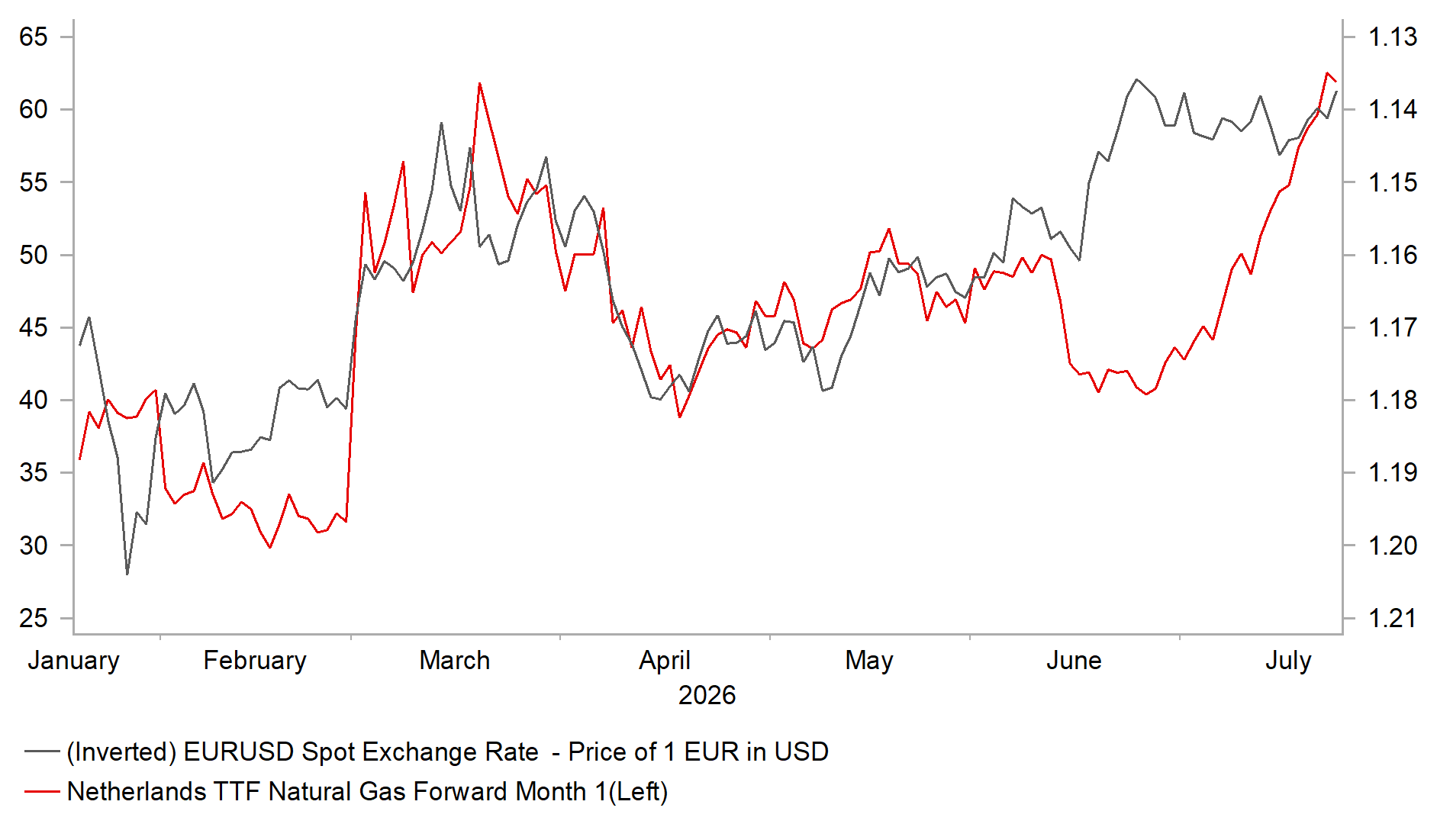
Source: Bloomberg, Macrobond & MUFG
YIELD SPREADS NOT SUFFICIENT TO SUPPORT EUR
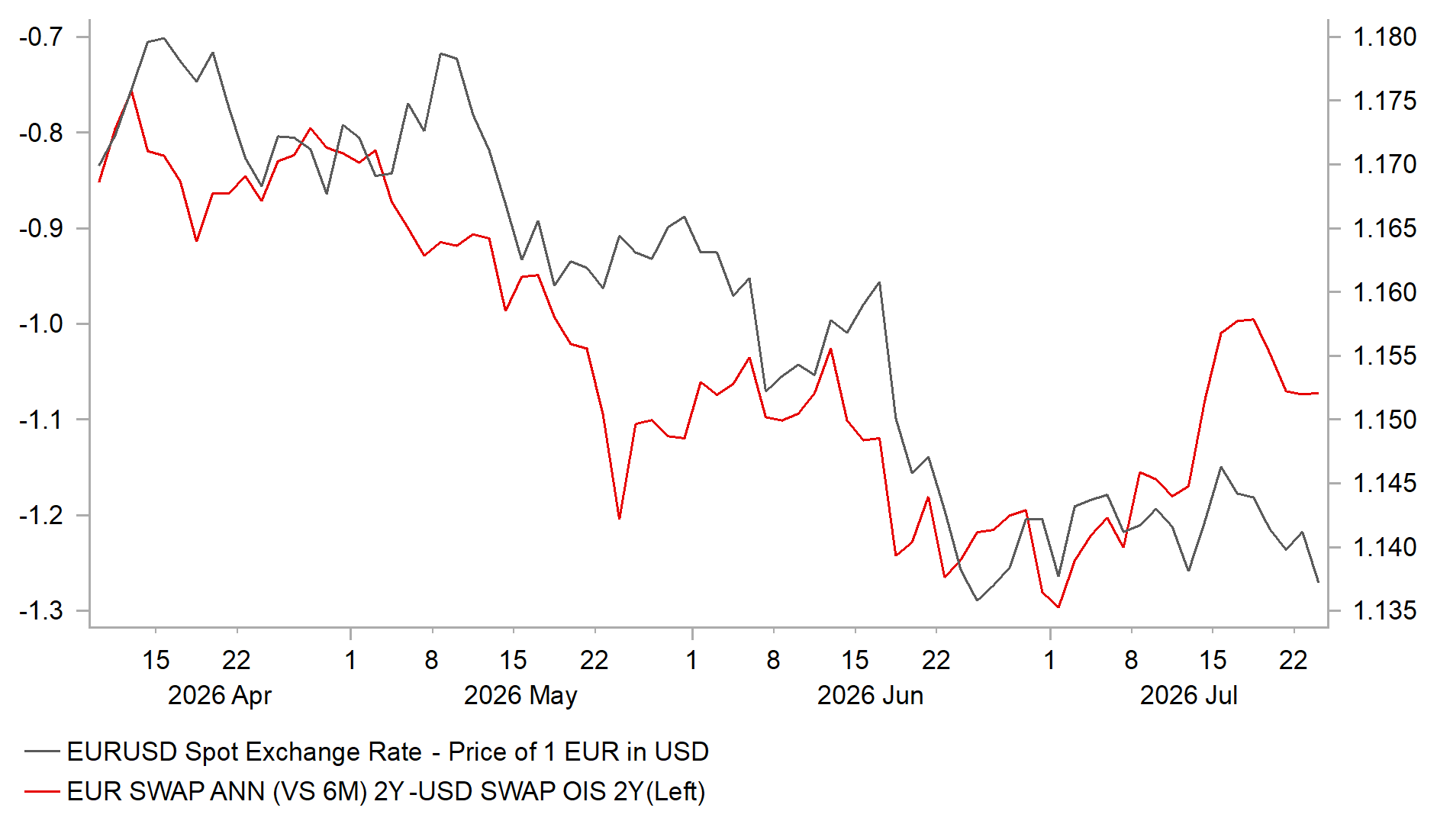
Source: Bloomberg, Macrobond & MUFG
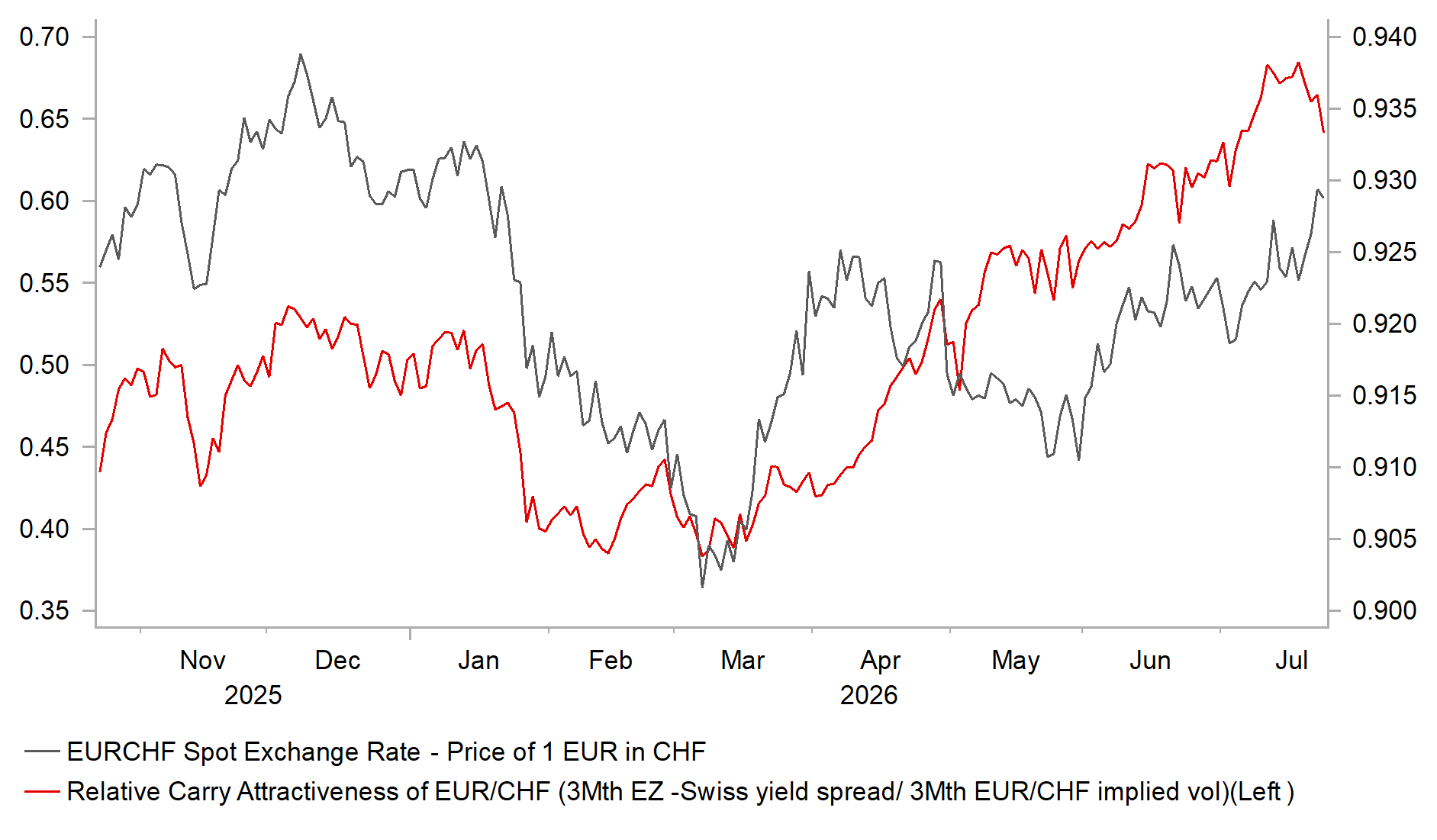
The clearest positive impact of higher euro area yields on the EUR has been against the Swiss franc. EUR/CHF has risen back above the 0.9300 level for the first time this year, with the CHF weakening even more than the EUR since the US-Iran conflict began. This marks a sharp contrast with 2022, when the CHF was one of the best-performing G10 currencies alongside the USD during the energy shock triggered by Russia's invasion of Ukraine. However, it is worth remembering that the CHF only began to strengthen meaningfully from June 2022, when the SNB adopted a more hawkish stance towards inflation risks. The SNB raised rates by 50bps in June and signalled that a stronger franc could help contain imported inflation. It subsequently reinforced that message through foreign exchange intervention, selling CHF 27.3 billion of foreign currency from the fourth quarter of 2022. Today, by contrast, the SNB appears less willing to tolerate a stronger currency, helping to explain the CHF's relative underperformance.
It stands in contrast to the SNB's current policy stance, which has been geared towards preventing an excessive appreciation of the CHF. Minutes from the 18th June policy meeting revealed that policymakers saw "no immediate need for action", while acknowledging that inflation risks had increased in recent months. The lower starting point for inflation this year has given the SNB greater flexibility than it had during the 2022 energy shock. However, oil prices have since risen by more than 20%, adding to upside inflation risks and increasing the likelihood that the SNB may need to reconsider its policy stance if higher energy prices prove persistent. For now, Swiss rate markets remain relatively relaxed, pricing in just 3bps of tightening by September and around 15bps by year-end. Market participants will also be closely monitoring any shift in the SNB's approach to the currency. At its June meeting, the SNB continued to signal a willingness to intervene in the foreign exchange market to weaken the CHF, reflecting concerns over the risk of a "rapid and excessive appreciation" amid heightened geopolitical uncertainty. So far, there has been little indication that policymakers are becoming more tolerant of a stronger CHF despite building inflationary pressures.
Another factor behind the CHF's weak performance during the current energy shock has been the resilience of risk assets, which has reduced safe-haven demand. MSCI's global equity index has risen by more than 10% this year, as optimism surrounding the continued expansion of AI investment and adoption (click here) has offset concerns over disruptions to global energy supplies. This stands in sharp contrast to 2022, when the same index had fallen by more than 20% by this point in the year. Financial market conditions are therefore far more supportive of FX carry trades, encouraging investors to sell low-yielding currencies such as the CHF. The current period of low volatility could also be viewed as a contrarian indicator, signalling the risk of a disorderly carry unwind. Potential catalysts include the intensifying energy price shock, more aggressive central bank tightening, and/or a sharp correction in AI-related equities.
SNB IS STILL CONCERNED BY RISK OF STRONGER CHF
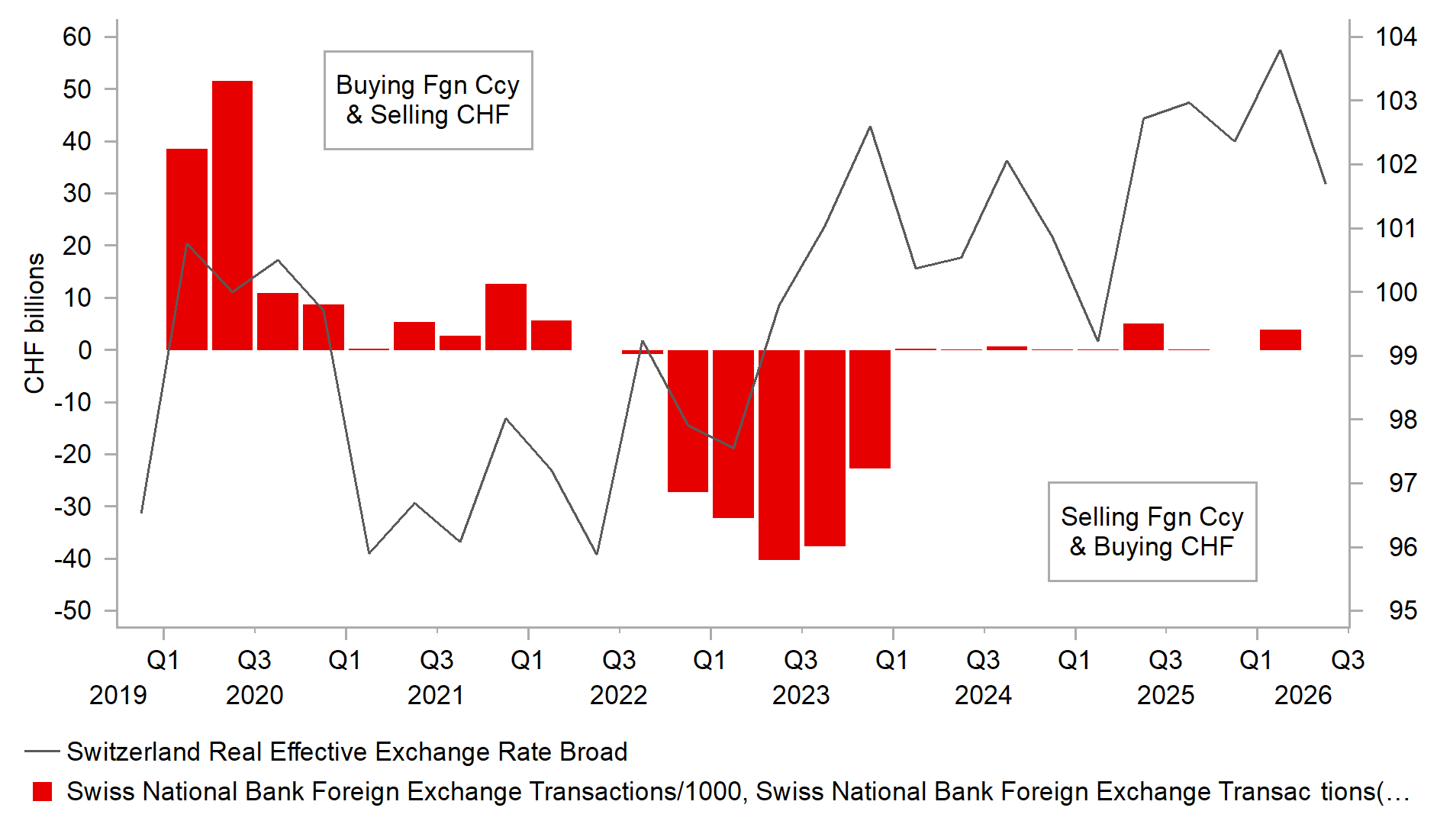
Source: Bloomberg, Macrobond & MUFG GMR
CHF HAS BECOME MORE ATTRACTIVE AS A FUNDER
Source: Bloomberg, Macrobond & MUFG GMR
Weekly Calendar
Ccy | Date | BST | Indicator/Event | Period | Consensus | Previous | Mkt Moving |
EUR | 27/07/2026 | 09:00 | Germany IFO Business Climate | Jul | -- | 85.6 | !! |
USD | 27/07/2026 | 13:30 | Durable Goods Orders | Jun P | 1.3% | -4.5% | !! |
AUD | 28/06/2026 | 04:05 | RBA's Bullock-Speech | !! | |||
USD | 28/06/2026 | 13:30 | Advance Goods Trade Balance | Jun | -$97.8b | -$105.9b | !! |
USD | 28/06/2026 | 15:00 | Conf. Board Consumer Confidence | Jul | 92.0 | 91.2 | !! |
AUD | 29/07/2026 | 02:30 | CPI YoY | Jun | -- | 4.0% | !!! |
SEK | 29/07/2026 | 07:00 | GDP Indicator SA QoQ | 2Q | -- | -0.2% | !! |
EUR | 29/07/2026 | 09:00 | ECB Wage Tracker | !! | |||
CAD | 29/07/2026 | 18:30 | BoC Summary of Deliberations | !! | |||
USD | 29/07/2026 | 19:00 | FOMC Rate Decision (Upper Bound) | 3.75% | 3.75% | !!! | |
EUR | 30/07/2026 | 06:30 | France GDP QoQ | 2Q P | -- | -0.1% | !! |
SEK | 30/07/2026 | 07:00 | Retail Sales MoM | Jun | -- | -0.2% | !! |
CHF | 30/07/2026 | 08:00 | KOF Leading Indicator | Jul | -- | 101.2 | !! |
EUR | 30/07/2026 | 10:00 | GDP SA QoQ | 2Q A | -- | -0.2% | !!! |
EUR | 30/07/2026 | 10:00 | Unemployment Rate | Jun | -- | 6.2% | !! |
GBP | 30/07/2026 | 12:00 | Bank of England Bank Rate | 3.75% | 3.75% | !!! | |
EUR | 30/07/2026 | 13:00 | Germany CPI YoY | Jul P | -- | 2.3% | !!! |
CAD | 30/07/2026 | 13:30 | Payroll Employment Change - SEPH | May | -- | 22.0k | !! |
USD | 30/07/2026 | 13:30 | Core PCE Price Index MoM | Jun | 0.1% | 0.3% | !!! |
USD | 30/07/2026 | 13:30 | GDP Annualized QoQ | 2Q A | 2.3% | 2.1% | !!! |
JPY | 31/07/2026 | 00:30 | Tokyo CPI YoY | Jul | -- | 1.7% | !! |
JPY | 31/07/2026 | 00:50 | Industrial Production MoM | Jun P | -- | 0.1% | !! |
JPY | 31/07/2026 | Tbc | BOJ Target Rate | -- | 1.00% | !!! | |
NOK | 31/07/2026 | 07:00 | Unemployment Rate SA | Jul | -- | 2.0% | !! |
EUR | 31/07/2026 | 07:45 | France CPI YoY | Jul P | -- | 1.8% | !! |
EUR | 31/07/2026 | 08:55 | Germany Unemployment Change (000's) | Jul | -- | -1.0k | !! |
EUR | 31/07/2026 | 10:00 | CPI Estimate YoY | Jul P | -- | 2.8% | !!! |
CAD | 31/07/2026 | 13:30 | GDP MoM | May | -- | 0.5% | !! |
USD | 31/07/2026 | 13:30 | Employment Cost Index | 2Q | 0.8% | 0.9% | !! |
Source: Bloomberg & MUFG GMR
Key Events:
There is a busy week ahead for central bank policy meetings. The sharp rebound in energy prices following the renewed conflict between the US and Iran is increasing pressure on central banks to deliver more hawkish policy signals. We expect the Fed to leave rates unchanged in the week ahead. However, the decision may not be unanimous. Dallas Fed President Lorie Logan recently stated that she believes “modestly higher interest rates would better balance the outlook and risks”. With the Fed moving away from forward guidance under new Chair Kevin Warsh, it is unclear whether the updated policy statement and press conference will provide much additional insight into the likelihood of rate hikes this year.
The BoJ's policy meeting could attract greater attention in the week ahead after Bloomberg reported that policymakers are open to a faster pace of rate hikes. The continued weakness of the JPY is reportedly adding to concerns over upside inflation risks, alongside higher energy prices. This supports our forecast for the BoJ to raise rates again as early as September. The BoJ is also expected to revise higher its growth forecast for the current fiscal year up from 0.5%. In addition, policymakers are reportedly considering changing their assessment that risks to the economy are "skewed to the downside", although such a revision may now be less likely given the rise in oil prices back towards USD100 per barrel.
The BoE is expected to leave rates unchanged in the week ahead, although the vote is unlikely to unanimous. At the June meeting, MPC members Huw Pill and Megan Greene dissented by voting in favour of a rate hike. Catherine Mann appears to be the next member most likely to join them, although mixed inflation developments in the UK could result in another 7-2 vote to keep rates unchanged. Headline inflation has surprised on the downside for three consecutive months through June, but the recent sharp rebound in energy prices highlights that upside inflation risks remain a significant concern.