

BoE review: Not done yet
Macro view: The BoE raised Bank Rate by 25bp to 4.00%, as expected, but it was a hawkish outing. The vote split was 8-1 in favour of a 25bp hike, with one dissenter pushing for 50bp. Policymakers also clearly signalled that this should not be viewed as a ‘one-and-done’ move amid a materially worse near-term inflation outlook. However, the BoE stopped short of validating the more aggressive tightening cycle currently priced by markets – indeed Governor Bailey was quite explicit in pushing back against the idea of an inevitable sequence of hikes. We therefore stick with our call for a follow-up hike in February, taking Bank Rate to 4.25%, while acknowledging that today's communication has increased the likelihood of a December move. The energy backdrop will remain the key factor. Current pricing points to a lower inflation peak than the BoE presented today, which, if maintained, would take out some of the urgency to act.
Markets view: The BoE’s hawkish policy update initially pushed short-term UK yields higher and reinforced the bullish outlook for GBP. Markets have priced in a greater risk of another hike as soon as December, although the timing remains highly dependent on energy prices and evidence of second-round inflation effects. Stronger-than-expected UK growth and the prospect of further tightening should remain supportive for GBP heading into year-end. However, the deepening sell-off in AI-related tech stocks could dampen upside for UK rates and the GBP.
Macro view: A hawkish hike but no pre-set path
The BoE hikes as expected – and it’s not done yet
The BoE raised Bank Rate by 25bp to 4.00%, as expected. It is the first UK rate hike since August 2023 and sees the BoE join other major central banks in responding to the energy shock with tighter policy. In our preview (see here) we wrote that it was no longer tenable for the MPC to continue sitting on its hands. That view was universally shared with all nine members supporting tighter policy. The sole dissent came from self-styled 'activist' voter Catherine Mann, who opted for a larger 50bp hike, making it an 8-1 split in favour of 25bp.
The accompanying communication was also broadly hawkish. There was a clear sense that this should not be seen as a ‘one-and-done’ hike. Indeed, Governor Bailey noted in his individual statement that he can “see the argument for a further increase in rates”.
We’d highlight that ‘increase’ singular feels significant here. Policymakers stopped short of endorsing the sort of fully-fledged tightening cycle which is currently priced by market participants. Bailey said in the press conference that “today's increase should not be seen as the first in an inevitable long sequence of hikes”. There was also another acknowledgement that market pricing probably reflects risk premia associated with uncertainty surrounding the conflict and inflation outlook.
In terms of projections, the BoE is now tracking headline inflation to peak at 4.9% next year, from ‘slightly above 4%’ at the last meeting in September. Further ahead the BoE sees inflation falling back to (indeed slightly below) target over the medium term. On growth, Q3 GDP growth expectations were also revised higher, from 0.4% to 0.7% Q/Q, in line with our tracking. However, medium-term growth projections remain relatively subdued with higher energy costs and tighter financial conditions expected to weigh on demand.
Against that backdrop, today’s hike, and indeed the probable follow-up move, should be seen as risk management positioning. The MPC continues to frame it as primarily an energy-driven price shock rather than a domestic problem. However, the persistently volatile energy backdrop and looming uptick in headline inflation have raised the risk of broader pass-through, and it is this which has prompted policy action.
December or February?
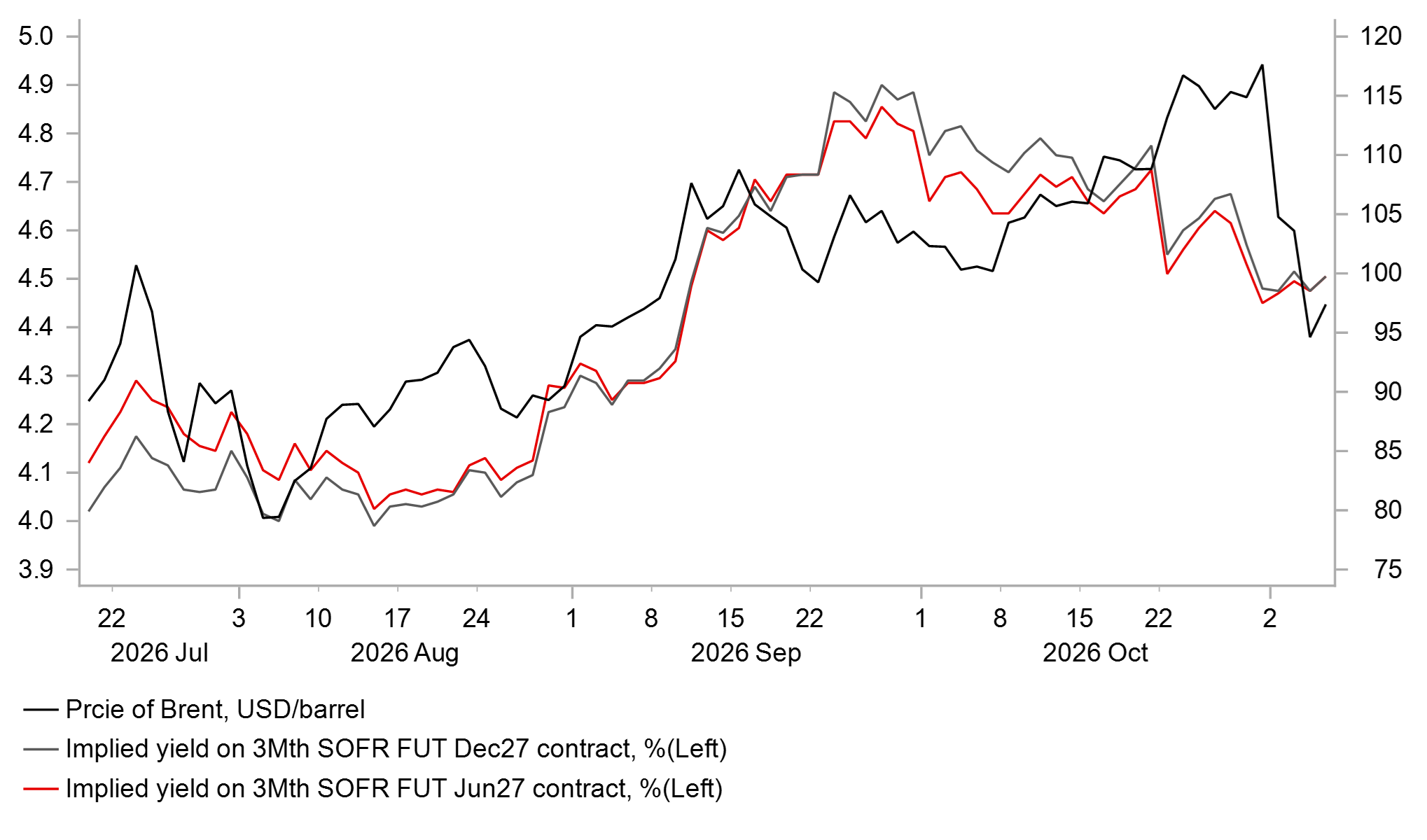
Looking ahead, market pricing for a December hike has increased and is now seen as marginally odds-on. As we noted in the preview, there will be plenty of data between meetings which might support a move if the BoE is minded to go back-to-back. That includes two CPI and labour market reports and business surveys. Based on Bailey’s comments in the Q&A the most important factor will likely be the energy backdrop, however. Any urgency to tighten would be reduced if the retracement in prices seen over the last 48 hours sticks.
Indeed, it’s quite possible that the BoE will revise its peak CPI assumption downward in December, which would weaken the case for an immediate follow-up. The 27 October cut-off date for market-based assumptions used for projections came ahead of the recent decline in wholesale prices after the US midterm elections. If current energy prices are maintained then fuel prices would have less of an upward effect on inflation over coming months (the MPR projections assumed that oil prices would only fall to the current level of ~95 USD/bbl by May next year). However, a lot of the uptick in inflation is already baked in. The observation period for the January Ofgem price cap is now largely complete and the increase in utility bills alone is expected to add around 0.4pp to the headline rate. All told, our current tracking is for a peak of ~4.6% vs the BoE’s 4.9%.
The other point worth noting is that the closer we get to year-end, the more informative survey evidence on 2027 annual pay settlements will become. As things stand, forward-looking wage expectations seem relatively contained amid plenty of signs of labour market slack. If annual pay settlements remain broadly benign, as seems likely to our minds, then the MPC might be more able to look past an uptick in headline inflation between now and December – especially if energy prices remain close to/lower than current levels.
Our base case remains one further hike in February, the next projection meeting, completing a moderate and gradual tightening cycle. While other central banks have already raised rates, we don’t subscribe to the view that the BoE was behind the curve coming into this – policy was already in restrictive territory, and financial conditions had tightened as previously-expected cuts were priced out after the start of the conflict. We would characterise the BoE as leaning a bit more forcefully against inflation risks rather than playing catch-up.
That said, today's broadly hawkish tone does shift the balance of risks. A December move and a terminal rate of 4.5% are both more plausible now. The energy backdrop will remain the key swing factor for the former, while more concrete evidence of second-round effects would be needed, we think, for a higher terminal rate.
Markets view: UK yields head higher but limited impact on GBP
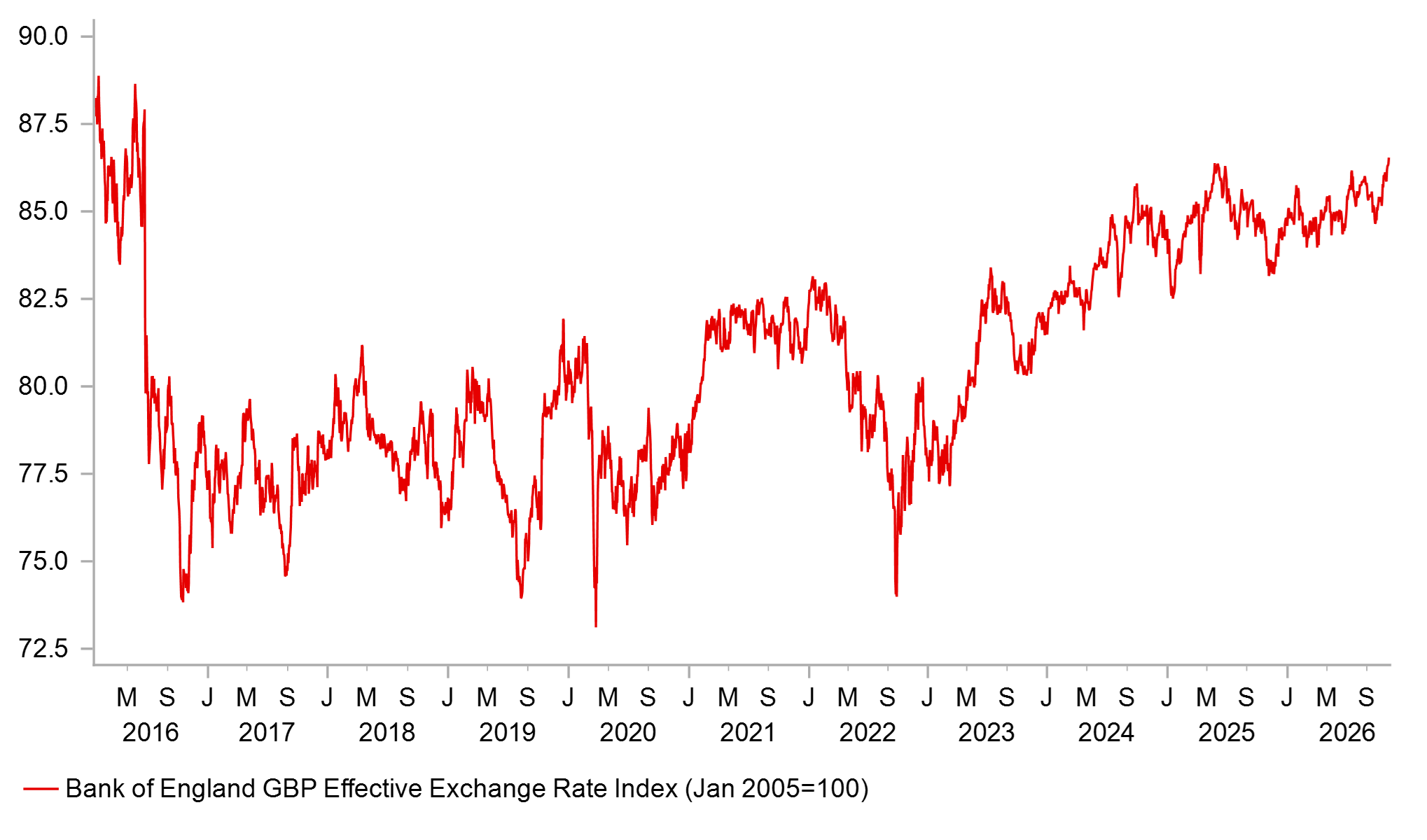
Hawkish BoE policy update should reinforce GBP’s bullish trend
The biggest financial market reaction to today’s BoE policy update was at the short end of the UK yield curve. The yield on the 2-year Gilt initially increased by around 6bps as market participants have priced back in more BoE rate hikes over the coming years. In contrast, yields at the long end have increased by less, resulting in the UK rate curve continuing to flatten. The yield spread between 2- and 10-year Gilts has fallen to its lowest level since March 2025, at around 36bps. However, those initial moves have quickly reversed triggered by the deepening sell-off in AI-related equities. The Nasdaq equity index has fallen sharply by around 5% and is currently undergoing the largest correction lower since the first four months of 2025.
The path for UK rates and BoE policy remains highly dependent on energy prices, evidence of second-round inflation effects and tightening financial conditions. In the accompanying press conference, Governor Bailey stated clearly that there was a strong case for another rate hike if the US-Iran conflict is not resolved. It was a view shared by the majority of other MPC members, with Catherine Mann, Huw Pill, Megan Greene and Clare Lombardelli all leaning towards at least one more hike. We have been forecasting that the BoE will follow up today’s hike with another increase in February next year, but acknowledge that there is now a higher risk of a back-to-back hike in December. The UK rate market is now attaching around 13bps of hikes by December.
One important caveat is that Governor Bailey indicated that the BoE will be mainly focused on energy price developments heading into year-end. The price of oil has dropped sharply over the past week, which was not incorporated in the BoE’s updated economic forecasts. If oil prices remain at much lower levels, reflecting perhaps progress towards a US-Iran deal following the US mid-term elections, the BoE may be more inclined to hold off on hiking rates again as soon as next month. After one more hike, the case for further increases is judged as less clear-cut by MPC members. Governor Bailey stated, “I’m not going to sign up to the idea of ‘two-and-done’” while emphasising that a series of hikes is “not inevitable”. The BoE will be watching closely for evidence of building second-round effects to assess whether further rate hikes are required in 2027. At the same time, a deeper sell-off in AI stocks and resulting tightening of global financial conditions could dampen the BoE’s willingness to tighten policy further.
Today’s hawkish hike from the BoE is supportive of the GBP, although the initial impact has been muted. The GBP is already trading close to year-to-date highs against the EUR and briefly rose back above 1.3500 overnight against the USD. The GBP has recently been supported by growing optimism over stronger UK growth, higher UK yields and fiscal concerns becoming a bigger market issue in the euro area than in the UK. At today’s policy meeting, the BoE acknowledged that UK growth has surprised positively, partly reflecting stronger exports and an AI-related investment and productivity boost. In the near term, stronger activity suggests less spare capacity in the economy and has added to the case for tighter monetary policy. However, the inflation implications are ambiguous. The BoE still needs to determine whether the recent improvement in productivity represents a persistent increase in the economy’s supply capacity. Overall, today’s hawkish BoE policy update should reinforce the GBP’s bullish momentum heading into year-end. One downside risk for the GBP would be a deeper sell-off for AI stocks and tightening of financial conditions given the GBP’s role as more of a high yielding G10 currency.
TWI GBP AT POST-BREXIT HIGH
Source: Bloomberg, Macrobond & MUFG GMR
HIGHER OIL PRICE & BOE RATE HIKE EXPECTATIONS
Source: Bloomberg, Macrobond & MUFG GMR