

Moody’s reprieve for euro but downside risks remain
EUR: France avoids another credit rating downgrade ahead of ECB meeting
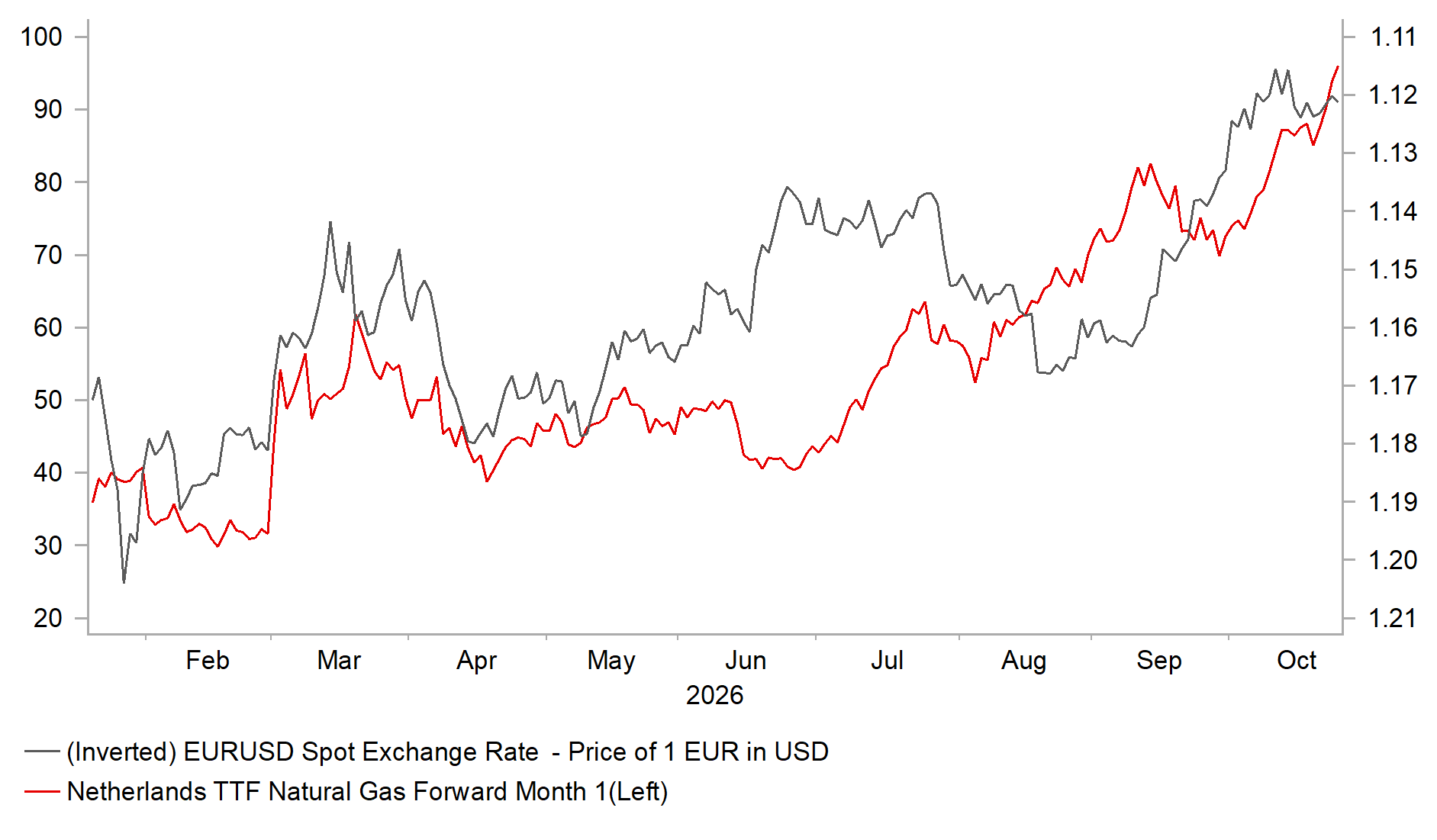
The euro has gained modestly at the start of the new week after falling to fresh year-to-date lows against the pound and yen. It is currently the worst performing G10 currency this month undermined both rising energy prices and heightened investor concerns over fiscal and political risks in France. The price of natural gas in Europe has risen sharply this month by more than a third lifting it above EUR 90/MWh heading into the winter reinforcing stagflation risks for the euro area economy. So far this year the euro area economy has proven more resilient than expected to the energy price shock but the release of the euro area PMI survey at the end of last week signalled that growth momentum may be about to soften. The euro area composite PMI fell by 1.2 points to 51.9 in October, and even more sharply in France by 2.7 points to 48.4. The bigger drop in business confidence in France is no surprise given the recent tightening of financing conditions and social unrest which has undermined sentiment. France’s economy was already underperforming this year prior to the recent negative shock. A further loss of growth momentum will make it even harder for the government to meet their 1.0 growth target for next year assumed in their Budget plans.
However, the French government received a reprieve at the end of last week when Moody’s announced it would leave France’s credit rating unchanged at Aa3 one notch above S&P and Fitch. They noted that France’s credit rating was underpinned by its wealthy and diversified economy as well as its highly competent public institutions. However, they did acknowledge that the strength of the institutional framework is facing recurrent tests from a divided parliament, often at odds with the government on policy priorities or implementation, as well as periods of political and social instability. The high and rising debt burden as well as weakening debt affordability metrics are other key challenges. The debt burden is higher than they had forecast in their last review and government bond yields have risen more rapidly, while widespread social protests have erupted which could constrain fiscal consolidation efforts.
Crucially, Moody’s is assuming that the deficit reduction budget for next year is adopted, while financing costs and social tensions abate somewhat in the coming months. Moody’s is currently forecasting modest fiscal tightening next year lowering the budget deficit from 5.4% of GDP to 5.2%. They emphasized that a significant and sustained fiscal effort will still be needed beyond the presidential elections. They acknowledged that the sharp rise in government borrowing costs in recent months is adding to risk for a further weakening of France’s debt affordability although the weighted average maturity of government debt of around 8.5 years means that the increase in yields needs to be sustained over an extended period of time to have a meaningful impact on debt affordability metrics. Moody’s kept France’s credit rating on negative watch and stated a downgrade would likely result from further evidence that the ability of the legislative institutions to take measures that would prefer a rapid and prolonged deterioration of debt affordability has weakened. Other potential triggers include pausing or reversing key provisions of structural reforms such as pension reforms, and a further escalation in geopolitical risk.
We don’t expect Moody’s decision to leave their rating on hold to bring much relief for French bonds or the euro, although it may prevent further selling at the start of this week ahead of the ECB’s upcoming policy meeting. The ECB’s upcoming policy meeting has more potential to be a bigger market mover, although we believe it is too soon to expect the ECB to announce policy measures to support government bond markets. Please see our latest FX Weekly report for more details (click here).
NATURAL GAS PRICES COULD DRAG THE EURO FURTHER LOWER
Source: MUFG Research, Macrobond, Bloomberg
USD: Central bank meetings in focus
Five G10 central banks meet this week with the RBNZ, BoC and Federal Reserve all meeting on Wednesday followed by the ECB on Thursday and the BoJ on Friday. We expect the RBNZ and the BoC to hike by 25bps while the Fed, ECB and the BoJ to remain on hold. That’s what the OIS market is close to indicating as well with the RBNZ and BoC pricing to hike by 25bps close to 90%.
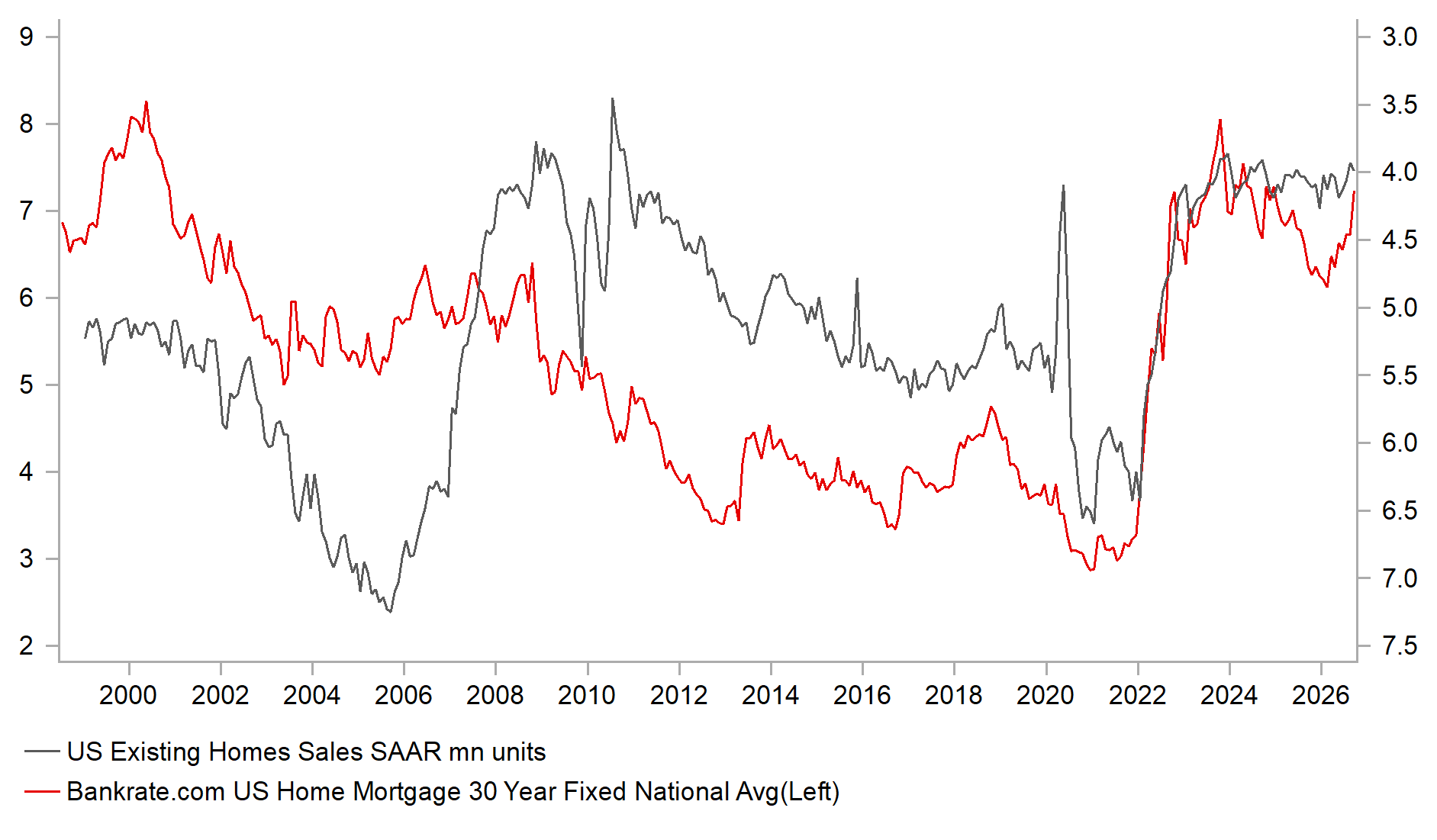
The key event though will still be the Fed on Wednesday and what kind of communication Fed Chair Warsh delivers. While there is only 2bps of hikes priced for Wednesday, the December meeting is priced at 21bps and hence some hawkish signals will be required for the pricing to remain justified. The Fed will not want to alter those expectations dramatically and in general there are no strong signals of concern that would justify at this point a shift away from the current median dot profile of one further hike this year that was communicated in September. Still we would argue there are some amber flashing lights. The Nasdaq is 6% down from the record closing high in October and the data is beginning to show the interest rate sensitive housing market starting to weaken further. Last week housing starts fell 5.2%; pending home sales fell 7.3%; and the weekly mortgage applications showed a seventh consecutive drop, the longest run of consecutive declines since November 2022 when rates had surged due to the global inflation shock.
The pricing for a hold on Wednesday has been sustained despite a stronger than expected CPI report for September that tells you other factors are at play. The AI sell-off, the housing-related data and turmoil in the French bond market underline the impact of tightening financial conditions. The final FOMC meeting of the year is not until 9th December and the signs of tightening financial conditions continue to build so there is certainly a chance that Fed rate hike expectations for December could ease.
In that context, the willingness of Warsh to signal the Fed remains on the path highlighted by the dots will be important. In circumstances of tightening financial conditions and bond market volatility in Europe we would assume the dollar will remain underpinned, and the risks remain skewed to the upside.
US MORTGAGE RATES CONTINUE TO DEPRESS HOME SALES
Source: MUFG Research, Macrobond, Bloomberg
KEY RELEASES AND EVENTS
Country | BST | Indicator/Event | Period | Consensus | Previous | Mkt Moving |
DE | 09:00 | German Business Expectations | (Oct) | - | 90.4 | !! |
DE | 09:00 | German Ifo Business Climate Index | (Oct) | 90.0 | 89.9 | !! |
DE | 09:00 | German Current Assessment | (Oct) | - | 89.5 | !! |
GB | 11:00 | CBI Distributive Trades Survey | (Oct) | -47 | -55 | ! |
US | 12:30 | Chicago Fed National Activity | (Sep) | - | -0.04 | ! |
US | 14:30 | Dallas Fed Mfg Business Index | (Oct) | - | 9.8 | ! |
US | 17:00 | 2-Year Note Auction | - | - | 4.787% | !! |
JP | 23:50 | Corporate Services Price Index (CSPI) (YoY) | - | 3.7% | 3.7% | ! |
Source: Bloomberg & Investing.com