

To read the full report, please download PDF.
No relief in sight for the EUR
FX View:
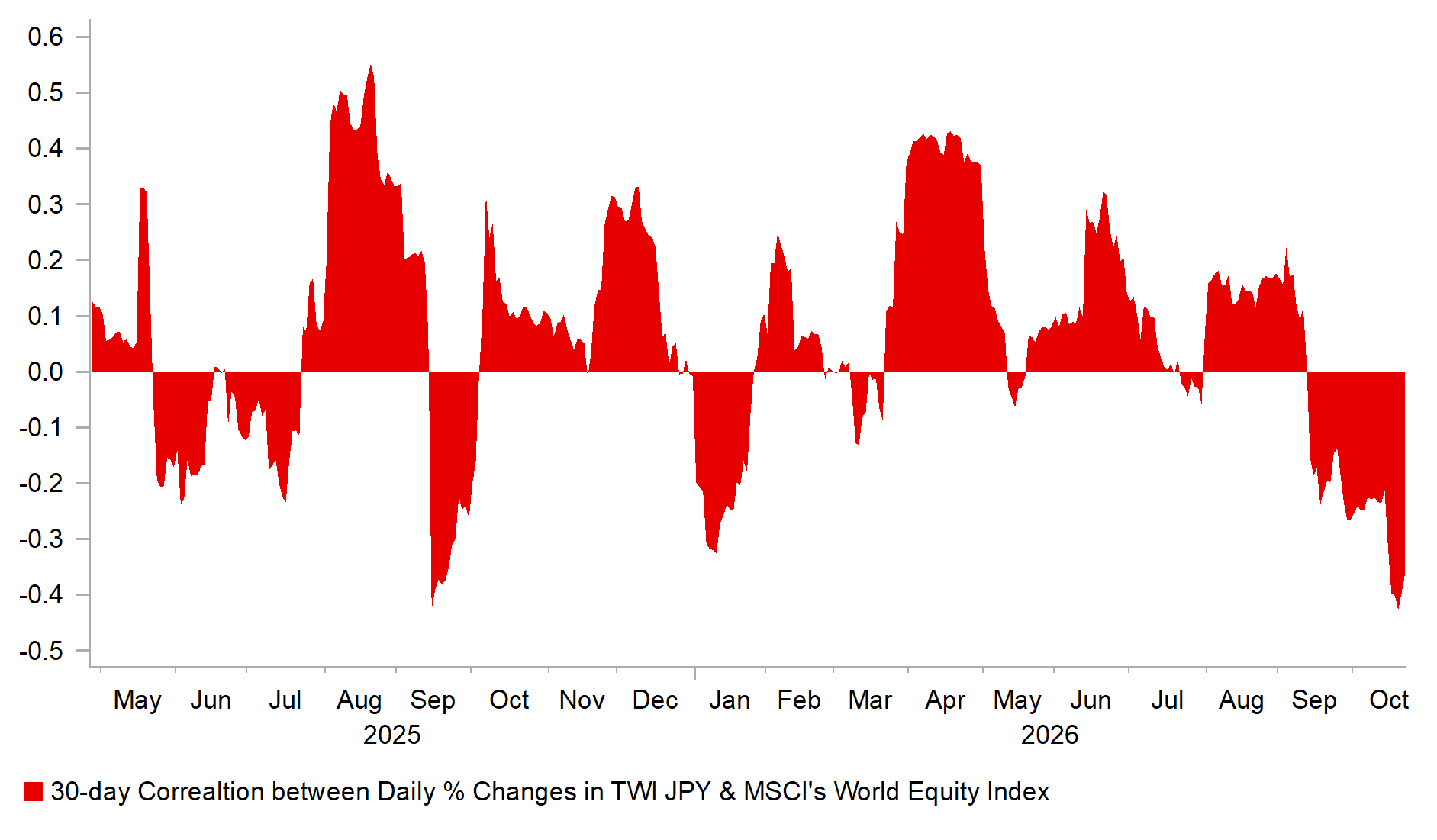
The EUR has continued to weaken over the past week, falling to fresh year-to-date lows against both GBP and JPY. Rising energy prices and fiscal risks in France have reinforced EUR weakness ahead of the ECB’s upcoming policy meeting, making it more difficult for the ECB to calibrate monetary policy. Tighter financial conditions are likely to reduce the extent to which the ECB needs to raise rates in response to higher energy prices. In contrast, upcoming policy updates from the Fed and BoJ could strike a relatively more hawkish tone while leaving rates on hold, signalling that more work remains to address upside inflation risks. Investors have become more risk-averse this week, boosting safe-haven demand for the CHF and JPY. The JPY’s negative correlation with global equity market performance has strengthened. We expect challenging financial market conditions to persist in the week ahead reflecting ongoing concerns over higher government bond yields, energy prices and the recent paring back of AI-related investment optimism.
ANOTHER BAD WEEK FOR THE EUR
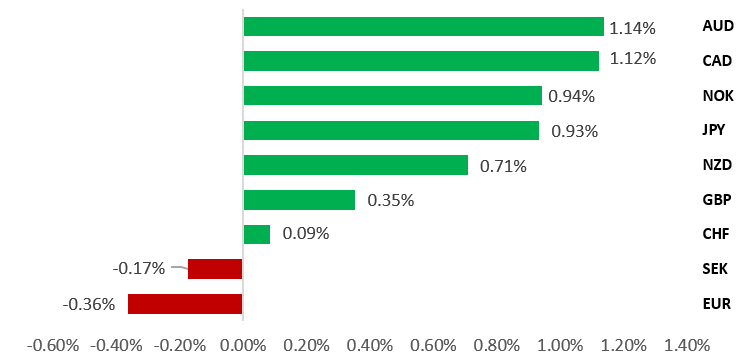
Source: Bloomberg, close on 23rd October 2026 (Weekly % Change vs. USD)
Trade Ideas:
We are maintaining a short EUR/JPY trade idea.
IMM FX Positioning:
The largest weekly changes in leveraged fund positioning were: (i) an increase in short CAD positions of 8,487 contracts; (ii) an increase in short EUR positions of 23,740 contracts; (iii) an increase in short JPY positions of 8,630 contracts; (iv) a decrease in long CAD positions of 11,363 contracts; and v) an increase in short NZD positions of 10,832 contracts. It was the largest short EUR position since October 2021.
What happens to the dollar after US tech credit cracks?:
US IG tech-credit stress and falling Treasury yields point to greater USD downside risk, with EUR and CHF supported.
FX Views
G4 FX: EUR weakens further ahead of next week’s ECB policy meeting
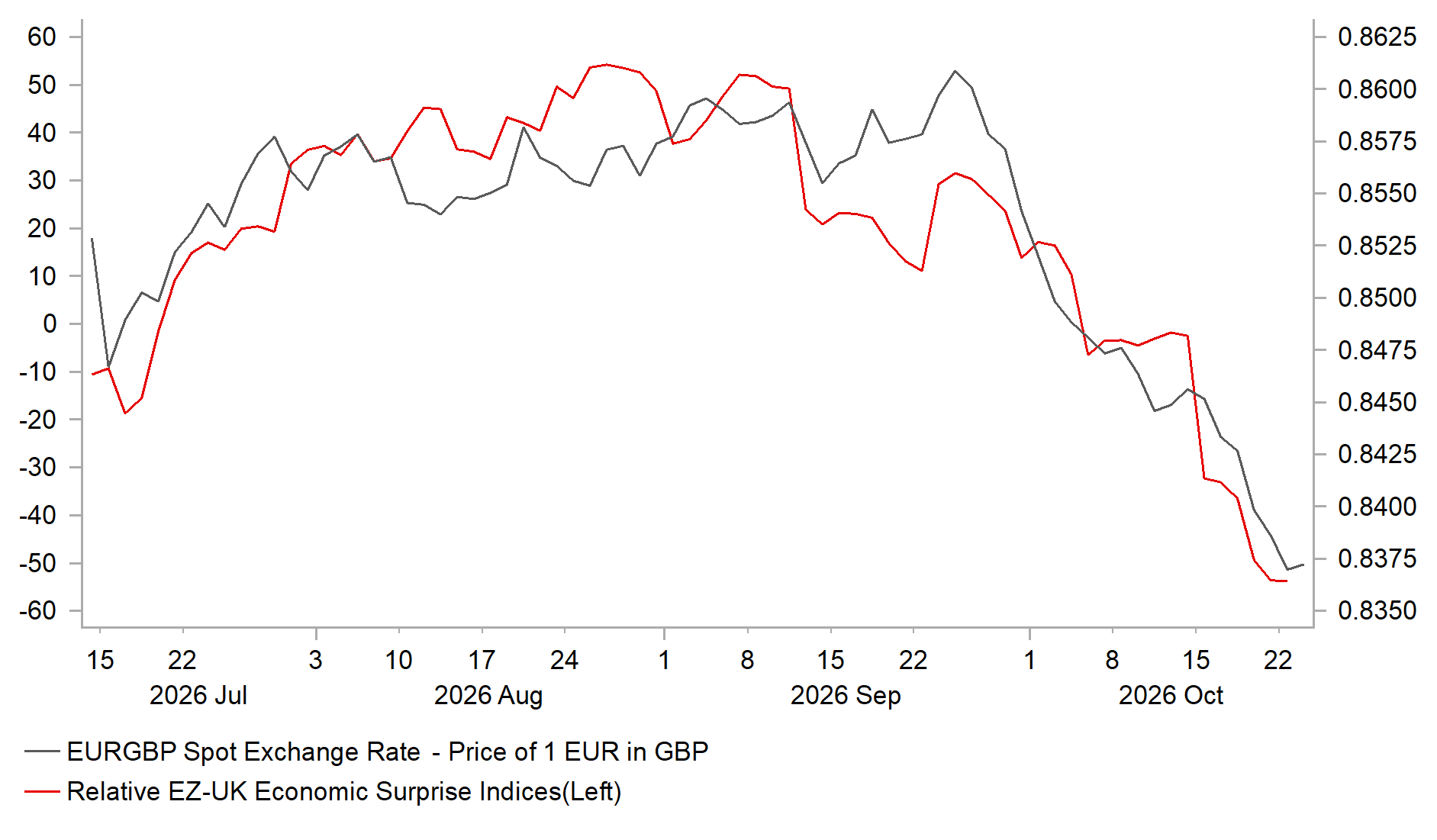
The EUR has continued to underperform over the past week, falling to fresh year-to-date lows against both GBP and JPY. EUR/GBP has fallen below the 0.8400 level for the first time since May last year, while EUR/JPY has moved within touching distance of the 175.00 level for the first time in just over a year. The two main drivers behind the weaker EUR have been the worsening energy price shock and intensifying concerns over fiscal and political risks in France. Natural gas prices in Europe have climbed above EUR90/MWh this week, supported by media reports that the US and Israel are considering further military strikes on Iran following the US mid-term elections in early November. At the same time, escalating fighting involving the Houthi rebels and the Saudi and Yemeni governments has raised the risk of a broader regional crisis that could further disrupt energy supplies. These developments have increased the likelihood that energy prices remain elevated for longer. A larger and more prolonged energy price shock would add to downside risks for the euro area economy and the EUR, further undermining investor confidence in the region's growth outlook.
Higher energy prices are also making the ECB’s policy decisions more challenging. Oil and natural gas prices are currently trading between the ECB staff’s adverse and severe economic scenarios, which are projected to push headline inflation above 4%, increasing pressure on the ECB to tighten policy. At the same time, the recent unwanted tightening in financial conditions, driven by a loss of confidence in French government bonds, is likely to make the ECB more cautious about the risk of overtightening policy. President Lagarde recently noted that higher government bond yields are tightening financial conditions and are likely to weigh more heavily on growth and inflation than the ECB anticipated at its September policy meeting.
The risk of slower growth ahead was highlighted by the latest euro area PMI surveys for October. The euro area composite PMI fell for the first time since May, declining to 51.9, driven primarily by weakness in France, where the composite PMI dropped more sharply to 48.4. This raises fresh doubts about the resilience of the euro area economy. These developments prompted us to withdraw our call for another ECB rate hike at next week’s policy meeting. Market participants will be listening closely to President Lagarde’s press conference for clues on how the ECB may respond (click here) to the intensifying sell-off in the French government bond market. The EUR could weaken further if the ECB signals that higher bond yields are reducing the need for additional policy tightening and/or indicates that some form of market intervention may be required. Nevertheless, we still expect the ECB to deliver further modest policy tightening, including one additional rate hike before year-end in December.
HIGHER ENERGY PRICES & FISCAL RISK WEIGH ON EUR
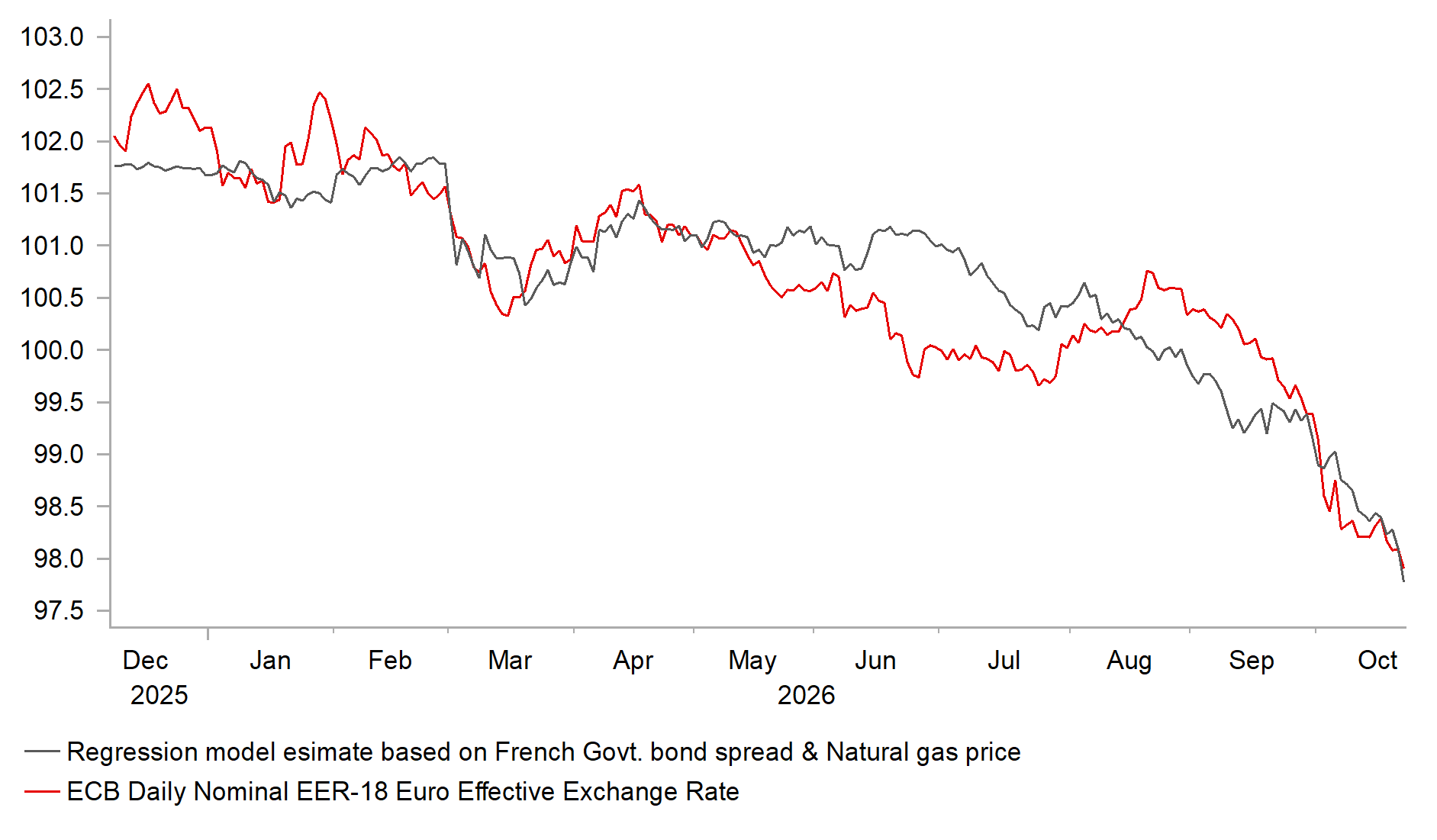
Source: Bloomberg, Macrobond & MUFG GMR
EUR/GBP VS. RELATIVE ECONOMIC SURPRISES
Source: Bloomberg, Macrobond & MUFG GMR
Recent developments in France have helped divert some market attention away from the state of the UK’s public finances ahead of next week’s Budget. It will be the first Budget delivered under Prime Minister Andy Burnham, whose appointment initially generated some concern over a potential shift towards looser fiscal policy. However, the sharp rise in government borrowing costs has created a more challenging backdrop, even as UK growth has continued to surprise to the upside this year. Against this backdrop, the Prime Minister and Chancellor appear determined to make the Budget a low-key event (click here). We expect the Budget to include a package of targeted fiscal support measures alongside modest revenue-raising initiatives, rather than signalling a significant shift in policy direction. Higher borrowing costs are estimated to have reduced the government's fiscal headroom by around GBP11 billion, and media reports suggest that the government does not intend to replenish that headroom, which is expected to fall to around GBP14 billion. A decision to operate with reduced fiscal headroom is unlikely, on its own, to trigger a gilt market sell-off that would spill over into a weaker GBP, although it remains a downside risk. Barring a negative Budget surprise, we expect GBP to strengthen further in the near term, supported by the UK's stronger cyclical momentum. Stronger labour market and inflation data released this week have reinforced our view that the BoE will begin raising rates next month.
The JPY has also strengthened against the EUR over the past week, supported by a more risk-off trading environment. The modest correction in global equity markets and the decline in bond yields outside Japan, with France being a notable exception, have provided support for the JPY even as energy prices have continued to rise. The yen is also benefiting from the hawkish repricing of BoJ rate expectations. While the BoJ is widely expected to leave rates unchanged next week following last month’s hike, it is likely to reiterate its commitment to a faster pace of policy normalisation in light of current inflation trends and the limited negative impact on Japan’s economy. According to Bloomberg, BoJ officials view the underlying inflation trend as broadly consistent with their 2.0% target, while also judging that the policy rate remains some distance below neutral. A reaffirmation of the BoJ’s tightening bias next week should provide support for the JPY, especially if global risk sentiment remains fragile.
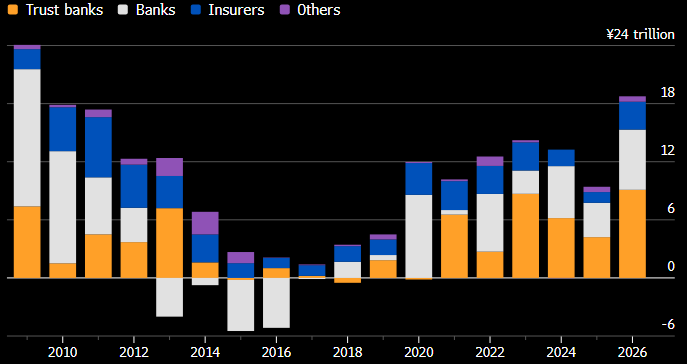
Bloomberg highlighted earlier this week growing evidence that higher interest rates in Japan are helping to boost domestic demand for JGBs. Japanese investors’ purchases of domestic government bonds during the first half of the current fiscal year rose to their highest level since 2009. According to the Japan Securities Dealers Association, net purchases totalled JPY18.8 trillion in the six months to 30th September. Trust banks accounted for almost half of total purchases, while banks contributed roughly one-third. If domestic demand for Japanese assets continues to strengthen, it could help reduce downward pressure on the JPY even without a significant repatriation.
STRONGER CORRELATION BETWEEN JPY & EQUITIES
Source: Bloomberg, Macrobond & MUFG GMR
NET JGB PURCHASES IN 1H OF FISCAL YEARS
Source: Bloomberg
Weekly Calendar
Ccy | Date | BST | Indicator/Event | Period | Consensus | Previous | Mkt Moving |
EUR | 26/10/2026 | 09:00 | Germany IFO Business Climate | Oct | -- | 89.9 | !! |
EUR | 27/10/2026 | 09:00 | ECB Bank Lending Survey | !! | |||
EUR | 27/10/2026 | 09:00 | M3 Money Supply YoY | Sep | -- | 3.5% | !! |
USD | 27/10/2026 | 12:30 | Durable Goods Orders | Sep P | 1.4% | -0.1% | !! |
USD | 27/10/2026 | 14:00 | Conf. Board Consumer Confidence | Oct | 80.3 | 81.9 | !! |
USD | 27/10/2026 | 14:00 | New Home Sales | Sep | 652k | 684k | !! |
AUD | 28/10/2026 | 00:30 | CPI YoY | Sep | -- | 4.0% | !!! |
NZD | 28/10/2026 | 01:00 | RBNZ Official Cash Rate | 3.00% | 2.75% | !!! | |
NOK | 28/10/2026 | 07:00 | Retail Sales W/Auto Fuel MoM | Sep | -- | 0.6% | !! |
USD | 28/10/2026 | 12:30 | Advance Goods Trade Balance | Sep | -$125.0b | -$132.6b | !! |
GBP | 28/10/2026 | 12:30 | UK Budget | !!! | |||
CAD | 28/10/2026 | 13:45 | Bank of Canada Rate Decision | 2.50% | 2.25% | !!! | |
USD | 28/10/2026 | 18:00 | FOMC Rate Decision (Upper Bound) | 4.00% | 4.00% | !!! | |
SEK | 29/10/2026 | 07:00 | Retail Sales MoM | Sep | -- | 0.8% | !! |
USD | 29/10/2026 | 12:30 | Initial Jobless Claims | -- | -- | !! | |
USD | 29/10/2026 | 12:30 | Core PCE Price Index MoM | Sep | 0.3% | 0.2% | !!! |
USD | 29/10/2026 | 12:30 | GDP Annualized QoQ | 3Q A | 3.0% | 2.2% | !!! |
EUR | 29/10/2026 | 13:15 | ECB Deposit Facility Rate | 2.50% | 2.50% | !!! | |
EUR | 29/10/2026 | 13:45 | ECB Holds Press Conference | !!! | |||
JPY | 29/10/2026 | 23:30 | Tokyo CPI YoY | Oct | 2.7% | 2.7% | !! |
JPY | 29/10/2026 | 23:50 | Industrial Production MoM | Sep P | 1.3% | -2.4% | !! |
JPY | 30/10/2026 | Tbc | BOJ Target Rate | 1.3% | 1.3% | !!! | |
EUR | 30/10/2026 | 06:30 | France GDP QoQ | 3Q P | -- | 0.0% | !! |
EUR | 30/10/2026 | 07:45 | France CPI YoY | Oct P | -- | 3.1% | !! |
CHF | 30/10/2026 | 08:00 | KOF Leading Indicator | Oct | -- | 109.1 | !! |
EUR | 30/10/2026 | 08:55 | Germany Unemployment Change (000's) | Oct | -- | 12.0k | !! |
EUR | 30/10/2026 | 10:00 | GDP SA QoQ | 3Q A | -- | 0.6% | !!! |
CAD | 30/10/2026 | 12:30 | GDP MoM | Aug | -- | 0.0% | !! |
USD | 30/10/2026 | 12:30 | Employment Cost Index | 3Q | 0.8% | 0.9% | !!! |
EUR | 30/10/2026 | 13:00 | Germany CPI YoY | Oct P | -- | 3.3% | !!! |
Source: Bloomberg & MUFG GMR
Key Events:
The 3 major central banks of the BoJ, ECB and Fed are all expected leave rates on hold in the week ahead. We attach a higher risk of hawkish policy surprise from the Fed. Stronger US inflation data for September means that a back-to-back hike from the Fed can’t be completely ruled out although Fed officials have indicated that they are not in a rush to hike again. Even if rates remain on hold we expect the Fed to indicate that more work is needed to bring inflation back towards target in a timely manner.
The ECB’s upcoming policy meeting will attract even more attention than normal in light of the ongoing sell-off in the French government bond market. The yield spread between 10-year French and German government bonds contuse to widen out sharply moving closer to the peak during the worst phase of the euro-zone debt crisis. We expect higher bond yields to encourage the ECB to leave rates on hold in the week ahead even though upside risks to inflation from higher energy prices have increased. Market participants will be listening closely to assess how the ECB is likely to react to increasingly challenging financial market conditions.
The BoJ is expected to leave rates on hold after hiking last month. We expect the BoJ to reiterate that policy has entered a new phase consistent with a faster quarterly pace of rate hikes. We expect the next hike to be delivered in December. The Nikkei has also reported that the BoJ is likely to signal that inflation has effectively reached its 2% target. The BoJ is now more concerned by the risk of inflation overshooting their target.
Market expectations have moved decisively in favour of the BoC hiking rates in the week ahead. We expect the BoC to take the opportunity to hike rates in response to building concerns over upside inflation risks.
The UK government is expected to play it safe when they unveil their latest Budget prioritizing fiscal credibility.