

Focus on bond markets ahead of Jackson Hole
USD: FX moves determined by Bessent D-Day plan & Warsh
The US dollar is broadly stable at the start of a new week in which the word “debasement” is being used frequently as investors remain focused on the US Treasury and what else it plans to help contain the rise in long-term yields. In Friday’s FX Weekly (here) we asked whether the US dollar debasement trade is back and while we do not expect a repeat of the dollar selling in January (-4% intra-day high-to-low) there are risks that sentiment could deteriorate further. A few events will determine near-term dollar sentiment. Firstly, US Treasury Secretary Scott Bessent will today announce details of the US Economic D-Day plan that will exert further economic pressure on the Iran regime. Bessent has written a very hawkish piece published in the FT yesterday and makes clear action will be taken in order to “severe every economic lifeline that sustains the tyrannical regime”. Bessent goes on to describe this D-Day plan as “the single greatest financial offensive ever marshalled against an adversary”. Iran has promised that “not a single drop of oil” will pass through the Strait of Hormuz if the US follows through and announces plans. The oil markets does not seem to believe Iran with Brent crude oil down 1.4% so far today. Scott Bessent’s FT article mentions those that have facilitated Iran “would do well to consider the consequences of their complicity”. The focus of this D-Day plan is very likely to be on these other countries and that could create obvious tension with China, which remains a large buyer of Iranian crude oil. 80% of Iranian oil went to China in 2025 according to Kpler (by far the largest recipient) although that total has declined sharply in data for this month. Still, if China was to by hit hard possibly via its refiners or banks that would signal an escalation that would likely prompt a response from China. The US could also attempt to thwart financial flows by hitting financial intermediaries. If the action is seen a credible and severe we would certainly see crude oil bouncing back and the dollar would initially at least strengthen.
But it is hard to take a view on the dollar on just this event risk given the focus on dollar debasement. Scott Bessent is also due to provide information on fiscal consolidation plans following the UST bond buyback announcement last week. We are sceptical that much will come from that. But Fed Chair Warsh is also scheduled to speak at Jackson Hole on Friday. Will Warsh play his role in trying to restore investor confidence in the long-end of the curve? Warsh will need to thread a line. To dramatically alter his communication and provide clearer guidance could risk him being viewed as beholden to the Treasury and hence undermine his credibility. If he sticks to his guns and says little on his views on Fed action, he risks triggering further bond selling.
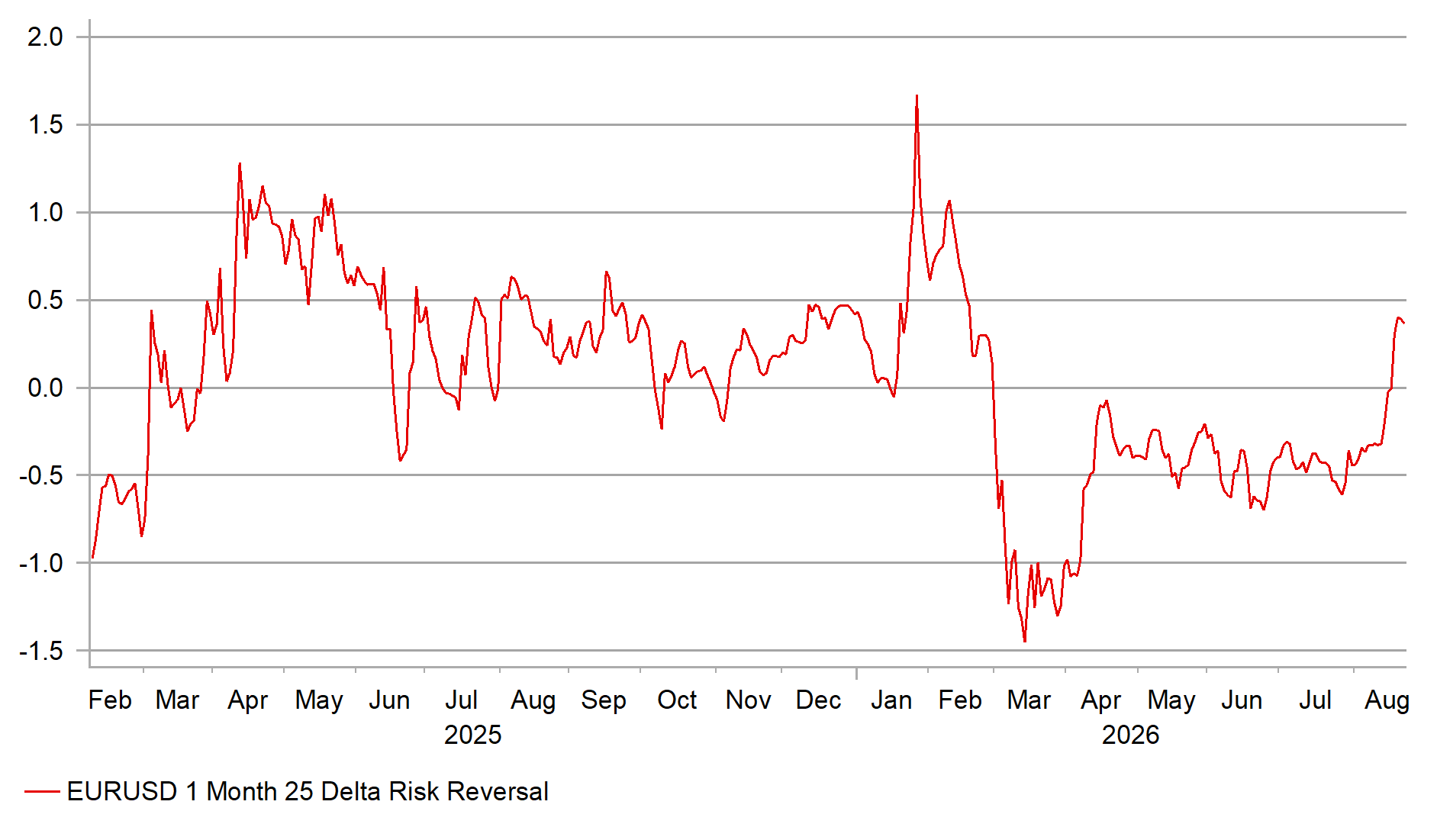
We see the risk skewed to more of the same from Warsh. That could see the long-end of the bond market suffer especially if by then there has been no credible measures announced on fiscal consolidation (likely). If crude oil prices have also risen due to a severe D-Day plan, we may see the 30-year yield break above the 5.34% high set last week. Dollar sentiment is turning and while the IMM weekly positioning data didn’t show a dramatic shift (to last Tuesday so too soon to capture the sentiment shift), the EUR/USD 1-month risk reversal turned in favour of EUR calls for the first time since the end of February when the Middle East conflict began. US dollar risks are skewed to the downside ahead of this week’s event risks.
EUR/USD RISK REVERSALS TURN IN FAVOUR OF EUR CALLS
Source: MUFG Research, Macrobond, Bloomberg
CAD: FX impact on new trade “war” more about risk of escalation
There was always a risk of a breakdown in negotiations on reaching a deal to avoid the avoid a US import tariff on USD 20bn worth of Canada exports, so we are unlikely to see a large sell-off of the Canadian dollar in response to the breakdown, confirmed late on Friday night. However, CAD is the clear underperformer in G10 so far today. Both the US and Canada indicated they were unhappy and PM Mark Carney made very clear that Canada would act aggressively in their response and would match “dollar for dollar” the tariffs on the US side. Carney stated that “you’re at war when you get attacked. We got attacked”. He went further with his direct criticism of the US failure to adhere to the USMCA deal stating that the US sometimes signs deals in pencil.
The medium-term FX and broader market response in Canada will be dictated not by this breakdown but by the evidence that this could escalate quickly and end with investors pricing greater economic harm for Canada. By promising to match dollar for dollar that risk of spiral is real. CAD will have understandably been undermined in early trading this week by the fact that the market had recently begun pricing in a positive outcome. CAD is the third best performing G10 currency so far in August, helped by higher crude oil but also by optimism a deal would be struck.
At this juncture the tariff of 50% on USD 20bn worth of US imports from Canada account for just 5% of Canada’s exports to the US. The tariffs took effect on Saturday morning at 12:01am applying to a range of goods from beer, wine, spirits, milk products and hockey equipment. The initial size would appear manageable. But the response from PM Carney opens up a round of retaliatory tit-for-tatt actions that could see a quick spiral. Canada’s tariff response to US imports are on goods ranging from steel and dairy products, household appliances, pulp and papers products and electronics. US Trade Representative Jamieson Greer has already indicated that the US is working on a response.
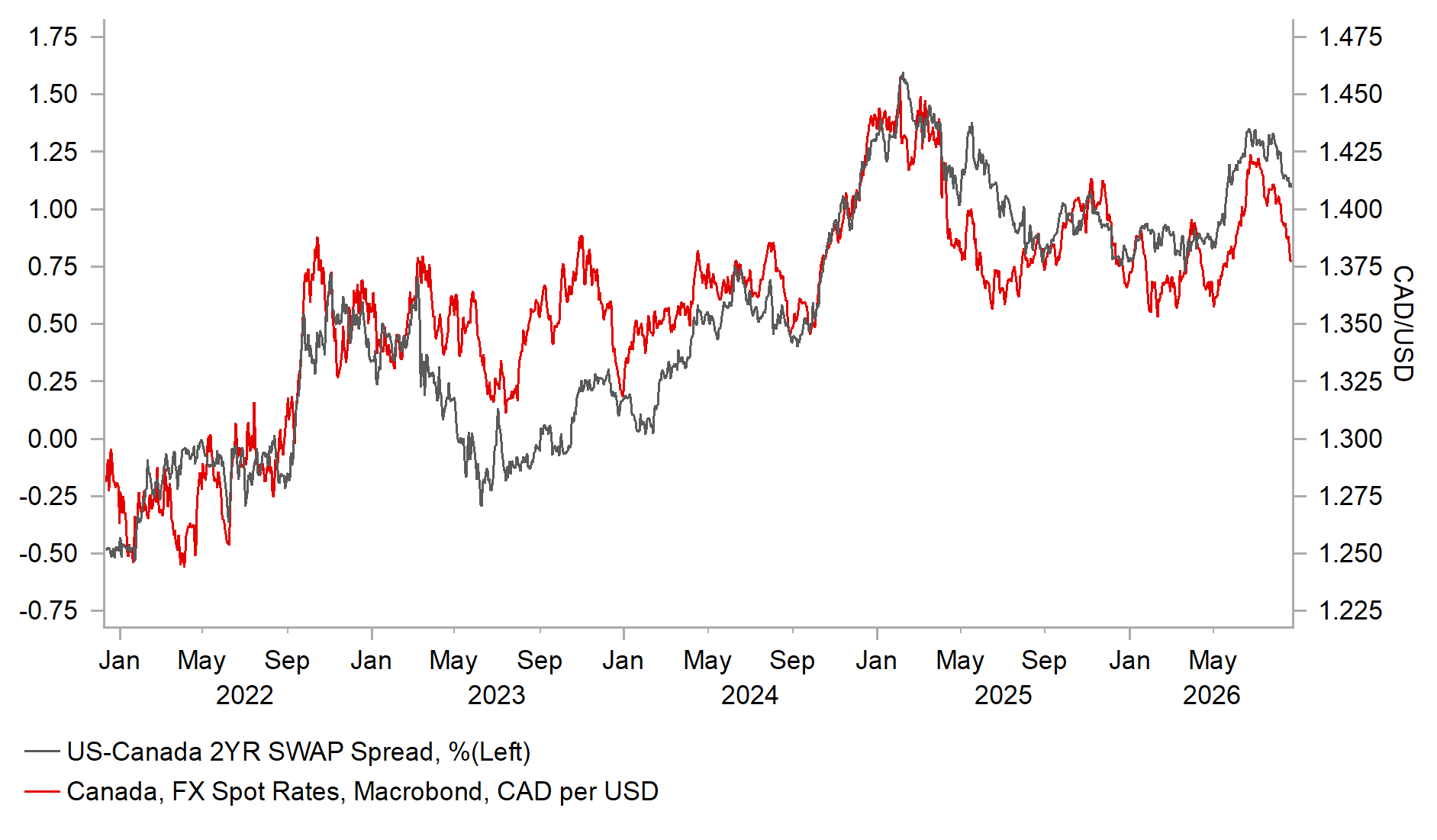
Covering the post-covid period, starting in 2022, USD/CAD and the 2-year swap rate spread has moved very tightly together over most of that period and the current 2-year US-CA swap spread suggests USD/CAD has over-extended to the downside and should currently be trading a little above the 1.4000 level, or around 2.0% higher than the spot close on Friday. While crude oil remains supportive, that support could also fade if energy price rises start to undermine global growth prospects and lift risk aversion. A quick retaliation by the US will undoubtedly force PM Carney to follow “dollar for dollar” that could see investor confidence hit more severely. CAD downside risks will intensify the longer there is no resolution to this escalating trade war.
USD/CAD VS 2-YEAR US-CA SWAP SPREAD – USD/CAD LOOKS TO HAVE OVER-EXTENDED TO THE DOWNSIDE
Source: Bloomberg, Macrobond, MUFG Research
KEY RELEASES AND EVENTS
Country | BST | Indicator/Event | Period | Consensus | Previous | Mkt Moving |
US | 13:30 | Chicago Fed Nat Activity Index | Jul | -0.05 | -0.02 | ! |
Source: Bloomberg & Investing.com