

Warsh leading the hawkish charge, meanwhile SEPs suffer from recency bias
Although the 25bp rate hike was what most forecasters (including us) expected after the hot August CPI print, the tone shifted on Fed Day once the press conference started. Chair Warsh just couldn’t hold back his hawkish leaning bias (even though this was not more hawkish versus what we learned in Jackson Hole). Meanwhile we argue to take the SEPs with a grain of salt (as Warsh does) because SEPs tend to have a recency bias and Fed forecasts have in the past seen drastic changes too.
On the hawkish side, Warsh repeated more than once that the decision to raise rates by 25bps at the September FOMC meeting was a process of removing accommodation (versus calling it tightening policy). He also dismissed the SEP path on inflation, suggesting waiting until 2029 to hit 2% is being too slow, implying his version of “timelier” calls for quicker and more hikes. If this was a one-person committee, Chair Warsh would want to crush inflation, but it’s not. We still believe that the majority do not share such excitement to embark on multiple hikes. We expect the compromise between the hawks/doves to be for the Fed to skip October and hike in December. Warsh kept stating that he is not “data point dependent” and that the FOMC is looking at trends in the data. That suggests to us they will not have enough time by October to decide if the overall data trends warrant to hike so soon.
Again, a lot can and will change over the course of 4Q26: we have the US midterm elections, where a split government will be viewed as disinflationary (less fiscal), the war has escalated but that can change quickly and result in a repricing in energy, and financial conditions have weathered the hawkishness for now, but we are entering a period of greater potential vol which could result in risk asset declines. Lastly, although Warsh remains focused on US fundamentals, he mentioned “spillovers” from other central banks tightening policy could help in the fight to reduce global inflationary pressures, limiting need for further Fed hikes.
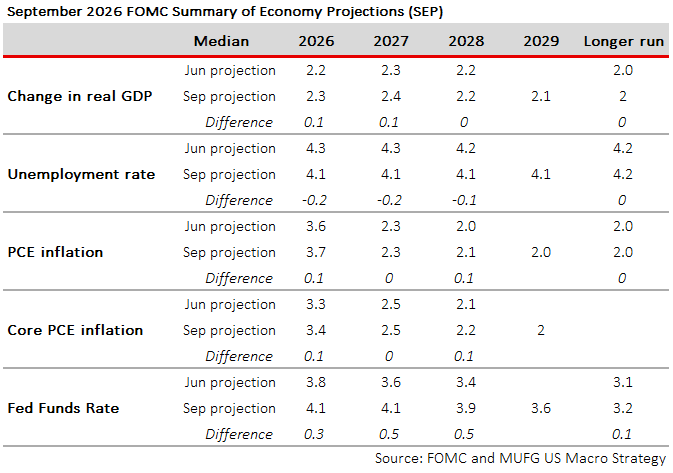
The Fed delivered first rate hike since 2023 at the September FOMC meeting, moving the target to 3.75-4% range. Both the official statement and Summary of Economic Projections (SEP) conveyed strength in the labor market, capital investment and overall growth. The median projection for real GDP rose slightly by 0.1% points in 2026 and 2027, while the median estimate for unemployment fell by 0.2% points. Overall, the economic forecasts show, and Chair Warsh explicitly stated that “our predominant focus is on the price stability side of our mandate.”
Median levels in SEP projections tend to overemphasize recent data points, most notably the estimates of the unemployment rate where 4.1% is now expected to remain unchanged for the next 4 years. On inflation, there was a marginal uptick in the 2026 Q4/Q4 growth rate compared to the June SEP for both core and headline PCE, likely driven by the recent rise in oil. However, the median inflation estimates for 2027 remained unchanged and FFR projections are up by 50bps (suggesting they would be higher without the Fed tightening policy). The median FFR dot is now at 4.125% for 2026 and 2027. This implies that the FOMC has increased confidence on their ability to, as Warsh stated, “remove(s) accommodation” without the risk of damaging growth or the labor market and staying higher for longer for over a year. The median projection for the long run neutral rate also rose slightly to 3.25%, though this change is marginal and reflects a general upward shift in the dot plot.
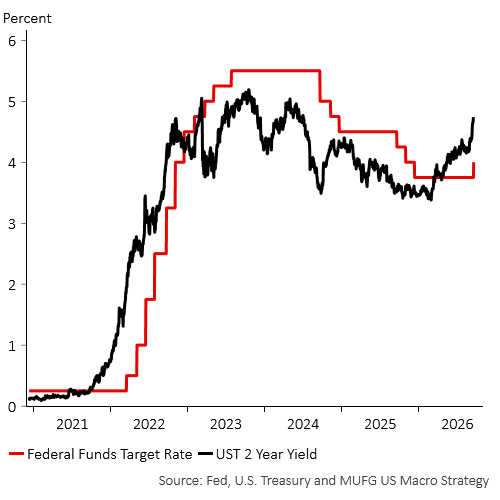
Since we recently updated our rates views (see link) post CPI we see no need to change our forecast path based on what we heard today. It’s clear Warsh is hawkish, we doubt such mood is shared by all. Granted the front-end of the US curve feels rudderless and drifting up to levels where the Fed Funds Rate was meaningfully at the last Fed hiking cycle. Net, 4.75% two-year notes feels like an overshoot.
Source: MUFG US Macro Strategy