

Statement: The FOMC held rates steady for the second meeting under Chairman Warsh, with policy rate unchanged at 3.50-3.75% (a level held since December 2025). There were basically no changes to the policy side of the statement, or to the macro-outlook. However, 3 voting regional Fed bank presidents (Beth M. Hammack, Neel Kashkari, and Lorie K. Logan) wanted to raise rates by 25bps at the July FOMC meeting. As a reminder, broader markets were on edge heading into this FOMC event, with many market participants increasingly worried about a surprise Fed hike. Recall, Fed Fund probabilities for this meeting were in the low 30% range for expectations of a 25bp increase, compared to the historical market threshold of around 60% plus typically seen in prior rate moves. This led to the initial reaction as a bull steepening, with the hike priced out and 2s rallying.
Presser: What started out as a "hawkish-hold" FOMC event quickly morphed into a more ambiguous one. Warsh remained focused on inflation and reiterated that this is the FOMC’s primary concern. However, likely in an attempt to avoid forward guidance, many answers lacked clarity. Warsh did emphasize that the US rates markets have been drawing their own conclusions on the economic outlook as opposed to just trying to guess what FOMC members are thinking. Warsh summed it up as "Market participants are learning to play the ball, not the referee." For the most part, this was the extent of the clarity with "Warshism" speak then dominating the Q&A.
Channeling an inner Greenspan, Warsh was likely keen to not give any clear thoughts that could be construed as forward guidance, resulting in some interesting responses:
On the Fed’s decision to not hike and stay on hold, Warsh responded:
“So, I wouldn't characterize what we did as anything like a pause. I would characterize what we did as a rigorous review of the economic situation. I would characterize what we did as a review of the big, hard questions, and I'd characterize it as a view of what our own homework is, to try to resolve those questions and the period ahead.”
Warsh on reiterating the Fed’s goal and commitment to the 2% target, though not acting now:
"I would again reiterate. What we do isn't just about what we say. It's not just about what we do. We're in the performance business and so if I look at the Treasury curve, if I look at the dollar, if I look at a lot of things that are internals inside of financial markets, I think what they're broadly saying is, that this committee does own it."
On characterizing the “family fight” and the potential differences in views from the dissenters, Warsh said:
"So, could people come to different conclusions? Absolutely, but my own judgment is this is a period of watchful thinking, not watchful waiting and I think the score on that vote was unanimous."
Going forward, if Greenspan is his guide as he attempts to buy time and not provide forward guidance, then perhaps this quote can tell us what to expect: “Since I've become a central banker, I've learned to mumble with great incoherence. If I seem unduly clear to you, you must have misunderstood what I said.” - Greenspan
Market Thoughts: There were a variety of reasons why the backend came under pressure. Without a clear understanding of Warsh’s reaction function and the Fed not hiking at this meeting, markets challenged inflation credibility. Also, markets are worried that the Fed might not hike rates, but instead, may change its policy on the balance-sheet, leading the curve to bear steepen with 30s having one of the largest selloffs at an FOMC meeting in over a decade (see chart below). The backend of the curve also did not benefit from any potential asset allocation shifts with stocks going out at the lows into the close of the trading session. With month-end ahead and the next month being August, which is typically a positive seasonal period for bonds, we believe this backup in rates is presenting a window to buy.
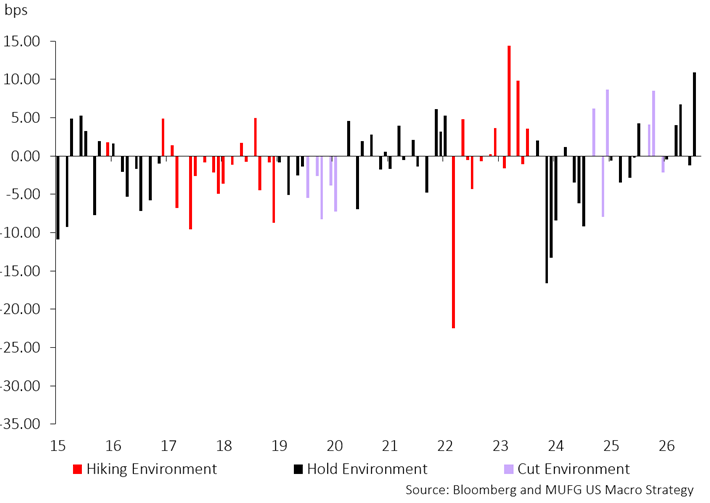
Looking Ahead: Based on what we heard at this meeting, a September hike is not a done deal. There is a lot of data and events to get through before the Fed meets again in 8 weeks (this is the longest gap between meetings every year). Most notable, we will get 2 jobs reports, 2 months’ worth of inflation reports, preliminary benchmark revisions to jobs numbers (QCEW), and the Jackson Hole symposium. Not to mention, the Middle East is still a fluid situation, and financial markets are increasingly looking under pressure from concerns about AI debt issuance and valuations. We think that Jackson Hole can still serve as a signaling opportunity, depending on how everything transpires in the economy and markets, with even Warsh saying, “Haven't made a decision whether it's going to be a big picture speech or whether it's going to be a more traditional set-up for all of the action we're going to have between September and December.”