
Weekly Recap: Taking stock of the post-election results and major market moves
Election Outcome:
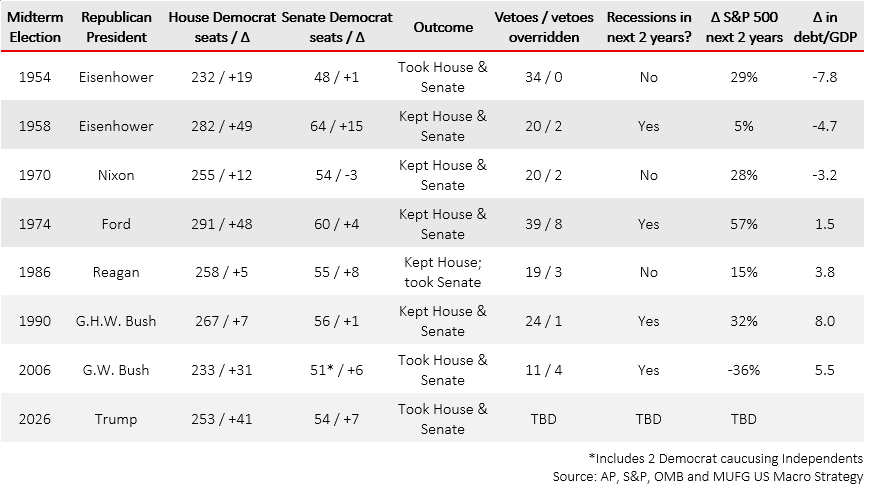
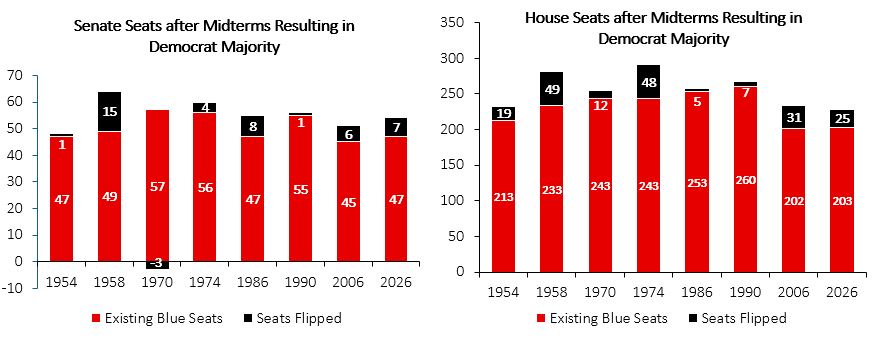
This week’s US midterm outcome, the Blue Tsunami was historic and far more decisive than expected, particularly in the Senate and governor races. In the Senate, Democrats held all 13 legacy seats and flipped 7 more from Republicans. Democrats have the potential to gain another 2 Senate seats with tight margins remaining in Alaska and Mississippi. Currently, Democrats have 54 seats in the Senate and Republicans have 44. The House went largely as polls expected. None of the chambers are at supermajority, the only saving grace for Republicans. Democrats will now control 253 House seats and Republicans have 162. 20 House races remain to be called. Governor elections also turned blue, with five state governor positions flipping to Democrat from Republican, including in states like Georgia, Ohio, Iowa, Nevada, and Texas.
Overall, these results are comparable to the Midterm elections in 1974 and 2006, given the sizable blue wave in the middle of major conflicts and geopolitical tensions. During the 1974 election, stocks were already in a major bear market, and the 2006 election was at the doorstep of the Global Financial Crisis. While the political backdrop today is similar, equity and credit markets have had years of strong outperformance but remain at stretched valuations. The new government will be operating with a small margin of error that won't upset the balance needed for markets to deliver.
What to Look Out For:
Foreign policy: The near-term question is whether strikes on Iran are off the table or will they intensify as an attempt to “finish the job” before new Congress. Energy markets appear to suggest the former as oil prices are falling on news of a potentially new Defense Secretary. It’s unclear how the war will change under a Democrat controlled Congress, but if history is any guide, “walking away” from military entanglements in the Middle East is no easy task. We remain skeptical that a complete resolution to the war is imminent. We would also be watching closely how the administration navigates relations with other countries, especially China, Russia, Europe and Canada given DC power dynamic shift.
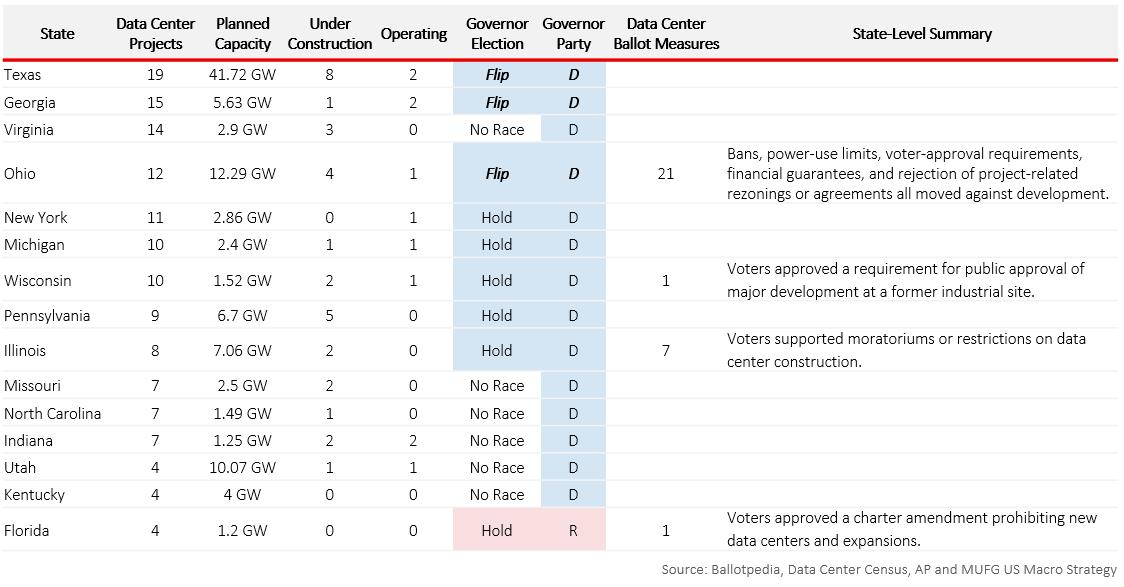
Business investment: With a Democrat controlled Congress, we expect more aggressive oversight, particularly in the AI sphere. The more speculative investments could slow as a result, but designing new regulations or guardrails on such a new industry will likely take several months or even years to implement. With Democrats also winning key governor races, future data center construction could run into hurdles, but reversing existing projects may not be legally viable (or politically wise). In general, the added uncertainty about AI acts as a headwind to growth and investment.
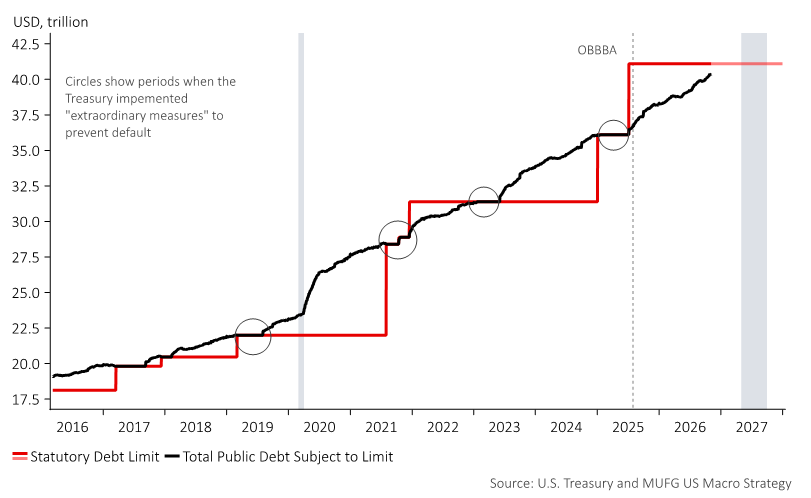
Government spending/tariffs: The newly divided government raises the political hurdle for new discretionary spending, especially in early 2027. Meanwhile a C.R. (continuing resolution) needs to pass to fund the government by Dec11. Further afield, fiscal policy is now more dependent on appropriations compromises, where negotiations can drag on for months (which raising the debt ceiling poses the most concerning risk in the medium-term). However, mandatory programs and interest costs continue to push outlays higher even with legislative gridlock. Areas for compromise exist, such as prescription drugs & healthcare (which can lower inflation too) and EV credits. Lastly, tariffs were also a big driver of voter angst and that could be an area of debate between Trump and the new Congress (where some Republicans might go to other side of aisle and vote to overturn).
Appointees and the Fed: The current Republican-led Congress has fewer than 30 days left on the job, and it will be difficult to nominate and confirm new judges, potential cabinet members and other political appointees. At the Fed, it’s possible that former Chairman Powell and other FOMC members resign before their terms expire, making it difficult to appoint (and have Congress confirm) very dovish replacements.
Market Implications:
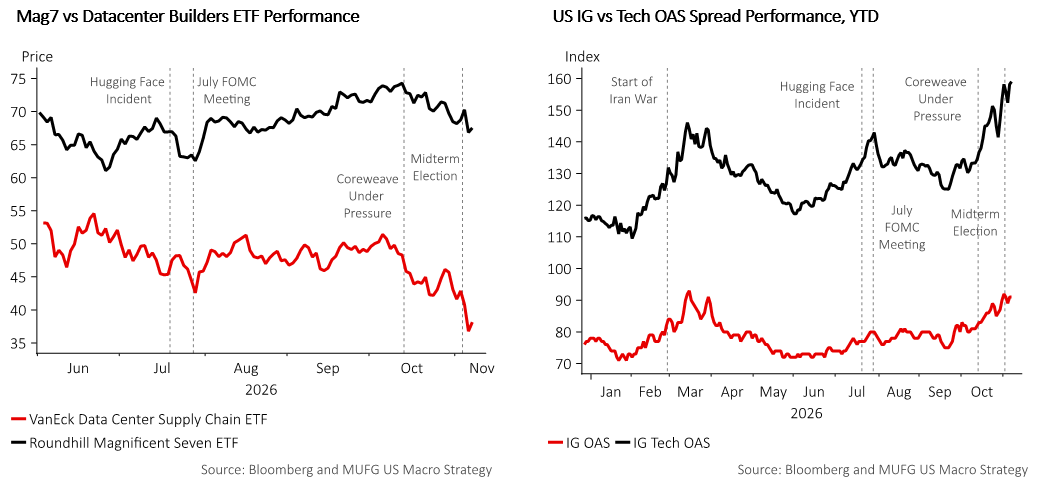
Financial Conditions: The repricing of late (mainly tech stock sector) has not made the viral jump into broader credit. But the feedback loop matters. Slower AI capex weakens fixed investment and GDP. Falling equities and wider spreads tighten financial conditions, which then weigh further on investment and activity. That is how an AI correction turns into a macro story rather than just a tech story. That linkage between a narrowly driven economy and financial conditions has been our concern all along, and why we have struggled with the idea of a meaningful Fed hiking cycle. If markets are tightening financial conditions, several hikes become increasingly difficult to deliver.
Furthermore, if risk markets were to truly experience a major drawdown, we think both the Fed and Trump puts are lower than what markets assume. Inflation is not resolved, limiting how quickly the Fed can respond. And if Democrats are actively trying to unwind parts of the President’s agenda, it is less clear whether they will view the stock market as the same barometer of success as Trump has. Overall, it may take considerably more pain before either the Trump and/or Fed put is triggered.
Rates Outlook: In general, from a big picture perspective, our long-standing view is that the U.S. economy and markets cannot operate with rates above 5% for sustained periods has again been vindicated by the nearly 50bp decline in the 10-year. We think much of this move was missed as market participants were focused on the risk of 6% yields, when 5.3% on 10s proved to be a good reloading point. The blue sweep should reinforce the lower rate move in the near term, as divided government constrains incremental fiscal spending and could help stabilize Treasury issuance. Less incentive to re-escalate with Iran would provide an additional tailwind for duration.
The longer-term bond outlook is less constructive, in our view. If this result increases the odds of a unified Democratic government in 2028, markets could eventually begin pricing another period of heavier fiscal spending/stimulus programs. This creates the potential for a two-stage Treasury move: bullish duration near term as DC gridlock and risk-off reinforces the rates rally but renewed fiscal and issuance concerns further out keep curves steep. Overall, we remain slightly bullish at these levels but think a return to much lower yields (sub 4%) remains difficult without a recession.
Equities Outlook: The trajectory for the AI-related industries remains the key risk for equities. The Democratic wins at the federal (Congress) and state (Governors) levels increase the potential for tighter AI and datacenter regulation and tax policy changes (compute-based taxes and local tax increases). Combined with less appetite from investors and the corporate sector, the buildout may slow just as concerns around valuations, positioning and AI financing are in the backdrop.
The issue is how dependent both markets and the global economy have become on continued AI and datacenter capex growth. You don’t need the AI story to fully collapse, just growing slower will be enough. Even a modest slowdown in capex could have a meaningful impact on fixed investment and growth. And the circular financing and intertwined nature of the AI trade is well televised. The bulls will say this is different from 2000 because today it is “profitable mega firms” doing the spending. Fair, but profitability was never really the vulnerability, concentration was. The late 1990s had broader earnings and GDP growth, and plenty of profitable firms funding the internet buildout then too.
Overall, for broader equity markets the jury is still out on how this will end given all the recent AI concerns. We do not take much solace in knee-jerk quick rallies like we’ve seen after the election results (or after big declines), as those seem more like position squaring versus the start of a sustained move. With gridlock potentially full of uncertainty (CR budget timing and still not clear indication of the conclusion to the US/Iran war) we would buy dips in bonds and sell rips in stocks.