
“Here is a quick overview of what I'll cover in my remarks this morning. You can call it an outline…you can call it a trail map…just don't call it forward guidance.” – Warsh at 2026 Jackson Hole Symposium
Warsh’s Jackson Hole speech was a bit more forthcoming than expected, teetering between discussing digital payment systems (theme for this year’s symposium) and an all-out revelation of his monetary policy framework (a mix of options 2 & 3 from our Jackson Hole Preview). Overall, the speech was hawkish, but this is not new for Warsh. Both of his press conferences since becoming Chair have been fairly hawkish, and so far, the policy rate remains unchanged. His assessment of the labor market hasn’t changed across all his speeches, switching between words like “solid,” “steady” and “stable” to eventually conclude that the Fed is succeeding in achieving their full employment mandate. When connecting the labor market to inflation, Warsh has outright rejected the Phillips Curve framework in the past, but was perhaps more explicit this time around, stating “…wage growth has not proven a reliable indicator of future inflation for a very long time.”
His assessment of inflation came across slightly more hawkish than his previous speeches. It caught headlines when he said “…while this summer's PCE and CPI readings were better than expected, they do not tell me that underlying trends have meaningfully improved.” Though relevant, Warsh was also quick to dismiss June’s negative CPI print in the last FOMC presser, stating that it mattered “not much.” Putting it all into perspective, his framing of inflation hasn’t changed significantly. Where he differed was his emphasis on the diffusion of PCE inflation components, rather than just focusing on the trimmed-mean or median PCE.
“Talking tough” on inflation is nothing new for Chair Warsh, and it’s warranted given the need to maintain an anchor on inflation expectations. The question is, was this a rallying cry to corral the FOMC to hike in September, or was this buying time? As Warsh prefaced the Jackson Hole speech with, don’t take this as forward guidance. He fell well short of directly calling for hikes, but instead offered ambiguity and uncertainty by stating “I wish our understanding of the economy were so precise as to provide a mechanical, tried-and-true answer…” There is still another jobs report and inflation report before the September meeting. Holding firm buys the Fed time to truly assess the trajectory of inflation after the supply shocks fade. And if they don’t fade and/or inflation shows no signs of slowing down, Warsh can give a more decisive policy action with (hopefully) support from his task forces at or around December (again, if needed).
We maintain our house view that the Fed will leave rates unchanged in 2026. The risk is the next payrolls report and inflation number will beat expectations, but even that may not be enough to get the full FOMC on board for a hike this early on. It seems unlikely that Warsh will tolerate a split decision vote for the first monetary policy move in his tenure, so a 12-0 vote is almost certainly the goal. He is attempting to lead an era of regime change at the Fed, but to get this level of unanimity, Warsh will need the data to cooperate. We don’t believe that a moderately strong August NFP and CPI will be enough to convince some of the more dovish voters to act in September. The trouble is, the Fed enters blackout almost immediately after the next jobs report (and before the next CPI), so markets will have little insight into how members of the FOMC are interpreting these crucial datapoints.
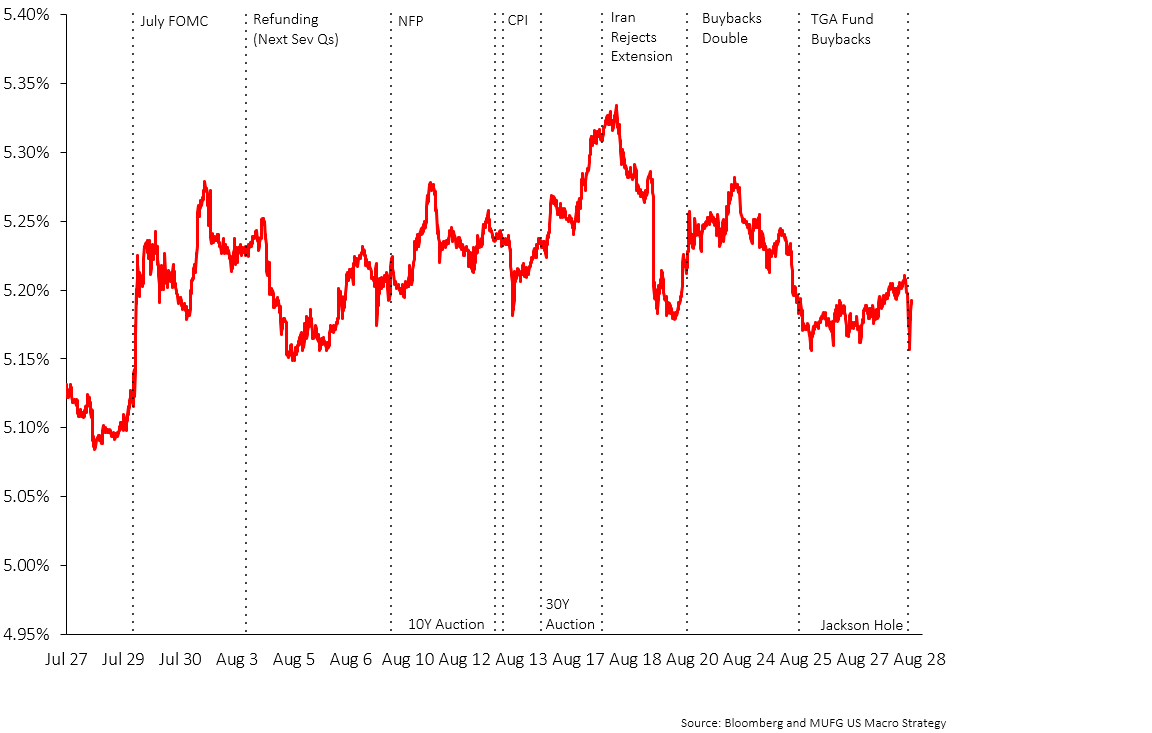
Heading into the September FOMC, the Fed will likely want to avoid the optics around hiking just before the Midterms, which is perceived as worse than cutting before a consequential election. Even if there is a tightening bias, waiting until December would be more reasonable, both from a political and economic perspective. However, there is always the risk that rates and futures markets force the Fed’s hand (September hiking expectations are now over 50% post Warsh’s Jackson Hole speech). If the FOMC ignores front-end pricing (effectively letting markets do the tightening for them), it could damage credibility with the long-end taking note. As shown in the chart below, the UST 30Y has been the barometer this past month, with a combination of Treasury buyback news/auctions, weaker July economic data (released in August) and Fed news making the 30Y rate swing around.