
To read the full report, please download the PDF above.
Middle East Daily
SOOJIN KIM
Research Analyst
DIFC Branch – Dubai
T: +44(4)387 5031
E: soojin.kim@ae.mufg.jp
MUFG Bank, Ltd. and MUFG Securities plc
A member of MUFG, a global financial group
Middle East Daily
COMMODITIES / ENERGY
Oil heads for strongest monthly gain since March. Brent crude edged lower to around USD88/b, while WTI traded above USD82/b, but both remained on track for their strongest monthly gains since March as escalating conflict between the US and Iran continued to support a geopolitical risk premium. Although shipping through the Strait of Hormuz has shown signs of improvement, security risks remain elevated as Saudi Arabia seeks to build an international coalition to protect Red Sea navigation following Houthi attacks on commercial vessels and energy infrastructure. Supply concerns were also reinforced by renewed disruptions at Kazakhstan’s Caspian Pipeline Consortium (CPC) export terminal, while US crude inventories continued to decline. Despite modest easing in immediate supply risks, continued disruptions across key export routes and heightened regional tensions are likely to keep oil prices volatile, with markets closely monitoring both geopolitical developments and the resilience of global energy supply chains.
Gold posts first monthly gain since February. Gold traded near USD4,080/oz and was on track to post its first monthly gain since February, supported by a weaker US dollar and the Fed’s decision to leave interest rates unchanged. The dollar softened after Japan intervened to support the yen, making dollar-denominated gold more attractive to overseas buyers, although the greenback recovered modestly later in the week. The Fed’s 9-3 vote to keep rates on hold also provided support, despite policymakers signalling that further tightening remains possible if inflation persists. While expectations of higher-for-longer interest rates may continue to limit upside, a weaker US dollar and ongoing geopolitical uncertainty are likely to provide near-term support for gold prices.
MIDDLE EAST - CREDIT TRADING
End of day comment – 30 July 2026. Overnight we saw a steepening of the UST curve post FED for the history books. What wasn't surprising in the morning was that short end/belly bonds were wider (+5/10bp), but surprising was to see long end +2/3bp as well/ The risk off mood was just too strong and long end had sellers first thing. The market opened anywhere from 2/10bp wider. Flows were heavy, seen a lot of selling in QATAR today, mainly in the belly. Macro risk though traded on the front foot and in the afternoon, we started to see flows getting more supportive with some buying coming in from ETF and RM side. But this wasn't enough to reverse the widening. Nothing closes tighter. ADGB curve did best, 49s always getting a bid supporting long end which goes out -0.875pt/+0bp. Belly is up to -0.375pt and +3/5bp. QATAR underperformed, have long end 50s -1pt/+2bp and traded some 30s today closing -0.10pt/+6bp. Quasis broadly followed these sovgn moves.(Source: Dominik Roth, Credit Trader)
MIDDLE EAST - MACRO / MARKETS
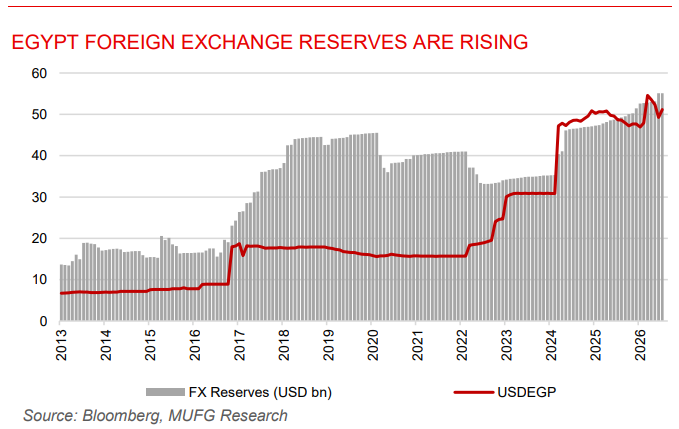
IMF approves USD1.8bn financing for Egypt. The IMF approved the seventh review of Egypt’s reform programme, unlocking around USD1.8bn in financing, including USD1.5bn under the Extended Fund Facility (EFF) and USD272 million through the Resilience and Sustainability Facility. The IMF noted that Egypt has navigated the impact of the Middle East conflict from a stronger macroeconomic position, supported by robust economic growth, moderating inflation and rising foreign exchange reserves. The approval follows progress on structural reforms, including state asset sales, publication of the government’s ownership policy and tax measures to strengthen public finances. The disbursement comes shortly after the European Commission released EUR1.5bn under its Macro-Financial Assistance programme. The latest financing reinforces investor confidence and strengthens Egypt’s external liquidity position, although continued implementation of structural reforms and exchange rate flexibility will remain critical to sustaining macroeconomic stability.
Saudi Fiscal deficit narrows despite economic contraction. Saudi Arabia’s fiscal deficit narrowed sharply to USD9.1bn in Q2 2026, down from USD33.5bn in the previous quarter, as higher oil prices boosted government revenues despite a contraction in economic activity. Oil revenue increased 28% q/q, while government expenditure declined 3.5%, benefiting from stronger crude prices even as oil production remained below pre-conflict levels. However, preliminary data showed the economy contracted 4.8% y/y in Q2, reflecting a 24.7% decline in the oil sector amid continued disruptions linked to the regional conflict, while non-oil growth slowed to 0.6%. The IMF noted that Saudi Arabia has remained resilient, supported by strong macroeconomic fundamentals and diversified energy and logistics infrastructure, and expects higher oil prices to offset weaker export volumes, forecasting the fiscal deficit to narrow to 3.7% of GDP in 2026. The results highlight the Kingdom’s resilience to geopolitical shocks, although sustaining fiscal and economic performance will depend on a recovery in oil production and stronger momentum in non-oil activity.