
To read the full report, please download the PDF above.
Middle East Daily
EDWARD BELL
Head of Research
DIFC Branch – Dubai
T: +971 (4)387 5033
E: soojin.kim@ae.mufg.jp
SOOJIN KIM
Research Analyst
DIFC Branch – Dubai
T: +971 (4)387 5031
E: soojin.kim@ae.mufg.jp
MUFG Bank, Ltd. and MUFG Securities plc
A member of MUFG, a global financial group
Middle East Daily
COMMODITIES / ENERGY
Oil holds near USD 103/b as Middle East supply recovers. Oil steadied after its sharpest decline in more than a week, with Brent sliding 2.5% to USD 102.59/b and WTI closing below USD 90/b as recovering Middle East exports eased supply concerns. Exports via the Strait of Hormuz have increased as Saudi Arabia has shifted flows to the east following the temporary shut-down of the East West pipeline earlier this month. Saudi Arabia has also reportedly managed to increase flows on the East-West line to about half of the pipelines 7m b/d capacity. Additional relief is expected from a final 40mb US strategic reserve release, while the API reported a build in US commercial crude inventories. However, refined-product markets remain considerably tighter, with Middle East diesel and gasoline exports at only 58% of pre-war levels amid constrained refinery capacity and Russian export restrictions. Recovering crude flows should temper supply-driven price pressures, although persistent product shortages and elevated freight costs are likely to keep the broader energy market tight.
Gold steadied as oil retreat eases inflation fears. Gold steadied around USD 4,180/oz after gaining 1.6% in the previous session, as lower oil prices eased concerns over energy-driven inflation, but elevated Treasury yields continued to weigh on gold. Fed officials continue to signal that further tightening may be necessary, although New York Fed President John Williams suggested just one additional increase later this year, reducing the market-implied probability of an October hike to around 50% from 70%. Gold remains on track for an almost 6% decline in September, with high yields limiting its recovery. US PCE inflation and Friday’s payrolls report will be key in determining the Fed’s next move and near-term direction for gold.
MIDDLE EAST - CREDIT TRADING
End of day comment – 29 September 2026. GCC bonds tried to stabilise today. In my names there was a marked increase in trading, and for the first time in a while it felt like risk is clearing. But with the steepening of the UST curve into the close long end bonds are again for sale. ADGB underperformed in the IG space today, mainly on early morning selling of 10y bonds, which arguably had outperformed peers like QATAR. ADGB 4.75 36s pp closes -0.375pt/+3bp. In the long end it was again mainly selling of ADGB 54s which kept pressure on duration closing -0.5pt/+1bp. In quasis the weakness was mainly in MUBAUH belly bonds, both 33s were sold closing -0.25pt/+3bp. On the other hand, QATAR had a good day, new 36s found buyers from the start and held in the afternoon rates weakness closing +0.125pt/-3bp. In corps DPWDU was very weak, long end 49s closed -1pt/+8bp and recently issued 36s was offered all day closing -0.5pt/+5bp. Risk feels wobbly heading out. (Source: Dominik Roth, Credit Trader)
MIDDLE EAST - MACRO / MARKETS
Oman expands Duqm oil storage as Hormuz risks persist. Oman plans to more than double crude storage capacity at Duqm, strengthening the Arabian Sea port’s role as an alternative energy hub outside the Strait of Hormuz. State energy company OQ aims to expand onshore storage to 10mb within three years from around 5mb currently, while considering the purchase of two VLCCs that could provide another 4mb of floating storage within about six months of acquisition. Longer term, Oman aims to expand Duqm’s onshore capacity to around 40mn barrels. The plans come as Gulf producers seek alternative export and storage options amid persistent Hormuz disruptions and soaring shipping costs, with VLCC rates on the Gulf-to-China route exceeding USD 1mn per day. Oman has also held early-stage government-level discussions over potential regional pipelines terminating at Duqm, while Saudi Arabia, Kuwait and the UAE explore alternative export infrastructure. Greater storage capacity and potential pipeline connectivity could strengthen Duqm’s role as a regional energy hub, offering Gulf producers greater flexibility and reducing dependence on Hormuz during future supply disruptions.
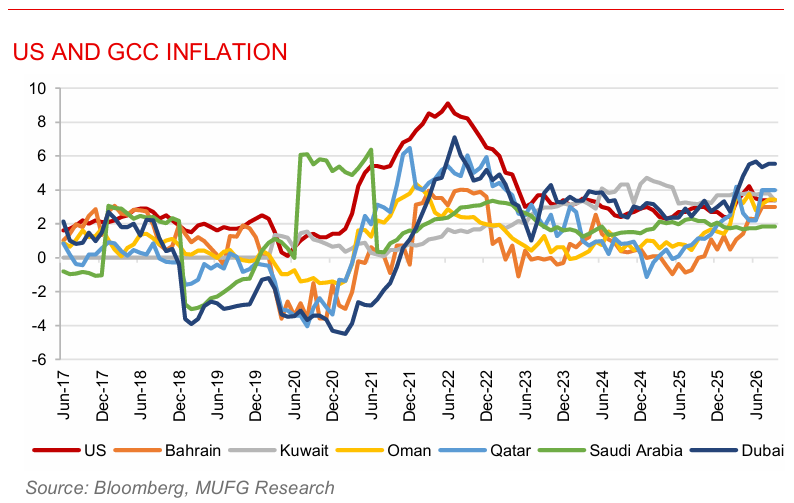
Qatar CPI rises 0.7% as recreation costs jump. Qatar’s Consumer Price Index rose 0.71% m/m and 3.98% y/y to 102.78 in July 2026, as the National Planning Council introduced a new 2024 base year, adopted the COICOP 2018 classification, and updated the consumption basket and expenditure weights using the 2023/24 Household Income and Expenditure Survey. Excluding housing, water, electricity, gas and other fuels, CPI increased 1.22% m/m and 3.91% y/y, highlighting the moderating effect of housing costs on headline inflation. Recreation, sport and culture recorded the largest monthly increase at 9.15%, followed by restaurants and accommodation services (1.35%) and health (1.23%), while housing and utilities fell 0.64% and clothing and footwear declined 0.39%. The July increase was therefore concentrated in selected service categories rather than broad-based, with lower housing costs continuing to contain overall inflationary pressures.