
To read the full report, please download the PDF above.
Middle East Daily
EDWARD BELL
Head of Research
DIFC Branch – Dubai
T: +971 (4)387 5033
E: edward.bell@ae.mufg.jp
SOOJIN KIM
Research Analyst
DIFC Branch – Dubai
T: +971 (4)387 5031
E: soojin.kim@ae.mufg.jp
MUFG Bank, Ltd. and MUFG Securities plc
A member of MUFG, a global financial group
Middle East Daily
COMMODITIES / ENERGY
Oil holds above USD 116 as Iran conflict risks support prices. Oil prices are being supported by geopolitical anxieties that the US is preparing a renewed offensive against Iran which could threaten oil production and exports across key Middle East producers. Brent futures for December are trading above USD 116/b, having spiked to nearly USD 118 early in the session. Vessels transiting the Strait of Hormuz continue to come under attack with another vessel reportedly hit according to the UKTMO. At the same time, satellite data focused on Saudi Arabia showed that exports are increasing from the country’s Gulf coast export facilities. Oil prices will continue to see an upside skew until there is clarity on the geopolitical conditions in the Middle East, with the period following next week’s US midterms in focus for a potential deterioration in regional security. European gas prices are also holding onto their recent gains with front month TTF at EUR 100/MWh. In Japan, JERA reported that it held enough gas inventories to keep supply stable into December but cautioned that there was unlikely to be surplus volume in the coming colder months.
Gold breaks below USD 4,000 as hotter inflation weighs. Gold prices have broken below USD 4,000/troy oz as PCE inflation for the US came in hotter than expected, with the monthly pace rising by 0.5% m/m, its fastest level since March this year. A continued sell off in other risk markets is also likely prompting selling in gold markets as investors seek to cover positions. Market expectation for a December hike from the Fed have faded somewhat, likely with an eye on the current volatility in financial markets, which may provide somewhat of a floor for gold in the short-term. Metals are sliding across the rest of the precious metals complex with silver down 1.3% and platinum off by 2%.
MIDDLE EAST - CREDIT TRADING
End of day comment – 29 October 2026. Overnight the FED decision produced a steepening of the UST curve and VP Vance contacted Iran to give diplomacy a push. Despite weaker tech the market took this well with more short covering in the main benchmarks. KSA was at the forefront of this closing 7bp tighter in the 10y/30y bucket, 36s conv +0.75pt/-7bp, 56s +1pt/-7bp with shorts struggling to cover. It was less dynamic in the other main sovgn curves, but ADGB long end is still going out +0.5pt/-4bp, so does QATAR. Belly and front-end bonds though widened 2/5bp given sticky cash prices and the steepening move in UST. Quasi sovgn bonds showed the same dynamics but with lower vol, TAQAUH was busy around the new issues with new 36s closing +0.375pt/-1bp. The underperformer remains financial bonds in general. Cash prices hardly moved widening the senior curve 5bp on average. AT1s remained for sale and are the only sector closing lower in cash price, MASQUH 6.25 perp closed -0.25pt/+10bp. Overall risk markets are on the move with tech leading the weakness, credit indices though remained flattish on the Fed, lower oil/ hopes for a diplomatic solution. GCC bonds remain driven by technicals with a strong bid for duration/ benchmarks and derisking flows in off the runs. (Source: Dominik Roth, Credit Trader)
MIDDLE EAST - MACRO / MARKETS
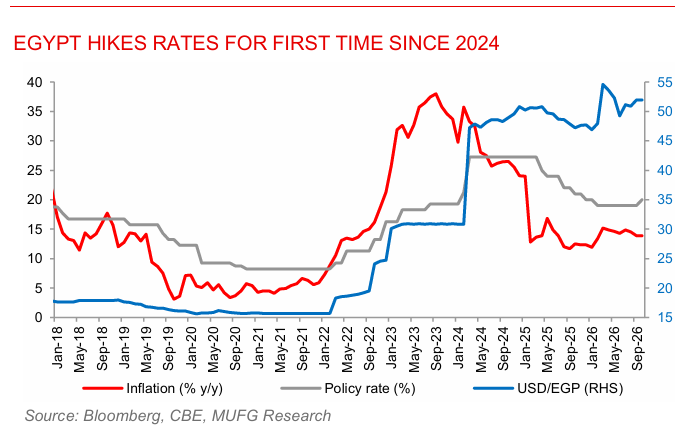
Egypt delivers surprise rate hike as inflation and FX risks persist. The Central Bank of Egypt (CBE) delivered a surprise rate hike at its October monetary policy committee, taking the benchmark deposit rate to 20%. It was the first hike from the central bank since 2024 with the CBE noting that the backdrop for policy decisions contained more “risks and uncertainty” and that it wanted to preserve the disinflation tentatively in effect in Egypt. Inflation in Egypt has slowed in 2026 relative to where price growth had been in 2023-24 but high oil and energy prices, along with further subsidy reform, mean that inflation has proven sticky at between 13-15%. The Egyptian pound has also sold off sharply in October and the CBE is likely attentive to not wanting to prematurely cut rates and risk further sell-offs in the value of the pound.
Saudi Arabia’s foreign reserves fall 4.5% in September amid fiscal pressure. Saudi Arabia’s official reserve assets declined 4.45% m/m to SAR 1.746tn (USD 465.7bn) in September 2026, according to the Saudi Central Bank (SAMA), marking the third consecutive monthly contraction. Reserves fell by approximately SAR 81bn (USD 21.7bn) during September, bringing the cumulative decline since June to SAR 108bn (5.8%), although total holdings remained 3.3% above their year-earlier level. The decline coincides with elevated government financing requirements, including a SAR 160bn fiscal deficit in H1 2026. Despite recent declines, Saudi Arabia’s external buffers remain substantial, with the IMF estimating reserve coverage at approximately 171% of its adequacy benchmark for 2026, indicating continued capacity to withstand external shocks.