
To read the full report, please download the PDF above.
Middle East Daily
SOOJIN KIM
Research Analyst
DIFC Branch – Dubai
T: +44(4)387 5031
E: soojin.kim@ae.mufg.jp
MUFG Bank, Ltd. and MUFG Securities plc
A member of MUFG, a global financial group
Middle East Daily
COMMODITIES / ENERGY
Oil eases after US strikes focus on military targets. Brent crude fell toward USD89/b, while WTI traded near USD83/b, as markets assessed a new wave of US military strikes on Iranian military targets that stopped short of damaging critical civilian infrastructure. The US said it targeted dozens of Islamic Revolutionary Guard Corps (IRGC) facilities, including missile, drone and maritime assets, in response to attacks on US personnel in Jordan. Meanwhile, US commercial crude inventories fell to their lowest level since 2018, underscoring tightening physical supply, while around 13mb/d of Gulf oil exports continued to flow through the Strait of Hormuz and alternative pipelines. However, attacks on LNG vessels near Egypt’s Damietta port and ongoing threats to shipping in the Red Sea highlight persistent risks to regional energy infrastructure. While the limited scope of the US strikes helped ease immediate fears of broader supply disruptions, continued security risks across key shipping routes are likely to keep a geopolitical premium embedded in oil prices.
Gold holds gains after Fed keeps rates unchanged. Gold traded near USD4,060/oz after gaining nearly 1% as the US Fed left interest rates unchanged, reducing immediate pressure from higher borrowing costs despite persistent inflation risks. The Fed voted 9-3 to maintain rates, although policymakers signalled that further tightening remains possible if inflation stays elevated. Lower short-term Treasury yields following the decision supported bullion by reducing the opportunity cost of holding non-yielding assets. Meanwhile, renewed US strikes on Iran kept geopolitical tensions elevated, while the Fed’s decision has provided near-term support for gold, expectations of higher-for-longer interest rates, and persistent Middle East tensions are likely to keep the metal trading within a broad range around the USD4,000/oz level.
MIDDLE EAST - CREDIT TRADING
End of day comment – 28 July 2026. Like said yday whilst sovgn bonds were tighter the bounce had no breadth and never felt as strong as the sovgn performance. Today we gave up all of it in terms of spread moves in sovgn and most quasi/fins/corps are wider over two days. Flows remain light and only in the last hours did we see some buying coming in. That could set up for a stronger morning tomorrow if macro risk stays stable. For today though the theme was sideways cash prices at best against higher UST/ lower rates. Even curves like QATAR seem to be completely irresponsive to UST move which is rare. I close ADGB/ QATAR unch/+5bp. In fins seen some activity in FABUH which found some buying on wider levels but still closes broadly +5bp. NEW FABUH 36s LT2 is starting to clear around 99. Quasis saw a new private placement in TAQAUH 5y in 750mm which widened the curve 5/8bp around the 5y point. The focus now will turn to the FED and month end rebal/ flows. UST spreads are starting to look cheap but only inflows will tighten them. (Source: Dominik Roth, Credit Trader)
MIDDLE EAST - MACRO / MARKETS
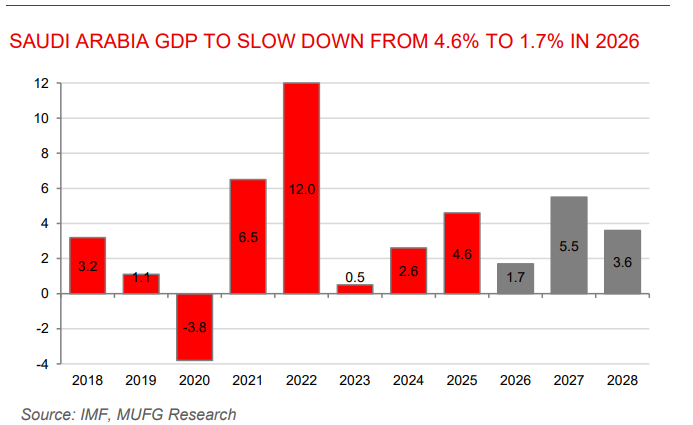
IMF: KSA remains resilient despite regional conflict. The IMF assessed that Saudi Arabia has demonstrated remarkable resilience despite the disruption caused by the Middle East conflict and the temporary near-closure of the Strait of Hormuz, supported by strong macroeconomic fundamentals, diversified oil export routes through the East-West pipeline, and continued implementation of Vision 2030 reforms. While the conflict has weighed on oil exports, trade, confidence, and non-oil activity, higher oil prices have more than offset lower export volumes, generating an oil revenue windfall. The IMF expects GDP growth to slow from 4.6% in 2025 to 1.7% in 2026, with non-oil growth moderating to 2.6% before recovering as maritime traffic normalises. It recommends maintaining prudent macroeconomic policies, including a modest reduction in the non-oil primary deficit, while keeping any fiscal support temporary and targeted. Over the medium term, the IMF emphasises continued fiscal consolidation, stronger non-oil revenue mobilisation, spending efficiency, and sustained Vision 2030 reforms to deepen economic diversification, strengthen the private sector, and enhance resilience against future external shocks
Saudi Aramco considers new pricing for Mediterranean oil exports. Saudi Aramco is considering introducing a separate official selling price (OSP) for crude oil loaded from Egypt’s Sidi Kerir terminal for Asian buyers, reflecting higher transportation costs and shifting export routes amid continued security risks in the Red Sea. The move follows increased use of the Mediterranean export route as attacks by Iran-backed Houthis have made shipments from Yanbu more challenging, forcing cargoes destined for Asia to sail around the Cape of Good Hope. Asian refiners, particularly in India and South Korea, are seeking discounts to offset higher freight costs and longer transit times, while Aramco is still evaluating alternative delivery arrangements. The proposed pricing mechanism highlights how prolonged regional security disruptions are reshaping Saudi crude export logistics and increasing transportation costs, even as the Kingdom maintains oil exports through alternative routes.