
To read the full report, please download the PDF above.
Middle East Daily
EDWARD BELL
Head of Research
DIFC Branch – Dubai
T: +971 (4)387 5033
E: soojin.kim@ae.mufg.jp
SOOJIN KIM
Research Analyst
DIFC Branch – Dubai
T: +971 (4)387 5031
E: soojin.kim@ae.mufg.jp
MUFG Bank, Ltd. and MUFG Securities plc
A member of MUFG, a global financial group
Middle East Daily
COMMODITIES / ENERGY
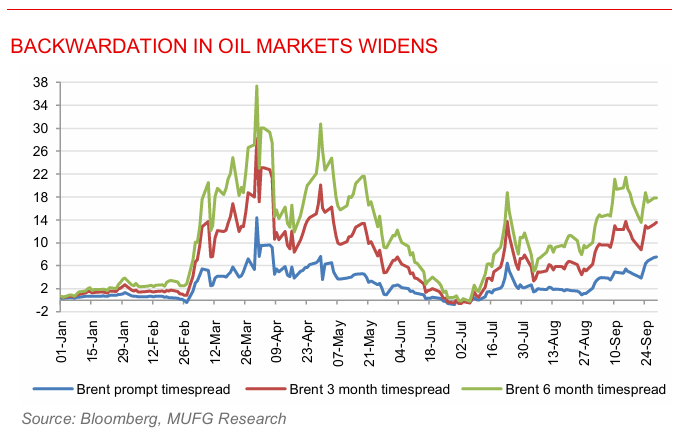
Oil rises as US-Iran impasse keeps market tight. Oil advanced with Brent above USD 107/b and WTI around USD 94/b as stalled US-Iran negotiations and tight physical markets outweighed recovering Saudi supply. Iranian officials reportedly see limited prospects for an agreement to reopen the Strait of Hormuz before the US midterm elections, while both sides rejected reports of greater flexibility on sanctions and Iran’s nuclear program. Saudi Arabia has meanwhile restored around half of the capacity of its East-West pipeline, with flows reaching at least 3.5mb/d after drone attacks halted the route earlier this month. Despite the recovery, physical supply remains tight, with Brent’s prompt spread widening to more than USD7/b from less than USD 1 at end-August, signalling strong demand for immediate barrels. Persistent uncertainty over Hormuz, tight prompt supply and constrained refining capacity should continue to support crude and product prices despite improving Saudi export capacity.
Gold rebounds as treasury selloff stabilises. Gold edged higher to above USD 4,140/oz as the selloff in US Treasuries stabilised. The 10-year Treasury yield held around 5.23% after reaching a 19-year high, although expectations for further Fed tightening remain a significant headwind. Gold is down almost 7% in September, as persistent inflation, elevated energy prices and the Fed’s first-rate hike since 2023 have pushed borrowing costs higher. Renewed US-Iran tensions have also lifted oil, adding to inflation risks, with markets pricing around a 70% probability of another Fed hike in October. Attention now turns to US PCE inflation and non-farm payrolls for further signals on the policy outlook. While stabilising Treasury yields provide some near-term support, persistent energy-driven inflation and expectations of additional rate hikes continue to constrain gold’s recovery.
MIDDLE EAST - CREDIT TRADING
End of day comment – 28 September 2026. Another weak session. The combination of higher rates and wider spreads again made the cash adjustment in our market sizeable. In terms of flows the morning was very heavy with a combo of ETF/ RM/ Local/ dealers trying to exit the market, but in the latter part of the afternoon we started to see a bit dip buying/ short covering and more two-way traffic from ETFs. In terms of performance lower beta IG sovgn closed 4/5bp wider. In ADGB 54s underperformed closing -1.5pt/+6bp, in QATAR new 36s underperformed closing -0.75pt/+5bp. Higher betas started to feel the pressure too, OMAN closed +10/+15bp, in the long end 51s closed -1.875pt/+10bp, in the belly 31s -0.75pt/+15bp. MOTROC also started to show some cracks, closing +10bp on average with the EUR curve underperforming the USD curve. (Source: Dominik Roth, Credit Trader)
MIDDLE EAST - MACRO / MARKETS
Saudi pipeline flows recover as Qatar extends LNG disruptions. Saudi Arabia has restored around half the capacity of its 7mb/d East-West pipeline, with flows reaching at least 3.5mb/d and crude loadings resuming at the Red Sea port of Yanbu after drone attacks halted operations on September 10. The route has been critical in allowing Saudi crude to bypass the Strait of Hormuz during the Iran conflict, although Aramco sharply increased Gulf shipments while the pipeline was offline, helping lift September exports to their highest since the war began. A full restoration could still take around six weeks, while Houthi attacks continue to threaten Saudi energy infrastructure and Red Sea shipping. Meanwhile, QatarEnergy has extended force majeure on LNG deliveries to customers in Asia and Europe through November or early December, as Hormuz traffic remains constrained and the damaged Ras Laffan complex continues operating at reduced capacity. Qatar has increased some shipments through the strait but flows remain well below pre-war levels. The Saudi pipeline recovery should improve crude export flexibility, while prolonged Qatari disruptions could keep global LNG supply tight and sustain elevated European and Asian gas prices into the Northern Hemisphere winter.
Bahrain inflation holds at 3.0% as food and transport costs rise. Bahrain’s headline inflation remained at 3.0% y/y in August, unchanged from July after accelerating from 2.3% previously, while consumer prices increased 0.2% on the month. Price pressures remained concentrated in selected categories, with recreation and culture rising 10.1% y/y, food and non-alcoholic beverages up 8.1%, and transport costs increasing 7.8%, pointing to continued pressure on household spending. However, these increases were largely offset by deflation across several other components. Clothing and footwear prices fell 9.4% y/y, while housing, water, electricity and gas declined 1.1%, with healthcare, communications and household appliance prices also recording modest decreases. The divergence across categories suggests underlying price pressures remain uneven, with elevated food and transport costs offset by softer housing and retail prices, helping keep overall inflation stable despite higher costs in key household expenditure categories.