
To read the full report, please download the PDF above.
Middle East Daily
SOOJIN KIM
Research Analyst
DIFC Branch – Dubai
T: +44(4)387 5031
E: soojin.kim@ae.mufg.jp
MUFG Bank, Ltd. and MUFG Securities plc
A member of MUFG, a global financial group
Middle East Daily
COMMODITIES / ENERGY
Oil retreats as US-Iran ceasefire supports supply recovery. Oil prices pared early gains after the US and Iran agreed to halt military attacks following weekend flare-ups, including an attack on an oil super-tanker near the Strait of Hormuz. Brent traded near USD72/b and WTI below USD70/b, with both benchmarks giving up earlier gains as the ceasefire revived expectations for a gradual normalisation of Gulf energy flows. While commercial shipping is expected to resume ahead of renewed peace talks, traffic through Hormuz remains below normal levels, with hundreds of vessels still stranded and shipowners remaining cautious after the latest security incidents. Oil prices are likely to remain under downward pressure as geopolitical risk premium continue to unwind and regional supply recovers, although intermittent disruptions and uncertainty over the durability of the ceasefire could keep short-term volatility elevated.
Gold declines despite renewed Middle East tensions. Gold fell toward USD4,000/oz despite renewed US-Iran exchange in the Persian Gulf, as markets focused on easing inflation expectations and prospects for resumed peace talks. Although weekend attacks disrupted shipping near the Strait of Hormuz and temporarily lifted oil prices, both sides later agreed to halt hostilities and resume negotiations in Doha, reducing immediate geopolitical concerns. Meanwhile, softer than feared US inflation data reinforced expectations that the Fed may not need to tighten policy as aggressively as previously feared. Gold is likely to remain under pressure as geopolitical risk premiums continue to fade and expectations for lower energy-driven inflation improve, although renewed disruptions in the Middle East could still trigger intermittent safe haven demand.
MIDDLE EAST - CREDIT TRADING
End of day comment – 26 June 2026. The spread widening continues. Shorter end and belly bonds were unchanged in cash prices today; long end bonds were lower by 0.25/0.375pt. That translated into a spread widening of 2/5bp with the UST strength into London close. Flow wise, the outflows are still concentrated in UAE index names, seen RM selling today ahead of month end, but so far not in big size. Still the market is long in the bonds getting sold. The spread widening is starting to add up, over the week the ADGB curve is 7/12bp wider. Macro risk moves didn't help today either. Once we get over month end much will depend on if outflows from RM stops and whether the primary market will see more supply. Expect more outflows though on Monday/ Tuesday. (Source: Dominik Roth, Credit Trader)
MIDDLE EAST - MACRO / MARKETS
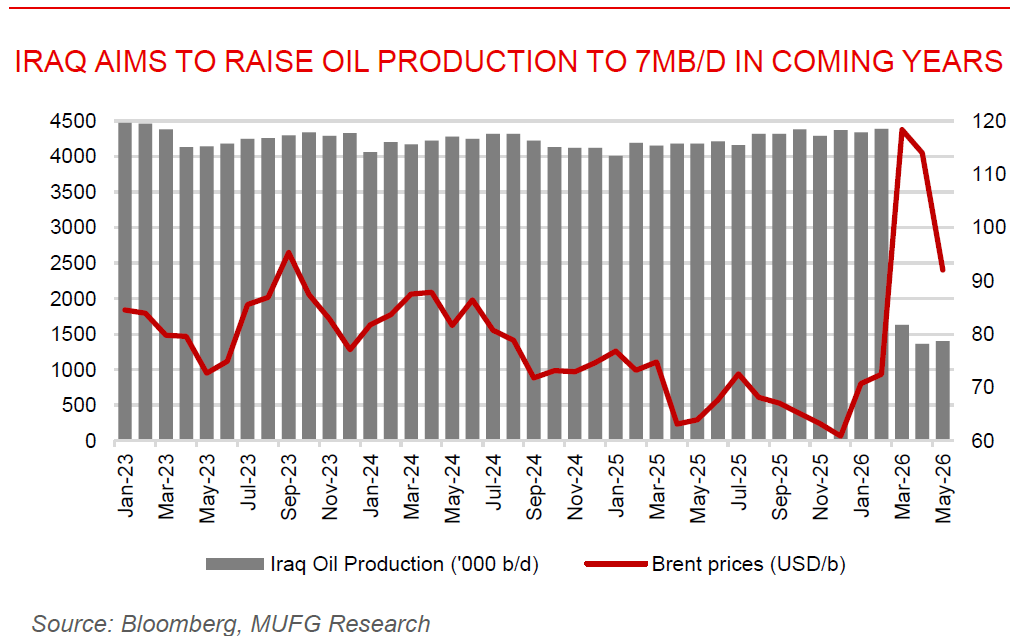
Iraq pushes for higher OPEC quota amid fiscal pressures. Iraq intensified its push for a higher OPEC production quota after warning it could reconsider its membership if output limits are not increased, although the government later clarified that leaving the group is not its official position. The move reflects mounting fiscal pressure, with Iraq’s economy heavily dependent on oil revenues and exports still constrained by disruptions to the Strait of Hormuz. At the same time, Prime Minister Ali Al-Zaidi is expected to discuss a proposed US-Iraq energy and development fund, during his visit to the US next month, backed by oil exports initially of 500,000b/d and potentially rising to 2mb/d, with proceeds financing long-term US investment in energy, electricity, and export infrastructure. Iraq also aims to increase oil production to 7mb/d over the coming years while expanding partnerships with international energy companies. Iraq is using both its OPEC quota negotiations and closer cooperation with the US to accelerate the recovery of its energy sector and attract foreign investment. While an OPEC exit remain unlikely, the episode underscore growing tensions within the producer group as member seek greater production flexibility in the post-war environment.
Jordan’s exports strengthen as trade deficit narrows. Jordan’s external trade improved in the first four months of 2026, with total exports rising 9.0% y/y to JOD3.86bn (USD5.4bn), driven by a 7.3% y/y increase in domestic exports and a 15.1% y/y rise in re-exports, while imports declined 1.5%. This narrowed the trade deficit by 13.4% y/y and lifted the export-to-import coverage ratio to 59% from 53% y/y, reflecting stronger external competitiveness and a more resilient manufacturing and logistics sector. Export performance was supported by a sharp 49.3% y/y increase in shipments to the EU, alongside solid demand for pharmaceuticals, potash, phosphates, fertilizers, garments, and chemicals. Against a challenging regional backdrop, Jordan outperformed many regional peers by combining rising exports with lower imports, benefiting from diversified export markets and overland trade corridors that have been less affected by disruptions in the Strait of Hormuz. Going forward, expanding access to European markets, strengthening higher value-added manufacturing, and improving logistics and trade efficiency will be key to sustaining export momentum and supporting Jordan’s external position through H2 2026.