
To read the full report, please download the PDF above.
Middle East Daily
SOOJIN KIM
Research Analyst
DIFC Branch – Dubai
T: +44(4)387 5031
E: soojin.kim@ae.mufg.jp
MUFG Bank, Ltd. and MUFG Securities plc
A member of MUFG, a global financial group
Middle East Daily
COMMODITIES / ENERGY
Oil rebounds as Middle East conflict re-escalates. Brent crude rose more than 3% to above USD87/b, recovering part of its recent losses after renewed military exchanges between Iran, the US and regional allies reignited concerns over energy supply disruptions. Iran’s Revolutionary Guard claimed missile attacks on a US base in Jordan and reported targeting three tankers, while US Central Command said it intercepted attacks on American forces and conducted retaliatory strikes against Iran-aligned groups in Iraq. Shipping activity through the Strait of Hormuz remained severely constrained, with only two commodity vessels recorded transiting the waterway on Tuesday, underscoring continued risks to global oil flows. Meanwhile, US crude inventories fell by 3.3 million barrels last week, according to API estimates, providing additional support to prices. The renewed escalation has restored a geopolitical risk premium to oil prices, with ongoing disruptions around Hormuz likely to keep markets volatile despite continuing diplomatic efforts.
Gold holds near key support ahead of Fed decision. Gold traded near USD4,020/oz as investors awaited the Fed’s closely watched interest rate decision amid persistent geopolitical tensions in the Middle East. Markets currently assign around a one-in-three probability of 25bps rate hike, with policymakers balancing softer June inflation against renewed inflationary pressures from higher oil prices following the recent escalation in the US-Iran conflict. Although gold has fallen by nearly 25% since the conflict began, the metal has remained supported around the USD4,000/oz level by sustained dip-buying. While geopolitical risks continue to underpin safe-haven demand, uncertainty over the Fed’s policy outlook and the prospect of higher for longer rates are likely to keep gains in gold constrained in the near term.
MIDDLE EAST - CREDIT TRADING
End of day comment – 28 July 2026. Like said yday whilst sovgn bonds were tighter the bounce had no breadth and never felt as strong as the sovgn performance. Today we gave up all of it in terms of spread moves in sovgn and most quasi/fins/corps are wider over two days. Flows remain light and only in the last hours did we see some buying coming in. That could set up for a stronger morning tomorrow if macro risk stays stable. For today though the theme was sideways cash prices at best against higher UST/ lower rates. Even curves like QATAR seem to be completely irresponsive to UST move which is rare. I close ADGB/ QATAR unch/+5bp. In fins seen some activity in FABUH which found some buying on wider levels but still closes broadly +5bp. NEW FABUH 36s LT2 is starting to clear around 99. Quasis saw a new private placement in TAQAUH 5y in 750mm which widened the curve 5/8bp around the 5y point. The focus now will turn to the FED and month end rebal/ flows. UST spreads are starting to look cheap but only inflows will tighten them. (Source: Dominik Roth, Credit Trader)
MIDDLE EAST - MACRO / MARKETS
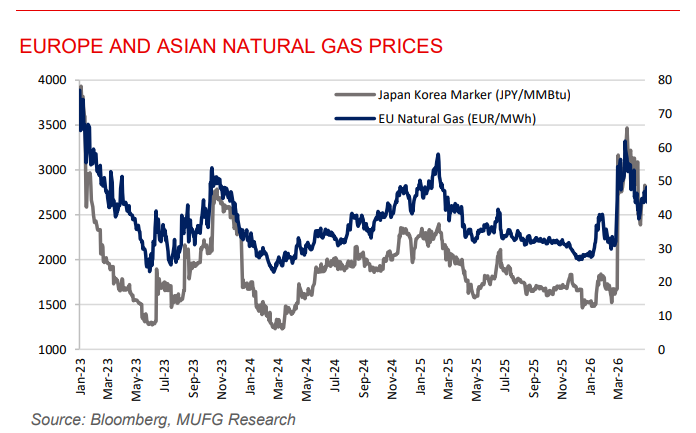
QatarEnergy extends LNG force majeure, tightening global gas market. QatarEnergy has extended force majeure on some LNG deliveries into September 2026, prolonging supply disruptions and tightening global gas markets ahead of the Northern Hemisphere winter. Italy’s Edison confirmed three additional cancelled cargoes, bringing the total number of affected shipments to 21 since April, while buyers in Asia also received extension notices. The prolonged outage follows damage to LNG facilities at Ras Laffan during the regional conflict earlier this year, reducing production capacity and highlighting that the disruption extends beyond shipping constraints. As the world’s second-largest LNG exporter, supplying around 20% of global LNG trade, Qatar’s reduced exports have supported higher European and Asian gas prices despite additional US LNG supply entering the market. The extension suggests supply constraints could persist into the winter heating season, leaving Europe particularly vulnerable given relatively low storage levels, while the pace of repairs at Ras Laffan and new LNG capacity additions will be key to restoring market balance.
Saudi funds back new private equity investment platforms. Saudi Arabia continued to deepen its private capital ecosystem, with Jada Fund of Funds committing to the first close of Growth Catalyst Fund I, while Brookfield Asset Management secured approximately USD2bn first close for its Middle East-focused private equity fund backed by the Public Investment Fund (PIF) and other institutional investors. Growth Catalyst Fund I is targeting SAR750mn (USD200mn) to provide growth capital to established Saudi SMEs, supporting business expansion, governance improvements and future exits. Meanwhile, Brookfield’s new fund will focus on buyout and growth opportunities across sectors including financial services, consumer and technology, with around 50% of investments allocated to Saudi Arabia. The fundraising highlights Saudi Arabia’s continued success in attracting domestic and international private capital, reinforcing the Kingdom’s strategy of developing local capital markets and accelerating private sector growth under Vision 2030.