
To read the full report, please download the PDF above.
Middle East Daily
SOOJIN KIM
Research Analyst
DIFC Branch – Dubai
T: +44(4)387 5031
E: soojin.kim@ae.mufg.jp
MUFG Bank, Ltd. and MUFG Securities plc
A member of MUFG, a global financial group
Middle East Daily
COMMODITIES / ENERGY
Oil rises as US-Iran talks stall over Hormuz. Oil advanced as prospects for a rapid reopening of the Strait of Hormuz faded, with Brent rising to around USD 106/b and WTI above USD 93/b. President Trump rejected Iran’s proposed conditions for reopening the waterway and lifting the US blockade, although negotiations are expected to resume this week. Physical flows through Hormuz remain closely watched, with Trump citing record shipments over the weekend while Iranian forces reportedly continued targeting vessels using unauthorized routes. US pressure on Iran is also intensifying, with Treasury Secretary Scott Bessent estimating only ~15mb of Iranian crude remain in transit and suggesting deliveries to China could largely cease within two weeks. Regional security risks remain elevated, with Saudi-led forces intercepting further Houthi drones and missiles targeting Saudi cities. Continued disagreement over Hormuz and persistent attacks should keep the geopolitical risk premium elevated despite recovering Gulf oil flows.
Gold slides as energy prices reinforce rate hike risks. Gold fell as much as 1.8% to below USD 4,206/oz, extending the previous week’s more than 2% decline as elevated energy prices reinforced inflation concerns and expectations for further Fed tightening. Fed officials have continued to signal that additional tightening may be necessary after this month’s 25bps hike, with markets pricing around a 65% probability of another increase in October. Long-term Treasury yields remain elevated amid stronger growth, fiscal concerns and expectations of higher policy rates, while the 2s10s yield spread narrowed to just 17bps last week. Persistent energy-driven inflation and elevated Treasury yields remain significant headwinds for gold despite continued geopolitical uncertainty.
MIDDLE EAST - CREDIT TRADING
End of day comment – 25 September 2026. Very weak markets. The weakness from yday continued from the start. There was an absolute buyer strike, probably also due to Friday/ weekend ahead. But sellers were not on holidays, and we saw again ETFs with sizeable BWICs. Real money also cut out of risk if anything and on top dealers did too. Long end ADGB bonds closed up to -1.25pt/+4bp and have now given up the sept gains in spread terms with cash prices making new lows. Belly bond widened even more as the UST steepened but cash was for sale closing up to -0.25pt/+5bp. New QATAR 5y/10y both closing +2bp and the 10y isn't that far off 6% yield anymore (5.92%/5.90%). Not many places to hide today and the overall feel is that not all bonds getting sold found clearing levels/ are in firm hands as the street tries to clear every selling flow straight in the market. (Source: Dominik Roth, Credit Trader)
MIDDLE EAST - MACRO / MARKETS
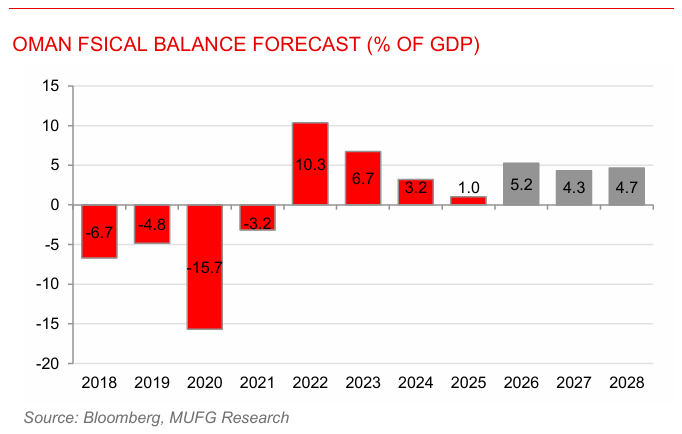
S&P affirms Oman at BBB- as uninterrupted energy exports boost growth outlook. S&P Global Ratings affirmed Oman’s ‘BBB-/A-3’ sovereign credit ratings with a stable outlook, citing the country’s resilience amid ongoing Middle East tensions and its unique ability to export hydrocarbons without relying on the Strait of Hormuz. The agency raised its 2026 real GDP growth forecast to 3.5% from 1.6%, reflecting stronger oil and gas production, elevated hydrocarbon prices, and increased trade and logistics activity as regional supply chains adjust to the conflict. Oman’s strategic ports on the Arabian Sea, including Duqm, Mina al Fahal, and Salalah, have allowed energy exports to continue uninterrupted, supporting fiscal and external balances. S&P expects Oman to record a fiscal surplus of 4.8% of GDP and a current account surplus of 3.5% of GDP in 2026, while maintaining substantial buffers, including liquid government assets exceeding 40% of GDP and foreign reserves near 20% of GDP. The agency also highlighted continued progress under Vision 2040, improving institutional effectiveness, and growing non-oil sectors such as logistics, financial services, and IT. While geopolitical risks remain elevated and disruptions are expected to persist into 2027, S&P believes Oman’s strong fiscal and external positions, neutral foreign policy stance, and role as an alternative regional trade and energy hub will help it remain resilient to regional volatility.
IMF supports Syria’s statistical capacity building. An IMF technical assistance mission is working with the Central Bank of Syria from September 20 to October 1 to strengthen the country’s monetary, financial and external-sector statistics. The program focuses on improving monetary and financial statistics (MFS) and external-sector statistics (ESS) in line with international standards, including better balance-sheet preparation, standardized reporting and data-quality assessment. IMF experts are working with central bank departments, the Planning and Statistics Authority and other government agencies to improve data availability and consistency across statistical frameworks. The initiative should strengthen the reliability and transparency of Syria’s macroeconomic data, supporting policymaking and the country’s broader re-engagement with international financial institutions.