
To read the full report, please download the PDF above.
Middle East Daily
SOOJIN KIM
Research Analyst
DIFC Branch – Dubai
T: +44(4)387 5031
E: soojin.kim@ae.mufg.jp
MUFG Bank, Ltd. and MUFG Securities plc
A member of MUFG, a global financial group
Middle East Daily
COMMODITIES / ENERGY
Oil extends decline as US-Iran talks raise de-escalation hopes. Brent crude fell toward USD87/b after plunging 8.7% in the previous session, while WTI traded near USD81/b, as signs of potential US-Iran negotiations eased fears of prolonged supply disruptions. President Trump said there was a “good chance” diplomatic talks with Iran would make progress after the US paused military strikes, while Iran continued to refrain from retaliatory attacks. However, shipping activity through the Strait of Hormuz remained well below normal despite ongoing Oman-mediated discussions to restore maritime traffic, underscoring persistent logistical risks. Elsewhere, Kazakhstan resumed crude exports through the Caspian Pipeline Consortium (CPC) terminal after temporary disruptions caused by Ukrainian drone attacks. While improving diplomatic prospects have reduced the geopolitical risk premium, oil markets remain sensitive to developments in Hormuz, with shipping disruptions and regional security risks continuing to support elevated price volatility.
Gold slips ahead of closely watched Fed decision. Gold fell as much as 0.8% to around USD4,040/oz as investors awaited this week’s Fed policy decision, while easing tensions between the US and Iran reduced inflation concerns. Markets remain divided over the Fed’s next move, with interest rate swaps implying around a 40% probability of a 25bps rate hike amid conflicting signals from softer June inflation and higher oil prices. Although gold has fallen by nearly 25% since the US-Iran conflict began, gold has remained supported around the USD4,000/oz level by sustained dip-buying. While easing geopolitical tensions have reduced safe haven demand, resilient investor inflows and uncertainty over the Fed’s policy path should continue to provide support for gold in the near term.
MIDDLE EAST - CREDIT TRADING
End of day comment – 27 July 2026. What a difference a weekend makes. Military operations were halted from both sides, and the market took the bait and came out with strong bids in the morning. Early morning inflows from ETFs accelerated the move higher, led mainly by long end bonds. Then came the fade which started around midday. Flows turned and with macro risk coming off the best levels in the afternoon, GCC bonds as well came off the tights into the close. ETFs into the close are selling again mostly newer issue and private placements like ADGB 36s or QPETRO 29s. The market is still closing tighter, especially led by sovgn and in IG by ADGB which closes up to 0.5pt higher and -5bp across the curve. QATAR underperformed that move closing on average -3bp. Quasi sovgn were more mixed. The market found an early bid in short end/belly bonds which carried bonds higher throughout the day. But dealers still have bonds to go, and especially long end came off led by selling in MUBAUH where 49s closed +0.125pt/-1bp. In corps DPWDU outperformed strongly, 37s closed +0.75pt/-7bp. (Source: Dominik Roth, Credit Trader)
MIDDLE EAST - MACRO / MARKETS
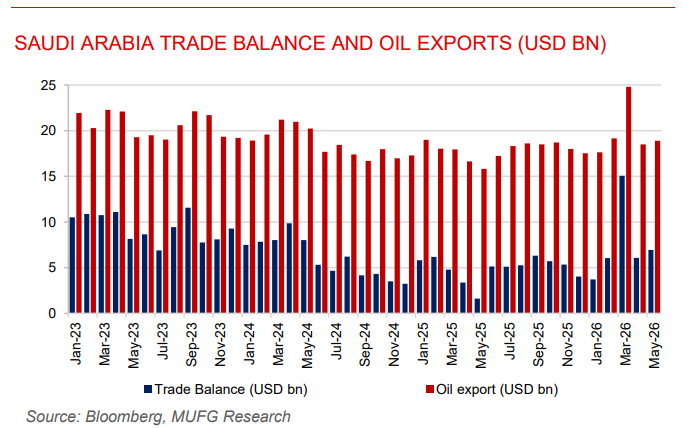
KSA’s May trade surplus surges 329% to USD6.9bn as oil exports rebound. Saudi Arabia’s merchandise trade surplus surged to USD6.9bn in May 2026, up 328.8% y/y, as a recovery in oil exports combined with a sharp decline in imports strengthened the Kingdom’s external balance. Total exports rose 3.9% y/y to SAR93.8bn, driven by a 19.5% increase in oil exports, lifting hydrocarbons’ share of total exports to 75.6% from 65.7% a year earlier, while imports fell 19.5% to SAR67.8bn. However, the improvement remained narrowly concentrated in the energy sector, with non-oil exports, including re-exports, declining 26.1%, reflecting continued weakness in manufacturing and re-export activity. China remained Saudi Arabia’s largest trading partner, accounting for 12.3% of exports and 22.0% of imports. The stronger trade surplus reinforces the recent improvement in Saudi Arabia’s external position, but its increasing reliance on hydrocarbons highlights that a sustained recovery in non-oil exports will be critical to advancing the Kingdom’s Vision 2030 diversification agenda, particularly amid softer oil prices and evolving global trade conditions.
Kuwait secures record pipeline investment. Kuwait signed a USD16bn lease-and-leaseback agreement for its crude oil pipeline network with Blackstone, Brookfield and KKR, marking the country’s largest-ever foreign direct investment (FDI) transaction despite ongoing regional security tensions. Under Project Peregrine, Kuwait Oil Company will retain 51% ownership and operational control, while the investors will hold the remaining 49% for 20.5 years, providing USD7.85bn in upfront proceeds to support Kuwait Petroleum Corporation’s investment plans. The deal follows Kuwait’s successful USD6bn sovereign bond issuance earlier this month. The back-to-back transactions highlight Kuwait’s ability to attract international capital despite geopolitical uncertainty, although sustaining investment momentum will depend on successful execution of Project Peregrine and broader efforts to diversify foreign investment beyond the energy sector.