
To read the full report, please download the PDF above.
Middle East Daily
EDWARD BELL
Head of Research
DIFC Branch – Dubai
T: +971 (4)387 5033
E: edward.bell@ae.mufg.jp
SOOJIN KIM
Research Analyst
DIFC Branch – Dubai
T: +971 (4)387 5031
E: soojin.kim@ae.mufg.jp
MUFG Bank, Ltd. and MUFG Securities plc
A member of MUFG, a global financial group
Middle East Daily
COMMODITIES / ENERGY
Oil eases as diplomatic signals temper Middle East risk premium. Oil markets are continuing to track Middle East geopolitics, with attention on diplomacy helping to push prices down from reaching near their highest levels in the last six months. Brent futures are trading below USD 115/b while WTI is below USD 101/b, both lower by about 1% on the day. Market focus this week has been on a meeting between security officials from Iran, Saudi Arabia, Turkey and Pakistan. The meeting concluded with pledges for further dialogue between the countries and Iran has stated it would be flexible on reopening the Strait of Hormuz though it would expect concessions from the US. The risk of a renewed US – Israeli offensive against Iran is still weighing on the outlook with markets now turning their focus to the outcome of today’s Israeli election. No clear majority is expected but all major candidates have reiterated that they will focus on Israeli security, which risks further regional escalation. Time spreads remain elevated close to the December Brent expiry (Oct 30) with the prompt spread in a backwardation of USD 5/b.
Gold holds near USD 4,000 as markets await fed signals. Gold is holding steady at USD 4,014.72/troy oz with a focus on the upcoming FOMC decision. While we do not expect a hike, the key signals for gold will come in whether the limited statement addresses the inflation outlook or if Fed Chair Warsh is pressed on the pathway for rates into 2027. Markets are pricing in almost an additional two full hikes in 2027 after a December move. Spot prices are down by about 3.5% so far in October with prices close to their year-to-date lows of USD 3,976/troy oz hit in July this year.
MIDDLE EAST - CREDIT TRADING
End of day comment – 26 October 2026. The spread widening continues. Macro markets were on the front foot for most of the day, credit indices tighter, equities higher, France dodged a downgrade, no military action over the weekend, you'd think this will give GCC cash markets a bit of a boost. But the selling just continued from the get-go. ETFs were again more sizeable sellers and today dealers were looking for an exit and where price insensitive when taking this exit. As result buyers: sellers’ ratio was 1:2 and interdealer flow higher in proportion to accounts flows. Sovgn curves are still very orderly in price action, KSA complex widened another 2/3bp as did KUWIB with cash down up to -0.125pt. QATAR 36s was another notable underperformer in the sovgn space closing -0.25pt/+4bp. But then comes the ugly ones away from sovgn where bid side liquidity is hard to come by. AT1s are one example, MASQUH 6.625 perps closing -0.75pt/+20bp. Other pressure points remain around new supply. On the back of the new MASDAR, old bonds got sold aggressively today with 35s going out -0.5pt/+8bp. (Source: Dominik Roth, Credit Trader)
MIDDLE EAST - MACRO / MARKETS
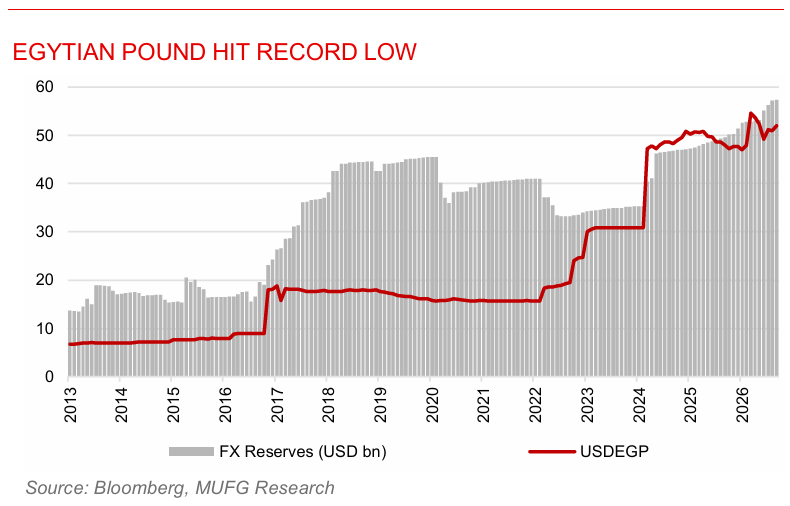
Egyptian pound hit record low as currency pressures intensify. The Egyptian pound weakened to a record low of EGP56 per US dollar on October 26, with the Central Bank of Egypt (CBE) quoting EGP56.21–56.35, reflecting a sharp depreciation from EGP52.3 at the beginning of the month. The currency has lost approximately 15% of its value in 2026, amid heightened external pressures and exchange-rate volatility. CBE Governor Hassan Abdalla reaffirmed the central bank’s commitment to a flexible exchange-rate regime, describing recent fluctuations as consistent with changing economic conditions. Despite the depreciation, Egypt’s external buffers remain relatively strong, with foreign-exchange reserves reaching a record USD 57.35bn in September, while Moody’s upgraded the sovereign rating to B3 in October. However, the weaker currency risks adding to inflationary pressures, with annual inflation at 13.9% in September, well above the CBE’s target, while the benchmark deposit rate remains at 19%. Persistent currency depreciation could complicate inflation management and delay monetary easing.
Saudi Arabia’s trade surplus widens in August as non-oil exports strengthen. Saudi Arabia’s trade surplus widened to SAR 15.6bn (USD 4.2bn) in August 2026 from a revised SAR 13.2bn in July, supported by stronger export growth, although the surplus remained 21% below its year-earlier level. Total exports increased 3.3% m/m to SAR87.2bn, outpacing a 0.6% rise in imports to SAR71.6bn. However, exports declined 11.5% y/y, reflecting continued weakness in oil shipments, with oil export revenues falling 12.5% y/y to SAR 61.1bn, accounting for 70% of total exports. Meanwhile, national non-oil exports excluding re-exports rose 17.8% m/m and 8.5% y/y to SAR 18.3bn, highlighting improving momentum in non-oil trade. The improving monthly surplus and stronger non-oil exports signal progress in trade diversification, although weaker oil revenues and persistent regional shipping disruptions could constrain the recovery in Saudi Arabia’s external trade balance.