
To read the full report, please download the PDF above.
Middle East Daily
SOOJIN KIM
Research Analyst
DIFC Branch – Dubai
T: +44(4)387 5031
E: soojin.kim@ae.mufg.jp
MUFG Bank, Ltd. and MUFG Securities plc
A member of MUFG, a global financial group
Middle East Daily
COMMODITIES / ENERGY
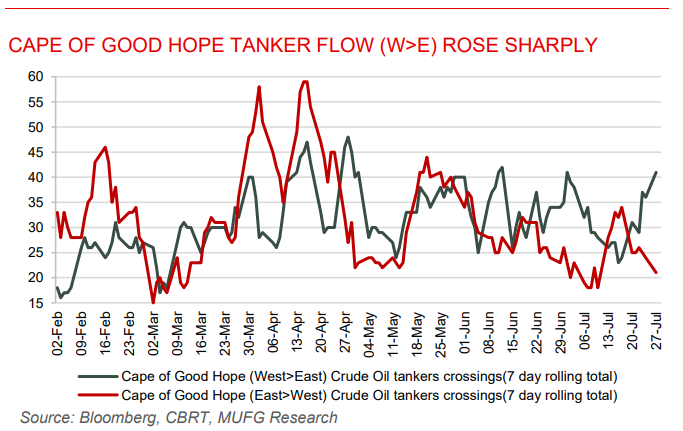
Oil retreat as US pauses strikes on Iran. Brent crude fell more than 7% before recovering to trade above USD93/b, while WTI also declined, after the US paused military strikes against Iran, raising hopes for a temporary de-escalation in the Middle East conflict. The pullback came despite Houthi claims of attacks on Saudi energy facilities in Yanbu and Jizan, although the incidents were not confirmed by Saudi authorities. Shipping activity through both the Strait of Hormuz and Bab el-Mandeb remained well below normal, highlighting continued disruption to regional energy trade, while Ukraine drone attacks also temporarily halted oil loadings at Russia’s Novorossiysk export terminal. Although the pause in US military action has eased immediate supply concerns, constrained maritime traffic across key export routes suggests geopolitical risk remains elevated, leaving oil prices vulnerable to renewed volatility if hostilities escalate again.
Gold rebounds as Middle East tensions ease. Gold rose as much as 1.6% to above USD4,100/oz after the US paused military strikes against Iran and Iran signalled a willingness to pursue diplomatic talks, easing concerns over oil supply disruptions and inflation. Brent crude fell more than 7% at the start of trading before recovering, as the pause in hostilities outweighed Houthi claims of attacks on Saudi energy facilities in Yanbu and Jizan. Gold has continued to find support around the USD4,000/oz level through sustained dip-buying, although it remains more than 20% below its February record high. The easing in geopolitical tensions has reduced inflation concerns and could lessen pressure on the Fed to tighten policy further, providing near-term support for gold ahead of this week’s closely watched Fed meeting.
MIDDLE EAST - CREDIT TRADING
End of day comment – 24 July 2026. Another day of spread widening. In the morning there was a bit of pushback against the 10/15bp widening of the ADGB long end yday. Some buying in 49s and 54s emerged lifting cash prices a touch but there wasn't any more activity in the afternoon and ADGB long end goes out +0.125pt/+2bp. The spread widening in the belly was more pronounced. The market is long and took cash prices lower (-0.125/-0.375pt). Coupled with the UST move higher you are looking at spreads being 5/8bp wider across UAE/QATAR sovgn and quasis. OMAN is still outperforming a touch especially if you look at spreads over a week or month (guess who has not issued public or private bonds). In corps ALDAR hybrid which got sold in the prior days continued to get offered down, 56s closing -0.5pt/+15bp. To be sure overall volumes were very low, and Friday spread moves can be significant. It is though pretty clear that techs remain firmly negative as the street has bonds to go. Only a change in flows will reverse the widening. (Source: Dominik Roth, Credit Trader)
MIDDLE EAST - MACRO / MARKETS
PIF signs USD15bn financing framework with US EXIM. Saudi Arabia’s Public Investment Fund (PIF) signed a USD15bn MoU with the Export-Import Bank of the United States to establish a financing framework supporting strategic investments and procurement from US companies. The agreement will provide long-term export credit financing for eligible PIF portfolio companies purchasing US goods and services, while expanding cooperation in sectors including advanced technology, aerospace, infrastructure, future mobility, water security and critical minerals. The deal builds on PIF’s broader capital-raising strategy and existing partnerships with international export credit agencies. The fund noted that the US is its largest international market, with USD65bn of procurement from US suppliers since 2017, contributing an estimated USD35bn to US GDP. The agreement further strengthens Saudi-US economic ties while supporting PIF’s investment strategy and facilitating technology transfer and supply-chain development across strategic sectors.
Morocco seeks funding for USD26bn Africa-Europe gas pipeline. Morocco is seeking financing from the US Export-Import Bank (EXIM) and the World Bank for the proposed USD26bn African Atlantic Gas Pipeline (AAGP), as renewed geopolitical tensions strengthen Europe’s push to diversify gas supplies. The 6,800km pipeline, backed by the Economic Community of West African States (ECOWAS), would transport gas from Nigeria, Senegal and Mauritania through Morocco before connecting to Spain via the Maghreb-Europe pipeline. The project is expected to have an annual capacity of 30 bcm, with half allocated to Morocco and the remainder exported to Europe. Construction is scheduled to begin in 2028, with first gas targeted for 2031, subject to financing. If completed, the project would strengthen regional energy integration, improve Europe’s supply diversification and enhance Morocco’s role as a strategic energy transit hub, although financing, cross-border coordination and long-term European gas demand remain key execution risks.