
To read the full report, please download the PDF above.
Middle East Daily
EDWARD BELL
Head of Research
DIFC Branch – Dubai
T: +971 (4)387 5033
E: edward.bell@ae.mufg.jp
SOOJIN KIM
Research Analyst
DIFC Branch – Dubai
T: +971 (4)387 5031
E: soojin.kim@ae.mufg.jp
MUFG Bank, Ltd. and MUFG Securities plc
A member of MUFG, a global financial group
Middle East Daily
COMMODITIES / ENERGY
Oil sells off despite geopolitical backdrop. Oil prices recovered some ground overnight with Brent futures managing a 2.3% gain to USD 91.40/b, moving back above the USD 90/b level but have given up some of those gains in early trade today with Brent currently around USD 90.20/b. WTI is following the international benchmark with a 2.3% gain overnight being partially unwound in trading today to leave prices below USD 81/b. Time spreads at the front of the futures curve are still relatively steady holding at a backwardation of USD 2.60/b in the Brent 1-2 month spread though physical prices remain close to futures, suggesting that even with the elevation of geopolitical risk in the region, flows of oil are still getting onto international markets. Saudi Arabia’s primary financial district in Riyadh was attacked again overnight following a Houthi drone strike while earlier today there were reports of drone attacks against Ras Tanura. In oil market fundamentals, the API reported a build in US commercial crude stocks of 100k bbl last week while gasoline stockpiles were unchanged and distillate inventories were higher.
Gold falls in line with broader risk off moves. Gold prices turned negative again overnight following a risk off move and broader market anxiety that the US will again raise tariffs on trading partners like China and the EU. Spot gold is trading at USD 3,549/troy oz, down 0.2% on the day. PCE inflation from the US will be the next key release for gold prices with markets watching for embedded inflationary pressures in the US that would keep the Fed on a hawkish trajectory.
MIDDLE EAST - CREDIT TRADING
End of day comment – 24 November 2026. Stable despite macro vol. The morning was constructive with spreads 3/4bp tighter and ADGB outperforming in the IG space and OMAN in the high beta space. Once equities started to turn lower late morning and UST moved higher, spreads started to widen a touch in most GCC bonds. Flows also became more skewed to sellers again with RM firmly remaining net sellers throughout the day albeit in smaller size than most of Nov. ETFs were more balanced but overall technicals remain strong such that the street are looking to buy the same and sell the same bonds. In terms of performance ADGB remained strong in the macro weakness as there is only little selling and the bid in long end bonds remains strong, 54s closing +0.75pt/-3bp. Against this QATAR was again weaker, mostly going out +1/2bp with cash up to 0.25pt higher. OMAN long end had some late activity in 47s closing +0.75pt/-4bp. Quasi sovgn were quiet today with a spread change distribution of -1bp/+1bp, QPETRO still feels heavy in 29s and 31s. Fins widened +2/3bp as prices remained broadly flattish. Activity was again centred around the latest issuance with new FABUH 37s T2 closing +10c/+1bp. The primary market saw a new QIIKQD 5y sukuk which will print at T+120bp and ADIBUH mandated a AT1 (Source: Dominik Roth, Credit Trader)
MIDDLE EAST - MACRO / MARKETS
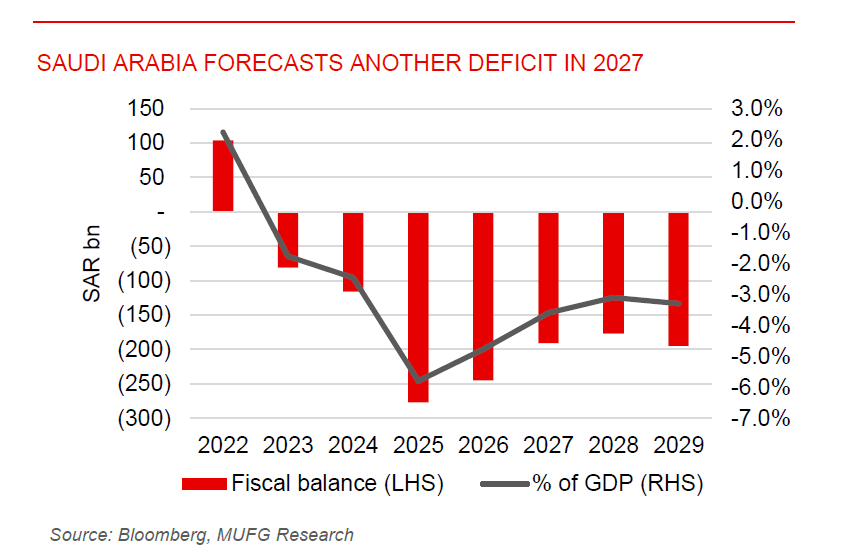
Saudi Arabia projects another deficit in 2027. Saudi Arabia has approved its 2027 fiscal budget, anticipating another year of fiscal deficit, the fifth consecutive annual shortfall with medium-term projections also implying a steady deficit. Total expenditure is forecast to unwind this year’s increase with a 3% decline in overall spending to SAR 1.39trn before expanding again in 2028-29 to reach a long-term expenditure target of SAR 1.5trn. Among the fastest growing elements of the government’s planned spending is debt servicing, which is due to increase by 31% y/y in 2027 to SAR 93bn as Saudi Arabia’s sovereign debt position has expanded steadily since 2022. Capital spending is forecast to drop by 2% y/y in 2027 compared with the MoF’s estimate for the 2026 level. Capex levels have been choppy and are estimated to have risen by 8% in 2026 after a near 12% drop in 2025.
UAE approves 2027 federal budget with focus on social services and security. The UAE has approved a federal budget of AED 90.1bn (USD 24.5bn) for 2027, slightly smaller than the budget approved for 2026. The federal budget covers nationwide expenditure and is smaller than individual emirate-level budgets. Within the total for 2027, the largest allocation will be for public services at AED 33.3bn, including spending on AI to improve government efficiency while AED 17.7bn was allocated for defence and public order and safety. The federal government is balanced but a full projection of revenues has not been released.