
To read the full report, please download the PDF above.
Middle East Daily
SOOJIN KIM
Research Analyst
DIFC Branch – Dubai
T: +44(4)387 5031
E: soojin.kim@ae.mufg.jp
MUFG Bank, Ltd. and MUFG Securities plc
A member of MUFG, a global financial group
Middle East Daily
COMMODITIES / ENERGY
Oil drops on diplomatic hopes despite ongoing supply disruption. Oil prices fell sharply, with Brent dipping to around USD97/b and WTI near UDS87/b, as renewed US diplomatic efforts to end the Iran conflict overshadowed continued military escalation and the near closure of the Strait of Hormuz. A proposed 15-point US plan to de-escalate tensions, alongside signs of potential negotiations, raised hopes of easing supply disruptions, even as US deployed additional troops and Iran maintained control over the critical waterway. Despite the pullback, oil remains on track for strong monthly gains amid persistent supply constraints, with global markets still grappling with reduced Gulf exports and rising fuel costs. The conflict has triggered widespread energy stress, including surging diesel prices, fuel shortages in multiple countries, and increased demand for alternative supplies, while uncertainty over negotiations and ongoing attacks continues to keep markets highly volatile.
Gold rebounds on diplomacy hopes despite ongoing war risk. Gold extended its recovery, rising as much as 2.8% above USD4,600/oz as investors responded to signs that the US may pursue diplomatic efforts to end the Middle East conflict. Optimism was supported by indications of potential talks between US and Iran, alongside calls from China for negotiations, while easing oil prices and a weaker dollar also provided support. However, gains come amid a fragile backdrop, with continued military escalation, tight control over the Strait of Hormuz, and troop deployments keeping uncertainty high. Rising energy-driven inflation risks and expectations of sustained or higher interest rates remain a headwind for gold, while recent forced selling potential central bank activity have added pressure. Despite this, gold continues to play a key role as a reserve asset and safe haven amid ongoing geopolitical and market volatility.
MIDDLE EAST - CREDIT TRADING
End of day comment – 24 March 2026. Stabilisation day ending tighter. The morning was a bit of a wobbly start on news overnight that KSA and UAE are considering joining the war. But soon the market found its footing as bids held up after the first trades. To be sure flows remain extremely low overall and sellers to buyer’s ratio traded 3:2. But the market was absorbing bonds easily in sovgn and quasi-issues. It was also good to see that some fins senior bonds are starting to find clearing levels, property names like DAMACR (+1pt) were also up. ETF flows are still net selling but flipping intraday again with ETF NAV moves. I close IG sovgn -1/2bp with cash unchanged in price terms, ADGB had some activity in long end, QATAR more in the belly. Oman had a mixed day, saw some bonds coming out in short to midterm 2026s-2031s whilst long was quiet but here as well cash price moves were minimal and spreads about 2bp tighter. Quasi sovgn had a good bid in ADNOCM and ADQABU up to 10y, closing ADNOCM 34s +0.25pt/-5bp.
MIDDLE EAST - MACRO / MARKETS
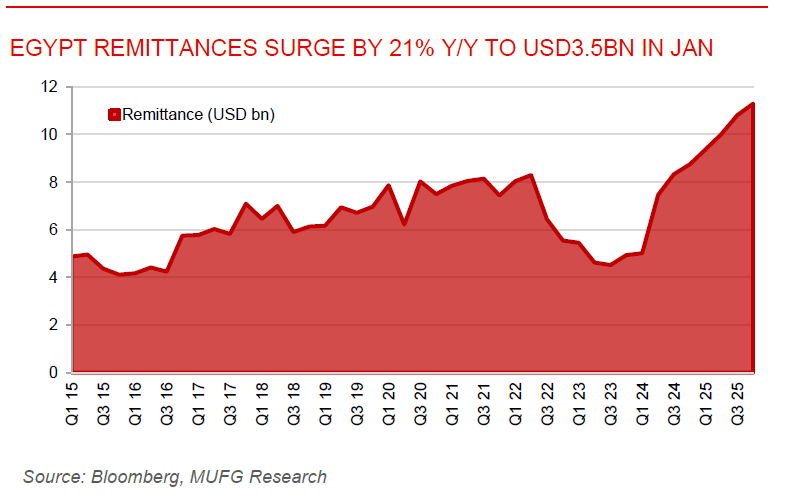
Egypt remittances surge, supporting external stability. Remittances from Egyptians abroad rose strongly by 21% y/y to USD3.5bn in January 2026, highlighting continued improvement in Egypt’s external position and helping ease balance of payments pressures amid global uncertainty. Despite a monthly decline from December levels, cumulative inflows for July 2025 – January 2026 increased by 28.4% to USD25.6bn, following a sharp surge in FY 2024/25 when remittances jumped over 66% to USD36.5bn. The growth has been driven by exchange rate reforms, improved access to official banking channels, and stronger economic conditions in key host countries such as the Gulf and Europe. As a major source of foreign currency alongside tourism, FDI, and Suez Canal revenues, rising remittances reflect increased confidence in the formal financial system, supported by policy measures such as currency liberalisation and the introduction of instant transfer services through Egypt’s banking network. Sustained remittance inflows and a more stable FX environment could support currency stability and allow for gradual monetary easing, although external risks and inflation trends will remain key factors shaping the rate outlook.
Gulf funds score big gains from Chinese AI bets amid market turmoil. Middle Eastern sovereign wealth funds have achieved outsized returns from early investments in newly listed Chinese AI companies, defying a broader global equity selloff driven by the ongoing Gulf conflict. Abu Dhabi Investment Authority (ADIA)’s stake in MiniMax has surged more than sixfold to over USD400 million, while Aramco Ventures’ investment in Zhipu has climbed to around USD415 million, making them among the top-performing IPOs of the year. These gains highlight strong investor appetite for Chinese AI firms despite geopolitical tensions and market volatility. At the same time, Gulf investors are navigating a delicate balance between maintaining ties with both the US and China, as they continue to deploy capital globally across sectors. Even amid regional instability, these funds remain active dealmakers, underscoring their strategic diversification and resilience in challenging macro environment.