
To read the full report, please download the PDF above.
Middle East Daily
SOOJIN KIM
Research Analyst
DIFC Branch – Dubai
T: +44(4)387 5031
E: soojin.kim@ae.mufg.jp
MUFG Bank, Ltd. and MUFG Securities plc
A member of MUFG, a global financial group
Middle East Daily
COMMODITIES / ENERGY
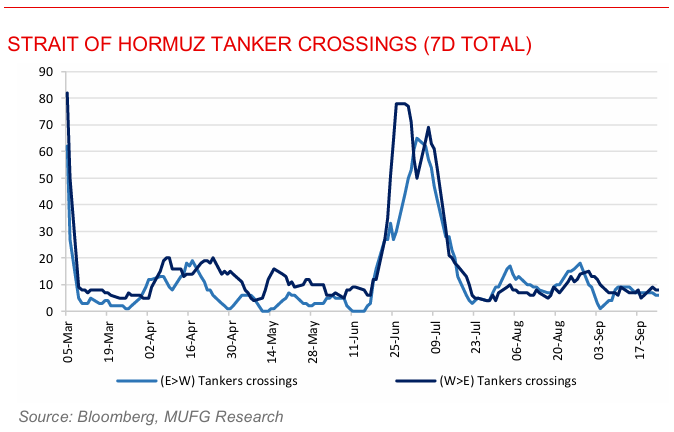
Oil pulls back as Hormuz flows ease supply concerns. Oil retreated after surging almost 4% in the previous session, with Brent falling toward USD 102/b and WTI near USD 91/b as signs of continued flows through the Strait of Hormuz eased supply concerns. US Treasury Secretary Scott Bessent said as much as 17mb/d can transit the strait, although estimates vary significantly. Traders are also awaiting progress on restoring Saudi Arabia’s damaged East-West pipeline, a critical route for bypassing Hormuz and exporting crude through the Red Sea. Security risks nevertheless remain elevated, with another vessel reportedly struck in Hormuz, while Iran reiterated significant conditions for restarting meaningful talks with the US. Refined-product markets also remain tight, particularly US diesel, prompting discussion of potential export restrictions. Continued Hormuz flows and a Saudi pipeline restart could ease physical supply pressures, but persistent tanker attacks and limited diplomatic progress should keep volatility and the geopolitical risk premium elevated.
Gold extends decline as rate hike expectations intensify. Gold held near USD 4,290/oz after falling 1.7% in the previous session, pressured by renewed energy-price gains, stronger US economic data and rising Treasury yields. Meanwhile, the S&P Global US composite PMI rose to 58.4 in September, its highest since July 2021, reinforcing concerns that robust demand could keep inflation elevated. Treasury yields consequently climbed to multi-year highs, with the five-year yield exceeding 5% for the first time since 2007. Fed officials have also maintained a hawkish stance, with Governor Michael Barr indicating that further tightening may be required. With markets now pricing at least three additional hikes by April, elevated yields and persistent energy-driven inflation remain significant headwinds for non-interest-bearing gold.
MIDDLE EAST - CREDIT TRADING
End of day comment – 23 September 2026. The bounce of UST off the 5% yield level was short lived and the weakness in global govt bonds set the tone in GCC bonds today. The morning was quiet but still reasonably constructive with an ongoing bid in duration bonds. That started to fade midday when selling flows started to grip the market as UST dipped to 5% in 10y. Post PMI we broke down to the current 5.08%. Spreads still look tighter on the day by 3/4bp across names, but that should correct as we know over a few days. With risk off and credit indices wider hard to see my GCC bonds being tighter. QATAR new issues held their reoffer spread, but on such rates move you'd expect the spread to tighten with some yield buyers coming in. 36s is still way more active than 31s. New SIB 31s had a very rough day and closed just around 99 from 100 reoffer (+8bp). That will be a risk going forward if new issues print with a concession and then trade badly in the secondary. All said with these moves and risk moves it will have to be seen how receptive the market is to any new issue plans from borrowers. (Source: Dominik Roth, Credit Trader)
MIDDLE EAST - MACRO / MARKETS
The US-backed Board of Peace unveils USD2.45bn Gaza recovery plan. The US-backed Board of Peace unveiled a USD 2.45bn six-month recovery plan for Gaza, covering 66 projects aimed at restoring essential infrastructure and economic activity. Priorities include temporary housing, rubble removal and repairs to hospitals and other critical infrastructure, although the package represents only an initial portion of Gaza’s much larger reconstruction needs. The Board estimates medium-term physical reconstruction costs at around USD 35bn, rising to more than USD 70bn over the longer term. The initiative is seeking international donor support, with regional countries expected to play a role, but implementation remains uncertain amid continued Israeli-Hamas tensions and unresolved security and governance arrangements. The plan provides an initial framework for reconstruction, but meaningful deployment of capital will depend on sustained security improvements, donor funding and progress on Gaza’s post-war governance arrangements.
Saudi and Qatari energy flows through Hormuz show signs of recovery. Saudi Aramco is accelerating crude exports through the Strait of Hormuz, selling an additional ~20mb for October-November delivery to Asian refiners after roughly 60mb of recent sales, largely via ship-to-ship transfers outside the strait. Some East Asian cargoes reportedly commanded premiums above USD 10/b to Dubai, reflecting tight regional supply. Saudi Gulf loadings have increased sharply since attacks forced the shutdown of the East-West pipeline, although the conduit has begun gradually ramping back up. Separately, an empty Qatari LNG tanker operated by Nakilat transited Hormuz into the Gulf, potentially giving Qatar greater flexibility to manage storage and prepare for higher exports from Ras Laffan. Rising Saudi loadings and Qatar’s preparations suggest Gulf exporters are increasingly testing Hormuz capacity, although sustained normalisation remains dependent on shipping security and the recovery of alternative export infrastructure.