
To read the full report, please download the PDF above.
Middle East Daily
SOOJIN KIM
Research Analyst
DIFC Branch – Dubai
T: +44(4)387 5031
E: soojin.kim@ae.mufg.jp
MUFG Bank, Ltd. and MUFG Securities plc
A member of MUFG, a global financial group
Middle East Daily
COMMODITIES / ENERGY
Oil holds near USD100 as supply risks broaden. Brent crude traded near USD100/b, while WTI hovered around USD91/b, leaving the global benchmark more than 13% higher on the week after briefly moving above triple digits. Prices remained supported by the widening Middle East conflict, with Houthi attacks on Saudi tankers in the Red Sea threatening a key alternative export route as disruptions continue to constrain traffic through the Strait of Hormuz. President Trump also warned of a potentially larger US military response against Iran, while Iran threatened retaliation against regional energy infrastructure if attacks escalate further. Beyond the Gulf, Ukraine strikes on the Caspian Pipeline Consortium terminal have added risks to Kazakh crude exports, tightening an already depleted global inventory backdrop. With both Hormuz and the Red Sea now exposed to disruption, the market is increasingly pricing a broader logistic-driven supply shock, keeping the Brent vulnerable to sustained trading above USD100/b if hostilities persist.
Gold retreats as oil surge revive Fed tightening risk. Gold fell as much as 0.7% to around USD4,020/oz as rising energy prices strengthened expectations that the Fed may tighten policy further to contain inflation. The selloff followed renewed escalation in the Middle East, with Brent crude moving above USD100/b, while two-year Treasury yields rose for a sixth consecutive session. Additional tariff measures on major US trading partners also added to inflation concerns, reinforcing the prospect of higher for longer interest rates. Markets now assign roughly a 34% probability of a Fed rate increase next week, with at least one hike already priced by September. Gold remains close to the USD4,000/oz level, viewed by some investors as technical support, but is still around 25% below its January peak near USD5,600/oz.
MIDDLE EAST - CREDIT TRADING
End of day comment – 23 July 2026. In GCC bonds very technical with some bonds unchanged in spread move and some +15bp. In general, the spread curves steepened today in all credits. Take new KUWIB where 3y and 5y by and large held their issue spread whereas 10y closed +5bp. But it was more spectacular in long end bonds which just got offered down lower and lower. We have ADGB 49s -1.5pt/+13bp. Away from these extreme long end bond moves most curves are generically +5/6bp. The UAE weakness/ underperformance is clearly mirroring dealer positioning. There is also an element of month end approaching and most likely not every index linked RM has sold all of their UAE risk yet. In terms of flow, the morning had some short end bond buyers. But what catches the eye is the outsized dealer/ dealer volume against client flow today which shows the urgency to get out of risk from dealer side. Client flow was 2:1 seller/buyer. The relentless higher UST yields seem to add to the urgency to get out rather now than later given summer liquidity it is probably still too early to look for RV/ directional trades. (Source: Dominik Roth, Credit Trader)
MIDDLE EAST - MACRO / MARKETS
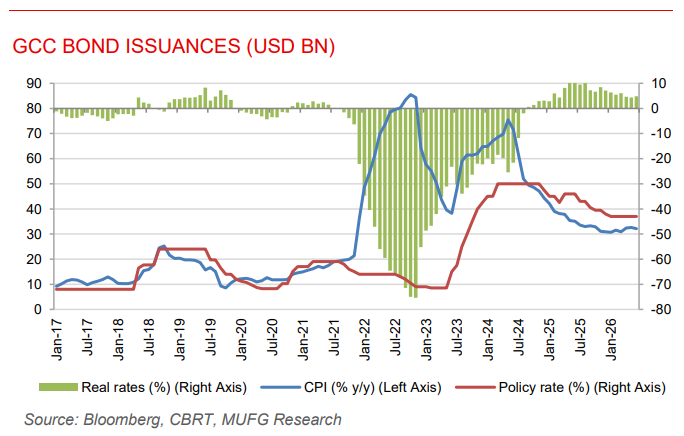
Turkey holds rates as geopolitical risks could inflation outlook. The Central Bank of Turkey (CBRT) kept its one-week repo rate unchanged at 37.0% for a fourth consecutive meeting, as policymakers balanced easing domestic demand against renewed inflation risks from higher energy prices and regional geopolitical tensions. The CBRT acknowledged that the conflict in the Middle East and rising oil prices could affect inflation through higher costs, economic activity and inflation expectations, while noting that domestic demand continues to moderate. Although annual inflation eased to 32.1% in June, the CBRT expects underlying inflation to temporarily accelerate in July and reiterated that it will maintain a tight monetary stance until price stability is achieved. The decision signals that monetary easing remain on hold, with policymakers prioritising inflation control and standing ready to tighten policy further should geopolitical developments or inflation expectations deteriorate.
UAE accelerate US investment and expands global trade strategy. The UAE said it is ahead of schedule in delivering its USD1.4 trillion investment commitment to the US, underscoring deepening economic ties with the US despite ongoing regional geopolitical tensions. Minister of State for Foreign Trade Thani Al Zeyoudi said the target could be achieved sooner than the planned ten-year timeframe, supported by the easing of US export restrictions on advanced AI chips. He also highlighted the UAE’s expanding network of Comprehensive Economic Partnership Agreements (CEPAs), while criticising the European Union for slow trade negotiations. Despite recent disruptions to trade and energy exports caused by the conflict around the Strait of Hormuz, the UAE reported resilient trade growth, supported by greater use of air cargo and continued investment in alternative ports and pipeline infrastructure on the country’s east coast. The developments reinforce the UAE’s strategy of strengthening strategic partnerships, diversifying trade routes and reducing its reliance on the Strait of Hormuz to enhance long-term economic resilience.