
To read the full report, please download the PDF above.
Middle East Daily
SOOJIN KIM
Research Analyst
DIFC Branch – Dubai
T: +44(4)387 5031
E: soojin.kim@ae.mufg.jp
MUFG Bank, Ltd. and MUFG Securities plc
A member of MUFG, a global financial group
Middle East Daily
COMMODITIES / ENERGY
Oil climbs as Houthi attacks raise risks to Red Sea supply routes. Brent crude rose as much as 2.5% to trade near USD96/b, while WTI climbed above USD88/b, extending this month’s rally as escalating geopolitical tensions heightened concerns over global oil supplies. Prices were driven higher after Iran-backed Houthi militants claimed responsibility for missiles and drone attacks on two Saudi oil tankers in the Red Sea, marking the first direct strikes on oil tankers in the waterway and raising concerns over a widening disruption to regional energy exports. The attacks come as Iran continues targeting vessels in the Strait of Hormuz, while the US launched a twelfth consecutive day of strikes on Iran and both sides ruled out near-term peace talks. With around 4mb/d of Sudi Crude exports now transiting the Red Sea, any sustained disruption to this corridor could materially tighten global oil supplies and increase the likelihood of Brent approaching USD100/b if geopolitical tension persists.
Gold holds firm despite rising rate concerns. Gold traded around USD4,130/oz, holding onto recent gains as dip-buying and continued geopolitical tensions supported safe haven demand despite rising oil prices fuelling concerns over higher US inflation. Investors remained cautious as the US and Iran showed little willingness to resume negotiations, while attacks on oil tankers in the Red Sea raised fears of a broader regional conflict. At the same time, surging energy prices have complicated the outlook for the Fed, with markets divided over whether policymakers will raise interest rates at next week’s meeting. The resilience of gold above the USD4,000/oz level suggest safe-haven demand is currently offsetting the headwinds from higher Treasury yields, although any renewed hawkish shift by the Fed could limit further upside in gold prices.
MIDDLE EAST - CREDIT TRADING
End of day comment – 22 July 2026. Cash drifted to the left throughout the day. In spread terms long end underperformed as the UST curve flattened. The rates move again came in the afternoon as the morning was flattish despite higher oil. What didn't helped spreads was the announcement of new KUWIB 3y(T+70bp), 5y(T+75bp) and 10y(T+85bp), but most impact was seen in the KUWIB curve where 35s closed -1pt/+10bp. Like yday sovgn bonds outperformed. ADGB had a good bid in the 10y area 34s to 36s ex private placement which closed nearly flat in cash and -3bp. Against this though long end closed -0.50pt/+3bp. What underperformed was again higher beta names. In sovgn SHJGOV was again +3/5bp with 36s -0.5pt/+5bp. Oman had bids in belly bonds, but long end was for sale closing -0.50pt/+3bp. What also underperformed were corps in general. DPWDU 37s was active closing -0.5pt/+5bp. ALDAR was also about up to 0.5pt lower and up to +5bp, hybrids finding it hard to clear. In quasis MASDAR underperformed on selling of 33s and 34s (-0.5pt/+6bp). (Source: Dominik Roth, Credit Trader)
MIDDLE EAST - MACRO / MARKETS
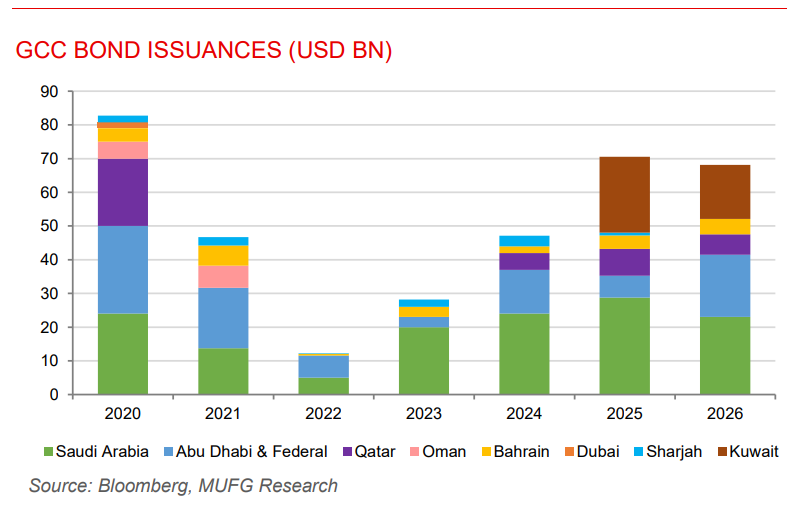
Kuwait raises USD6bn despite heightened geopolitical tensions. Kuwait successfully raised USD6bn through a three-tranche US dollar bond issuance, attracting approximately USD14.8bn in investor orders despite ongoing Iranian missile and drone attacks, underscoring continued investor confidence in the sovereign’s creditworthiness. Strong demand enabled Kuwait to tighten pricing by 25bps across the three-, five-, and ten-year maturities, with final spreads ranging from 70bps to 85bps over US Treasuries. The issuance follows Kuwait’s return to international debt markets in late 2025 after an eight-year absence, reinforcing its commitment to maintaining a regular presence in global capital markets. Although the ongoing US-Iran conflict has increased fiscal and economic pressures and widened Kuwait’s sovereign spreads, the country’s substantial oil wealth, sizeable sovereign wealth fund and strong credit profile continue to underpin market access. The successful issuance highlights investors’ willingness to look beyond near-term geopolitical risks, although Kuwait is now borrowing at noticeably higher spreads than before the regional conflict.
Dubai inflation accelerates further in June. Dubai’s CPI accelerated to 5.7% y/y in June 2026, up from 5.5% in May, remaining the highest among GCC economies as transport and food costs continued to drive price pressures. Transport inflation surged 18.1% y/y, reflecting the pass-through from higher fuel prices following recent regional geopolitical tensions, while food and beverage inflation rose to 7.6% and housing inflation remained elevated at 7.1%, despite easing for a third consecutive month. However, underlying price momentum showed signs of moderation, with monthly inflation slowing to 0.4% from 0.5% in May as transport price increases eased and housing inflation continued to soften amid additional property supply. While elevated transport costs continue to keep headline inflation high, the moderation in monthly price growth suggests inflationary pressures may gradually ease in the second half of the year if energy prices stabilise and housing supply continues to expand.