
To read the full report, please download the PDF above.
Middle East Daily
SOOJIN KIM
Research Analyst
DIFC Branch – Dubai
T: +44(4)387 5031
E: soojin.kim@ae.mufg.jp
MUFG Bank, Ltd. and MUFG Securities plc
A member of MUFG, a global financial group
Middle East Daily
COMMODITIES / ENERGY
Oil rebound as Middle East supply risks offset diplomatic hopes. Oil edged higher after four consecutive declines, with Brent rising above USD 101/b, while WTI traded near USD 98/b. Attention remains on potential US-Iran diplomacy around the UN General Assembly, including a possible meeting between Presidents Trump and Pezeshkian. However, physical supply risks remain elevated after another tanker was reportedly struck in the Strait of Hormuz, while Saudi Arabia appears to be shifting more crude exports back through the strait following disruption to its East-West pipeline. Libya added to supply concerns as output at the Sharara field fell by more than half to around 127,000b/d following a pipeline shutdown. Meanwhile, Houthi threats continue to affect Red Sea shipping, prompting calls for additional European naval protection. Prospects for diplomacy are compressing the geopolitical premium, but continued disruptions across Hormuz, Saudi export infrastructure, Libya and the Red Sea leave the physical market vulnerable and should keep oil prices volatile.
Gold edges higher as oil retreat eases rate-hike concerns. Gold edged higher to around USD 4,360/oz, recovering from its sharpest decline in a week as lower oil prices eased concerns over inflation and further Fed tightening. Traders are also assessing the Fed’s rate outlook following last week’s first hike in three years, with officials stressing that persistent supply-driven inflation could still require additional tightening. Longer-term investor demand remains supportive, with gold-backed ETFs attracting around 50 tonnes of inflows in September, marking a third consecutive month of gains. Easing energy prices provide near-term support for gold, although persistent underlying inflation and the possibility of further Fed rate hikes remain key constraints on the upside.
MIDDLE EAST - CREDIT TRADING
End of day comment – 21 September 2026. Fair to say the tightening from Friday had to be reversed, but there is more to it. New issues. Today QATAR announced a 2-tranche deal which will price 5y T+55bp/1bn and 10y T+65bp/2bn. That widened 34s/35s conv+sukuk 10bp and the curve generically 3/5bp with cash down up to -0.5pt. It will be interesting to see how the deal performs as some sukuk bank bonds in the 5y bracket are barely 10bp wider according to CBBT. The catch: there are sellers and the market has not found any clearing level as sellers do not force the trade. Another area which corrected today where AT1s again, here as well reality probably still has to set in. If senior curves yield 5.75% hard to see AT1s in the 6.25% area. Point in case, newly issued MASHREQ AT1s yield 7.25/7.5%. That means the market only seems to reprice once a new issue comes. That makes secondary vulnerable. To be sure there are area of strength. The bid in long end took a backseat today but is still there with bonds in the benchmark names +0.125pt/+1bp. Then names where the market doesn't expect new issuance also showed relative strength, namely OMAN where 47s close +0.375pt/+0bp. (Source: Dominik Roth, Credit Trader)
MIDDLE EAST - MACRO / MARKETS
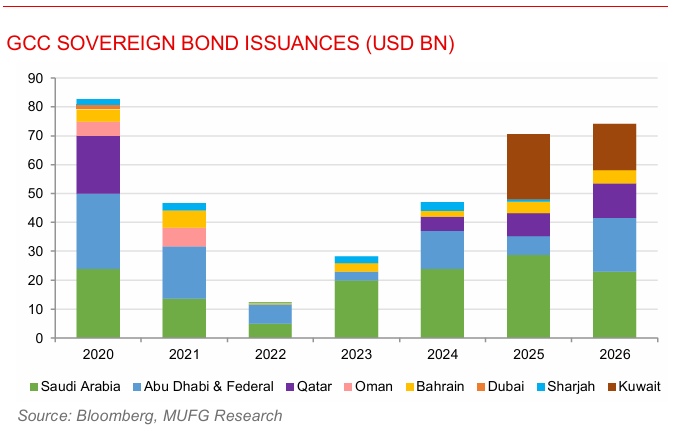
Qatar raises USD3bn as war fallout dries funding needs. Qatar raised USD 3bn from its first public international bond sale since November, as the government turns to debt markets amid a sharp deterioration in hydrocarbon revenues. The five- and 10-year bonds were priced at 55bps and 65bps over US Treasuries, respectively, around 30bp tighter than initial guidance, with orders peaking above USD 7.7bn, highlighting resilient investor demand. Qatar’s finances have come under significant pressure from disruption to LNG exports through the Strait of Hormuz, with LNG revenue collapsing to just USD 200mn in Q2 from USD 9bn in Q1. The country consequently recorded a USD 5.8bn Q2 budget deficit, equivalent to 11.4% of quarterly GDP, while government revenue fell 57% y/y. Nevertheless, Qatar retains substantial buffers, including its USD 580bn sovereign wealth fund and more than USD 70bn in FX reserves. Strong demand for the issuance demonstrates continued market access, but prolonged LNG export disruption could materially increase Qatar’s borrowing requirements.
Algeria’s robust growth masks rising fiscal and external vulnerabilities. Algeria’s economy remains resilient, with the IMF projecting real GDP growth of 3.8% in 2026, supported by higher hydrocarbon prices, stronger gas demand, and increased OPEC+ quotas, following growth of 3.9% in 2025. However, macroeconomic vulnerabilities are increasing, with inflation expected to rise to 5.5%, the fiscal deficit remaining high at 9.6% of GDP, and government debt projected to climb steadily over the medium term. Higher oil and gas revenues should help narrow the current-account deficit significantly in 2026, although external buffers are expected to weaken over time as reserves continue to decline. The IMF therefore recommends using the current hydrocarbon windfall to rebuild fiscal and external buffers through gradual fiscal consolidation, reduced reliance on central-bank financing, greater exchange-rate flexibility, and structural reforms to strengthen diversification and private-sector-led growth.