
To read the full report, please download the PDF above.
Middle East Daily
EDWARD BELL
Head of Research
DIFC Branch – Dubai
T: +971 (4)387 5033
E: edward.bell@ae.mufg.jp
SOOJIN KIM
Research Analyst
DIFC Branch – Dubai
T: +971 (4)387 5031
E: soojin.kim@ae.mufg.jp
MUFG Bank, Ltd. and MUFG Securities plc
A member of MUFG, a global financial group
Middle East Daily
COMMODITIES / ENERGY
Oil holds near highs as Saudi attacks reinforce geopolitical risk premium. Oil prices continue to hold onto recent highs with December Brent futures close to USD 111/b and WTI at USD 99/b, both up more than 1.5% in early trade. The focus for oil markets remains geopolitical risks after a drone hit the 1m b/d capacity Shaybah oil field in Saudi Arabia, resulting in several deaths though production was unaffected. The regional airport in the key oil producing region of Saudi Arabia was also attacked. Oil production and export have not been materially impacted by the recent increase in attacks by the Houthi militant group against Saudi Arabia but targeting of production and Aramco facilities will keep a wide geopolitical risk premium in spot oil. Physical spreads are moderating though with Dated Brent at close to USD 120/b, less than a USD 10/b gap compared with closer to USD 35/b premium only a few weeks ago. However, a threat to shipping remains live. Iranian media claims to have hit four tankers overnight while the UKMTO reported a tanker hit near Iraq on October 20. EIA data reported a draw in US crude stockpiles of 3.1m bbl last week with gasoline stocks also drew by 2.9m bbl. Distillate inventories were higher at 1.7m bbl. Weekly production data dropped by nearly 460k b/d to 12.8m b/d.
Gold extends decline as rising energy prices fuel inflation concerns. Gold prices are continuing to fade amid increasing inflation risks as oil and fuel prices push higher. Spot god is trading below USD 4,100/troy oz in early trade today, its lowest level since the start of August. The Fed is in its blackout period ahead of next week’s FOMC and some soft macro data is balancing the threat from higher energy in the Fed’s decision making. Market pricing is for less than 4bps of a hike at the October FOMC but closer to a full hike priced in for December.
MIDDLE EAST - MACRO / MARKETS
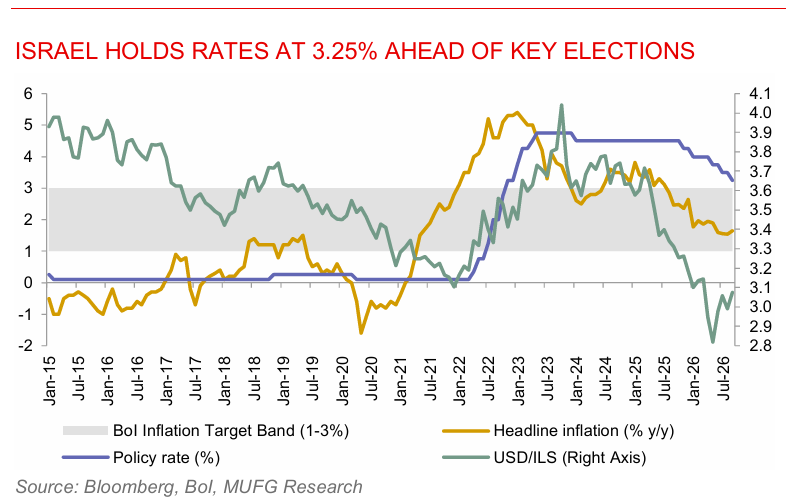
Bank of Israel holds rates at 3.25%, signals scope for further easing. Israel’s central bank (BoI) kept policy rates unchanged at 3.25% noting that inflation remains below the Bank of Israel’s target band while the shekel had depreciated against the US dollar since its last decision. The BoI expects the economy to grow by 5.6% in 2026 and to accelerate to 7.5% next year, assuming relatively limited military escalation despite continued regional tensions. The bank also noted “significant fiscal uncertainty” ahead of next week’s elections which could shape the fiscal outlook for Israel materially with the bank noting particular uncertainty “regarding the size of the defence budget.” We expect that BoI will have room for an additional 25bps of easing at the next meeting (November 23) as domestic inflation drivers are modest. However, a substantial change in the fiscal outlook should a clear coalition emerge following the election presents a risk to sustained further easing in 2027.
IMF approves 18-month staff-monitored program for Yemen. The IMF approved an 18-month, non-financing Staff-Monitored Program (SMP) for Yemen, aimed at preserving macroeconomic stability, strengthening fiscal discipline, and supporting institutional reforms amid ongoing regional conflict. Yemen’s economy is projected to contract by 1.5% in 2026 according to the IMF, marking its fifth consecutive year of decline, driven by the continued suspension of oil exports, weak domestic demand, energy shortages, and rising global commodity prices. Economic activity is expected to stabilise in 2027, while inflation is projected to rise from around 5% in 2026 to 17% in 2027. The current account deficit is forecast to narrow to 3.3% of GDP in 2026, supported by donor inflows, while the fiscal deficit before grants is expected to decline from 6.3% of GDP in 2025 to 5.1% in 2026 and 2.8% in 2027. The program prioritises domestic revenue mobilisation, improved tax and customs administration, electricity subsidy reforms, prudent, and stronger financial sector oversight. Nevertheless, Yemen remains in debt distress, with public debt reaching 114% of GDP in 2025, while limited FX reserves and heavy dependence on remittances and international assistance continue to constrain its recovery. The IMF emphasised that sustained reform implementation, donor support, and the eventual resumption of oil exports will be critical to restoring debt sustainability and supporting medium-term growth.
Lebanon’s inflation accelerates amid rising transport and housing costs. Lebanon’s inflation accelerated to 17.5% y/y in September 2026 from 16.7% y/y in August, marking its second consecutive monthly increase and the highest reading since May. Consumer prices rose 1.4% m/m, unchanged from August, reflecting persistent cost pressures across key expenditure categories. The acceleration was primarily driven by transport inflation, which increased to 35.2% y/y from 31.7%, alongside housing and utilities, which rose to 20.4% from 17.9%. Restaurant and hotel prices also increased at a faster pace, reaching 15.5%, while education inflation remained elevated at 35.7%. In contrast, food inflation moderated to 10.0% from 11.7%, partially offsetting broader price pressures. Lebanon’s inflation remains significantly above regional peers, including Saudi Arabia and Israel, although below Turkey. Persistent transport and housing costs suggest inflationary pressures remain entrenched, while continued food disinflation could provide some relief.