
To read the full report, please download the PDF above.
Middle East Daily
SOOJIN KIM
Research Analyst
DIFC Branch – Dubai
T: +44(4)387 5031
E: soojin.kim@ae.mufg.jp
MUFG Bank, Ltd. and MUFG Securities plc
A member of MUFG, a global financial group
Middle East Daily
COMMODITIES / ENERGY
Oil falls as US-Iran talks advance toward final agreement. Oil prices declined as signs of progress in US-Iran negotiations strengthened expectations for a gradual normalisation of Middle East energy flows. Brent fell to around USD79/b and WTI traded near USD75/b after mediators announced a roadmap toward a comprehensive peace agreement within 60 days. The talks follow last week’s MoU and include discussions on maintaining the reopening of the Strait of Hormuz and reinforcing regional ceasefire arrangements. While occasional tensions and political rhetoric continue to create uncertainty, oil markets are increasingly focused on the prospect of additional supply returning to the market. Producers including Kuwait and ADNOC have already begun preparing for higher exports, while a full reopening of Hormuz could release significant volumes of stranded crude. Combined with softer Chinese demand, the prospect of strong supply growth has weighed on prices and reduced the war-related risk premium that dominated markets earlier this year.
Gold rebounds on progress in US-Iran peace talks. Gold rose above USD4,220/oz after negotiators reported encouraging progress in high-level US-Iran talks aimed at securing a lasting resolution to the Middle East conflict. The formation of a direct communication channel between US and Iran and ongoing discussions on ensuring safe passage through the Strait of Hormuz helped improve market confidence, even as geopolitical risks remain elevated. Despite the positive diplomatic developments, gold has recovered only part of its recent losses and remains significantly below pre-war levels. The outlook for gold continues to be shaped by easing geopolitical tensions and lower oil prices reduce safe haven demand, while persistent inflation concerns and uncertainty over future US monetary policy provide support.
MIDDLE EAST - MACRO / MARKETS
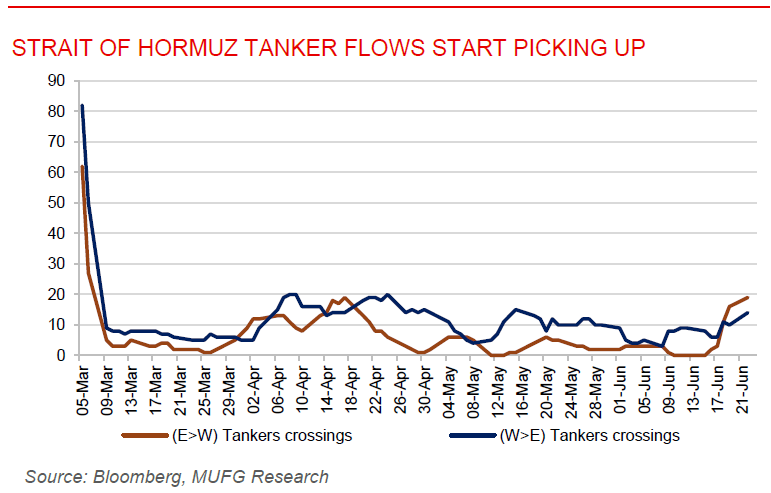
Gulf oil supply recovery gains momentum after US-Iran agreement. The reopening of Gulf energy flows is showing tangible progress following the signing of the US-Iran framework agreement, with Saudi oil tankers successfully transiting the Strait of Hormuz and regional producers gradually restoring exports. ADNOC has sold significant volumes of Upper Zakum, Umm Lulu, and Das crude to Asian buyers at sharply lower premiums, indicating that war-related supply concerns are easing and regional crude markets are normalizing. At the same time, Saudi Aramco’s substantial cut to July official selling prices and lower global oil price forecasts from major investment banks reflect expectations of a faster-than-anticipated recovery in Middle East supply. Overall, the market is increasingly pricing in a return toward pre-war export levels, although competition among Gulf producers may intensify as additional barrels return to the market and Asian demand remains relatively soft. In our view, the normalisation of Hormuz traffic and Gulf production is likely to keep oil prices under downward pressure in the coming months, with Brent expected to trend toward the low-USD80s/b range as supply recovers faster than demand.
GCC weights Iran reconstruction funding after backing US investment agenda. Less than a year after Saudi Arabia, the UAE, and Qatar pledged more than USD2 trillion of investments into the US economy, attention is increasingly turning to the proposed USD300bn investment vehicle outlined in the US-Iran framework agreement. Reports indicate that more than half of the funding has already been committed through private-sector participants, with investment expected to target Iran's energy, transport, logistics, and industrial sectors. While the structure and sources of future funding remain under discussion, Gulf nations have so far taken a measured approach as details of the mechanism continue to emerge. More broadly, the initiative highlights the growing role of economic cooperation in supporting regional stabilisation and reconstruction efforts. Looking ahead, any significant GCC participation is likely to develop gradually and be linked to the implementation of the agreement and the broader investment environment, making the evolution of reconstruction financing an important indicator of the region's post-conflict economic outlook.
Moody’s affirmed Qatari banks on strong capital and sovereign support. Moody's affirmed the ratings and stable outlooks of eight major Qatari banks, citing the sector's strong capital and liquidity buffers as well as continued support from Qatar's robust sovereign balance sheet. The agency acknowledged that disruption to hydrocarbon exports is expected to weigh on economic activity in 2026, but views the impact on bank credit metrics as temporary given Qatar's substantial financial resources, large hydrocarbon reserves, and high-income levels. Key institutions continue to maintain strong capital positions and healthy buffers, supporting resilience against near-term economic stress. Moody's expects economic conditions to strengthen from 2027 as LNG production capacity expands through the North Field projects, supporting stronger fiscal performance and a gradual recovery in non-oil activity. Qatar's banking sector remains well positioned relative to regional peers, with strong sovereign support, expanding LNG capacity, and substantial financial buffers likely to underpin credit fundamentals as economic conditions normalise.