
To read the full report, please download the PDF above.
Middle East Daily
SOOJIN KIM
Research Analyst
DIFC Branch – Dubai
T: +44(4)387 5031
E: soojin.kim@ae.mufg.jp
MUFG Bank, Ltd. and MUFG Securities plc
A member of MUFG, a global financial group
Middle East Daily
COMMODITIES / ENERGY
Oil climbs as geopolitical risks extend beyond the Middle East. Brent crude rose to around USD92/b, while WTI climbed above USD85/b, as escalating geopolitical tensions heightened concerns over global oil supplies. The rally was driven by continued US strikes on Iran, President Trump’s renewed threats of broader military action and Houthi attacks on shipping in the Red Sea, alongside recent tanker attacks near the Strait of Hormuz. Supply risks also broadened beyond the Middle East following attacks on the Caspian Pipeline Consortium terminal on Russian’s Black Sea coast, a key export route for Kazakh crude. Although the Strait of Hormuz remains open, commercial shipping through the waterway has declined sharply, while some tankers have altered routes to avoid security risks in the Red Sea. The widening geographic scope of supply disruptions suggests oil prices are increasingly being driven by global transportation risks, leaving the market vulnerable to further upside if geopolitical tensions persist.
Gold extends rebound on safe haven demand. Gold rose above US$4,100/oz, as investors continued buying on price weakness amid persistent geopolitical uncertainty in the Middle East. Safe-haven demand remained supported by ongoing US-Iran hostilities, including continued strikes near the Strait of Hormuz and Houthi threats to shipping in the Red Sea, while inflows into gold-backed ETFs recorded their largest daily increase in more than a month. However, rising oil prices have also reinforced inflation concerns, prompting markets to weigh the prospect of a more hawkish Fed despite softer US economic data. The latest rebound suggests geopolitical risks are outweighing concerns over higher interest rates for now, although elevated Treasury yields are likely to limit the pace of further gains in gold.
MIDDLE EAST - CREDIT TRADING
End of day comment – 20 July 2026. GCC bond prices for the main sovgn/ benchmarks matched the UST weakness, and spreads were unch for the likes of ADGB and QATAR. Then there were some notable underperformers, again led in the sovgn space by SHJGOV with 36s closing -0.5pt/+4bp and 50s -0.625pt/+5bp. In non sovgn market that weakness was mostly seen in recently issued bonds. Take FABUH 5.701 36s T2 which closed -0.375pt/+3bp. Away from the main state banks financials feel generally bidless and where sellers are forcing a trade there is a bit of price discovery going on. In the quasi sovgn space QPETRO 31s cleared the last two days around the 88 area and seems to find a base now after the selling pressure on the back of the 29s private placement. Selected UAE quasi bonds are also starting to stabilise, ADQABU 31s cleared in the street closing -0.125pt/-2bp. ETFs sold recently issued bonds/private placements but overall were net buyers. Some RM are also starting to buy on the back of higher yields. (Source: Dominik Roth, Credit Trader)
MIDDLE EAST - MACRO / MARKETS
ADNOC approves USD6.2bn offshore gas project to boost energy security. ADNOC has approved a USD6.2bn final investment decision to develop the Umm Shaif Gas Cap offshore gas project, aiming to strengthen the UAE’s domestic gas supply and expand its LNG export capacity. The project is expected to produce more than 600 MMcf/d from 2030, equivalent to around 10% of the UAE’s current daily gas demand. The investment includes more than USD5bn in offshore engineering and construction contracts, alongside a USD365 million drilling programme awarded to ADNOC Drilling. The decision supports the UAE’s broader strategy of achieving gas self-sufficiency while meeting rising domestic demand from industry and AI-related data centres and comes as the country continues to strengthen the resilience of its gas infrastructure following disruptions during the recent regional conflict. The project reinforces ADNOC’s long-term strategy to diversify gas supply, support economic growth and position the UAE as a larger player in the global LNG market.
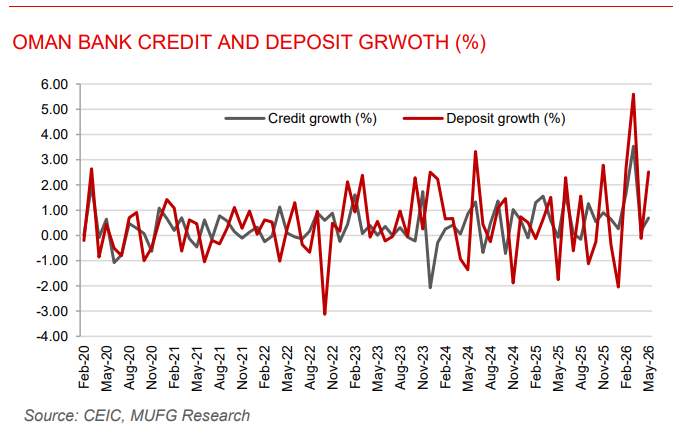
Fitch expects Oman’s banking sector to remain resilient in 2026. Fitch Ratings expects Oman’s banking sector to remain resilient through 2026, supported by solid economic growth, healthy oil prices and continued government-led investment, while assessing the impact of the recent US-Iran conflict as limited. The agency forecasts loan growth of around 5% this year, driven by retail lending and financing for energy and infrastructure projects, alongside real GDP growth of 4.1% in 2026, led by the non-oil sector. Fitch also expects asset quality and profitability to remain stable, with the sector’s impaired loan ratio holding near 4.2% and banks maintaining strong capital buffers, supported by a 13% average Common Equity Tier 1 ratio. The agency noted that Oman is less exposed than other Gulf economies to disruptions in the Strait of Hormuz, as its oil exports bypass the waterway, limiting the conflict’s impact on the banking system. The report suggests that ongoing economic diversification, fiscal reforms and public investment should continue to support credit growth and reinforce the banking sector’s resilience despite a more uncertain regional environment.